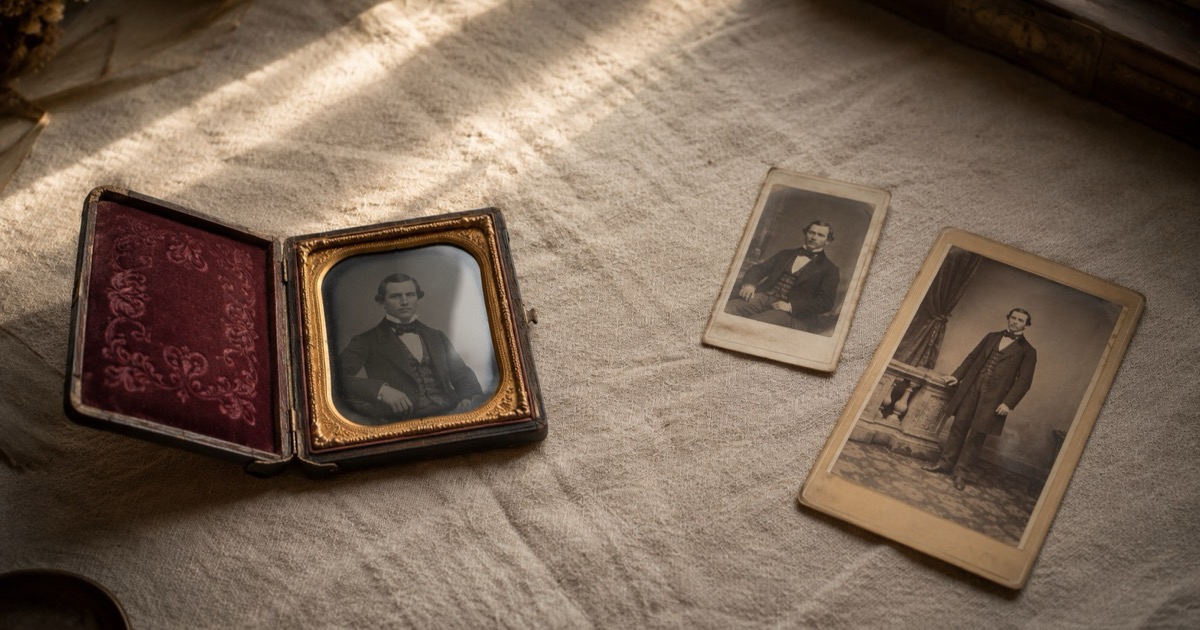
Learning how to date old photographs starts with identifying the physical format, because each nineteenth-century photographic process has a distinct look, feel, and lifespan. Before you look at the subject’s clothing or hairstyle, the object itself — the base material, the case or mount, the surface quality — tells you which decade or era you are working in.
To date an old photograph, identify its physical format first: a mirror-like image in a hinged case is a daguerreotype from the 1840s–1850s, an image on a plate a magnet attracts is a tintype, and small card-mounted prints are cartes de visite or cabinet cards. Match the format to its era, then narrow the range with mount style and clothing.
This guide walks through the major formats in chronological order and adds secondary cues from mounts, cases, and clothing that help narrow a date range further.
Quick identification checklist
- Hold the image at an angle: a mirror-like, shifting image on a metal-feeling plate in a hinged case is almost certainly a daguerreotype
- Test with a small magnet (held near but not touching): tintypes are on iron and will attract; daguerreotypes and ambrotypes will not
- Check the card stock thickness and corner style on mounted photographs — squared corners vs. rounded corners shifted at different times
- Look at the back of any card mount for the studio name, address, and any printed design — ornate backs with multiple fonts are typically later than plain backs
- Read the back of any postcard-format photo for the divided/undivided back design, which changed at a documented point
- Note clothing details as secondary evidence: sleeve styles, collar types, and hairstyles narrowed with the format era to tighten a date range
The format ladder: each process and its era
Daguerreotype (roughly 1840s–1850s)
A daguerreotype is a unique positive image made on a silver-coated copper plate. The surface is extremely delicate and produces a characteristic shifting image — depending on the angle, the image flips between a positive and a negative. This mirror-like, directional quality is the most immediate identifier. Daguerreotypes were almost always housed in hinged, padded cases (often thermoplastic or leather over wood) with a brass mat framing the image. The plate should never be touched directly; even a fingerprint can damage the surface permanently.
Ambrotype (roughly 1850s–1860s)
An ambrotype is an underexposed collodion-on-glass negative that appears positive when backed with dark material — black velvet, paper, or paint. It resembles a daguerreotype in presentation (same hinged case format, same brass mat) but differs in key ways: the image does not shift like a mirror at different angles, and a magnet will not attract it. If you gently slide the image out of its case and look at the back, you can often see the dark backing. Broken ambrotypes reveal the glass base. Some ambrotypes were hand-colored.
Tintype (roughly 1850s–1900s and beyond)
Tintypes — also called ferrotypes — are collodion images made directly on a thin iron plate, which is why a magnet attracts them. Despite the name, they contain no tin. Cheap, durable, and produced in enormous quantities, they are among the most common nineteenth-century photographs found today. Early tintypes were housed in cases; later ones were simply trimmed and handed over, often with scalloped edges. They continued to be made into the early twentieth century and appeared at fairs and novelty booths for decades afterward.
Carte de visite (roughly 1860s–1870s)
A carte de visite (CDV) is a small albumen paper print mounted on thin card stock roughly the size of a playing card. They were enormously popular and collected in album books. The card back often carries the photographer’s studio name, address, and sometimes a decorative design. Early CDV backs tend to be plain or simply printed; backs from the later 1860s and into the 1870s often feature more elaborate printing. Corner style shifts across the era: earlier CDVs often have square corners; rounded corners became fashionable later in the format’s run.
Cabinet card (roughly 1870s–1900s)
Cabinet cards are larger albumen or gelatin prints mounted on heavier card stock, designed to stand on a cabinet or mantel. The format superseded CDVs for formal portraiture. Card thickness, corner style (square then rounded, then square again in some later productions), and the style of the studio imprint on the back all help narrow dates. Backs evolved from simple text to elaborate multi-color designs with awards listed; thick, plain cards with minimal back printing are often later. The card color — white, cream, gray, or buff — also shifted across the era.
Real photo postcard (roughly 1900s–1940s)
Real photo postcards (RPPCs) are actual photographic prints made on postcard-sized paper stock. The key dating tool is the back design: an undivided back (no dividing line between the address area and message area) predates a specific postal regulation change in the United States in the early 1900s; after that change, divided backs became standard. The stamp box design and paper manufacturer’s code on the back can sometimes be traced to specific production windows.
Card mount and case cues
For CDVs and cabinet cards, corner style is a broad indicator: square corners are generally earlier, rounded corners fashionable through the 1870s–1880s, with some later pieces returning to square. Back printing evolved from plain studio text to ornate multi-font designs with award medallions. Card thickness and color shifted as the cabinet card era matured. Studio address changes on the back can sometimes be traced through local directories for a tighter date window.
For cased daguerreotypes and ambrotypes, leather-covered wood cases with simple linings are earlier; thermoplastic union cases with molded relief cover designs became common from the mid-1850s onward. The brass mat inside also evolved toward more elaborate embossed designs.
Clothing confirms but does not replace the format date. Leg-of-mutton sleeves on women are strongly associated with the 1890s; collar and cravat styles on men and hairstyle width shifted decade to decade.
Preservation basics
Old photographs are irreplaceable. Handle cased images by the case edges only; never touch the image surface. Store card-mounted photographs in acid-free paper sleeves. Never use adhesive tape — the damage is permanent. Keep all formats away from light, humidity, and temperature extremes.
Watch-outs and common mistakes
- Tintypes were made for decades; a tintype is not necessarily from the 1860s just because the format is old
- Damaged or discolored daguerreotypes should not be cleaned — any attempt to wipe the surface permanently damages it
- “Cabinet card” does not mean formal portrait — outdoor, trade, and occupational subjects exist and can be more valuable to specialty collectors
- Reproduction CDV-format cards were printed as novelties in the twentieth century; the card stock and printing technology betray them
- Clothing alone cannot date a photograph precisely — older clothing was worn for years, and rural or working-class subjects may lag urban fashion trends
Photo tips that improve identification
- Photograph the image at a raking angle to show the surface character — the shifting mirror quality of a daguerreotype or the flat matte surface of a tintype
- Photograph the full back of any mount or case to capture all printed text, studio names, addresses, and design elements
- For cased images, photograph both the open and closed case, including the mat and any paper liner
- For postcards, photograph the divided or undivided back clearly, including the stamp box corner and any manufacturer’s marking
Common questions
How can you tell a daguerreotype from a tintype?
Tilt the image: a daguerreotype has a mirror-like surface that flips between positive and negative as the angle changes, while a tintype stays flat and matte. A magnet held near the plate settles it — tintypes are on iron and attract, daguerreotypes are on silver-coated copper and do not. Daguerreotypes are also almost always found in hinged cases with brass mats.
Are old tintype photographs worth anything?
Most ordinary studio-portrait tintypes are common and sell modestly, because the format was cheap and produced in enormous quantities for decades. Value rises with unusual subject matter — occupational portraits showing tools of a trade, outdoor scenes, military subjects — and with strong condition. Cased early tintypes and images with documented identities or history interest specialty collectors more than anonymous portraits.
What is a real photo postcard and how do you date one?
A real photo postcard is an actual photographic print made on postcard-sized paper stock, popular from the early 1900s through the 1940s. The main dating tool is the back: an undivided back, with no line separating the address and message areas, predates a US postal regulation change in the early 1900s, after which divided backs became standard. The stamp box design and paper manufacturer’s code can sometimes narrow the window further.
Related guides
- Antique Postcard Identification Value
- How to Identify First Edition Books
- How to Identify Antique Picture Frames
When to use the Antique Identifier app
Photograph the image itself, the full back or base of any mount, and — for cased images — the open case including mat and liner. The app can identify the format type and era quickly and flag whether the clothing or studio details are consistent with the format’s known production window. For photographs that may have historical significance or involve notable subjects, a specialist in antique photography or a local historical society can provide deeper research than any app alone.