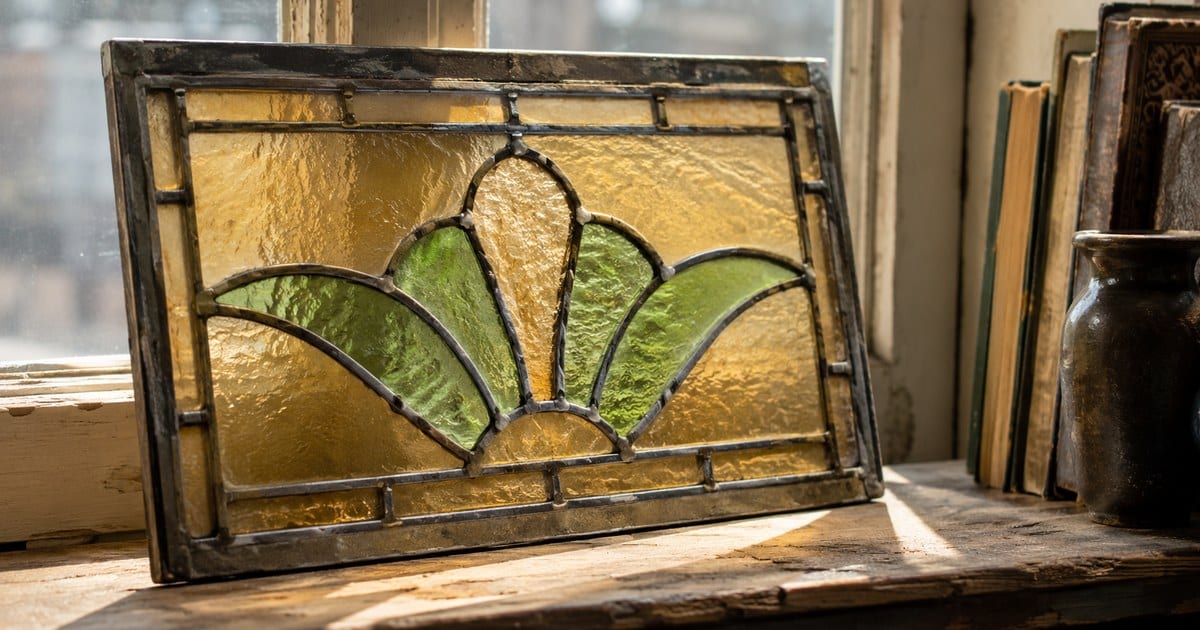
Most guides to antique stained glass windows open with style, which is the least reliable place to start. Style has been revived continuously. A workshop building panels last year can produce a convincing Art Nouveau design, and reproduction Victorian windows have been moving through architectural salvage for decades. The evidence that actually holds up is physical, and it lives in three places: the glass itself, the metal holding the pieces together, and the method used to join them. Read those three first and you can bracket a window’s age with real confidence before you have formed any opinion about the picture it makes.
Antique stained glass windows are dated primarily by the glass and the leading, not the design. Opalescent glass places a window after 1880. Mouth-blown glass shows ripples, seed bubbles, and striations that machine-rolled glass lacks. Genuinely old lead came oxidizes to a dull, pitted gray. Style narrows the range only loosely.
Quick identification checklist
- Hold the window against daylight and look at each color individually. You are checking whether any single sheet carries more than one color blended into it, which is the fastest era test available.
- Look across the glass surface at a shallow angle. Ripples, faint striations, and small elongated bubbles trapped in the sheet indicate hand-blown production.
- Inspect the lead came where it meets the glass. Old lead is dull, gray, and finely pitted, and the oxidation runs into the recesses rather than sitting evenly on the surface.
- Check the solder joints. Period joints are usually small, slightly domed, and irregular from piece to piece.
- Note whether any pieces are beveled. Beveled accents place a window in a specific popularity window rather than at the earliest end of the range.
- Look for copper foil rather than lead around small or curved pieces. Foil construction points to the later part of the nineteenth century or after.
- Record the frame, the putty, and any paint on the glass separately. These are often replaced or restored and can mislead you about the panel itself.
How to date antique stained glass windows from the glass itself
The glass is the strongest evidence you have, because the manufacturing methods behind it changed on a documented timeline that a modern maker cannot fake without buying genuinely old glass.
The single most useful test is opalescent glass. Opalescent sheets carry more than one color mixed within the same piece, giving a milky, streaked, or clouded appearance rather than the flat single tone of traditional cathedral glass. This is the material John La Farge patented in 1880, with Louis Comfort Tiffany receiving a closely related patent shortly afterward for assembling windows from it. The practical consequence for you is a hard floor: if a window contains true opalescent glass, it was made after 1880, and American opalescent work is heavily concentrated in the decades that followed. That single observation eliminates every earlier attribution in one step.
Cathedral glass, which is transparent and a single color per sheet, was in use long before and long after that date, so its presence does not date a window on its own. Slag glass, an opaque marbled material often seen in amber, caramel, or green, reads as a later development and is most associated with lampshades and panels from the early twentieth century. Treat it as a soft indicator rather than a fixed bracket.
Surface texture separates mouth-blown from machine-rolled glass
Before glass was rolled by machine, sheets were made by blowing a cylinder, cutting it lengthwise, and flattening it in a kiln. That process leaves evidence you can see and feel.
Hold the panel so light rakes across the surface rather than passing straight through. Mouth-blown glass shows gentle waves, faint parallel striations from the flattening, and small bubbles that are stretched rather than round, because the blowing and flattening pulled them out of shape. Run a fingertip across the sheet and the surface reads as slightly uneven. Modern machine-rolled glass, including the deliberately textured art glass sold today, is uniform in thickness and repeats its texture on a regular pattern, because it came off a roller. Uniformity is the tell. Genuine old glass is inconsistent from sheet to sheet within the same window, since the maker was working with whatever stock the studio had.
Read the lead came and the solder joints
The metal is the second independent line of evidence, and it is the one reproductions most often get wrong.
Lead came ages by oxidizing to a dull, chalky gray with fine pitting across the face of the strip. Crucially, that oxidation is uneven. It sits deeper where moisture collected, in the recesses, at the joints, and along the bottom of the panel where water ran. An artificially aged finish, whether applied as a patina chemical or as paint, tends to be even in tone across the whole panel and looks the same on the top edge as on the bottom. Old lead is also soft and often slightly deformed, so the came does not run in perfectly straight lines across a large window.
Solder joints tell a similar story. Hand-soldered period joints vary in size and shape from junction to junction and typically sit as small domes over the intersection. Very uniform, flat, or unusually large joints across an entire panel suggest a later hand or a restoration.
Beveled accents and copper foil as construction clocks
Two construction choices bracket a window from a different direction.
Beveled glass, where the edge of a clear piece is ground and polished at an angle to throw prismatic light, was popular in American residential windows from roughly the late 1870s through the 1920s, peaking around the turn of the century. Bevels are therefore uncommon in the earliest surviving American work and are strongly associated with the late Victorian and Edwardian decades. Their presence supports a later date within the antique range rather than an earlier one.
Copper foil is the other clock. Wrapping the edge of each glass piece in thin copper and soldering the wrapped edges together allows far smaller and more curved pieces than lead came can hold. The method is associated with Tiffany’s studio in the later nineteenth century and became the standard approach for intricate work afterward. A window built entirely in foil is not an early window, and one that mixes lead came for the large fields with foil for fine detail is following a well established later practice.
Style narrows the range, but only loosely
Style is useful as a secondary check, provided you treat it as a range rather than a date.
Art Nouveau work, with long sinuous lines, whiplash curves, and naturalistic flowers and vines, belongs roughly to the 1890 to 1910 period. Art Deco panels, with sharp geometry, stepped forms, and strongly angular leading, run from around the mid 1920s onward. Earlier Victorian domestic glass tends toward symmetrical borders, jeweled centers, and repeated geometric fields.
The reason style comes last is that all of it has been reproduced sincerely and continuously. A geometric panel made for a bungalow renovation in the 1990s can look exactly right stylistically while failing every glass and leading test above. Style tells you what the window was trying to be. The material tells you when it was made.
Watch-outs and common mistakes
- Dating from the frame. Sash and frames are replaced routinely. A modern frame around a genuinely old panel is common, and so is the reverse.
- Reading painted detail as age. Kiln-fired glass paint on faces, hands, and drapery has been used continuously for centuries and does not date a window by itself.
- Assuming a repair means a reproduction. Old windows almost always carry replaced pieces and re-leaded sections. Localized new lead in an otherwise consistent old panel is a repair history, not a verdict.
- Trusting an even patina. Uniform darkening across every strip of came, including protected areas, points toward an applied finish rather than natural oxidation.
- Ignoring the bow. Old windows sag and bow over time as lead fatigues. A perfectly flat large panel deserves a closer look at everything else.
- Confusing plated construction with damage. Some period work layers two pieces of glass to build up a color. That is a technique, not a repair.
Photo tips
- Shoot the window twice, once with light coming through it and once with light falling on it. The transmitted shot shows color and opalescence, and the reflected shot shows surface texture and came condition.
- Take a raking-light photograph across the glass surface. Set the camera nearly parallel to the panel so ripples, striations, and bubbles cast visible shadows.
- Photograph the came and a solder joint close up, filling the frame. Oxidation texture and joint shape are the two details that most often decide a dating question.
- Include one shot of the whole panel square-on against a plain sky or wall, with all four edges visible, so proportions and border design are readable.
- Document every crack, replaced piece, and bulge separately. Condition drives value in this category more than in most, and these images keep your research honest.
Common questions
How can I tell if a stained glass window is antique or a reproduction?
Work from the material rather than the design. Genuinely old panels show mouth-blown surface irregularity, glass that varies from sheet to sheet, lead came with uneven pitted oxidation that is heavier in recesses and along the bottom, and hand-soldered joints of inconsistent size. Reproductions typically show uniform machine-rolled glass and an evenly toned finish on the metal. No single observation settles it, so stack several.
Does opalescent glass mean my window is valuable?
It means your window was made after 1880, which is a dating fact rather than a value judgment. Value in this category is driven by size, design quality, condition, whether the panel is complete and structurally sound, and whether it can be attributed to a known studio. A plain opalescent border panel and a major figural window from a recognized workshop sit far apart, even though both contain the same material.
What is the difference between stained glass and leaded glass?
Leaded glass describes any window assembled from pieces held in lead came, whatever the glass is. Stained glass usually implies colored glass, and in strict usage refers to glass that has been painted and kiln-fired with detail. Most American residential windows sold as antique stained glass are more accurately colored leaded glass, which is a description rather than a downgrade.
Related guides
- How to Tell If a Mirror Is Antique
- How to Identify Antique Picture Frames
- Antique Steamer Trunk Identification
- How to Tell If a Tiffany Lamp Is Real
When to use the Antique Identifier app
Stained glass is awkward to research from a description, because the vocabulary for glass types and leading styles is exactly what a beginner does not have yet. Photographing the panel in transmitted light, then again in raking light, and letting the app suggest the glass type, construction method, and likely period gives you the terms to search with. From there you can check the specific tells above yourself and look at comparable sold panels of similar size and condition, which is the only place a realistic value comes from.