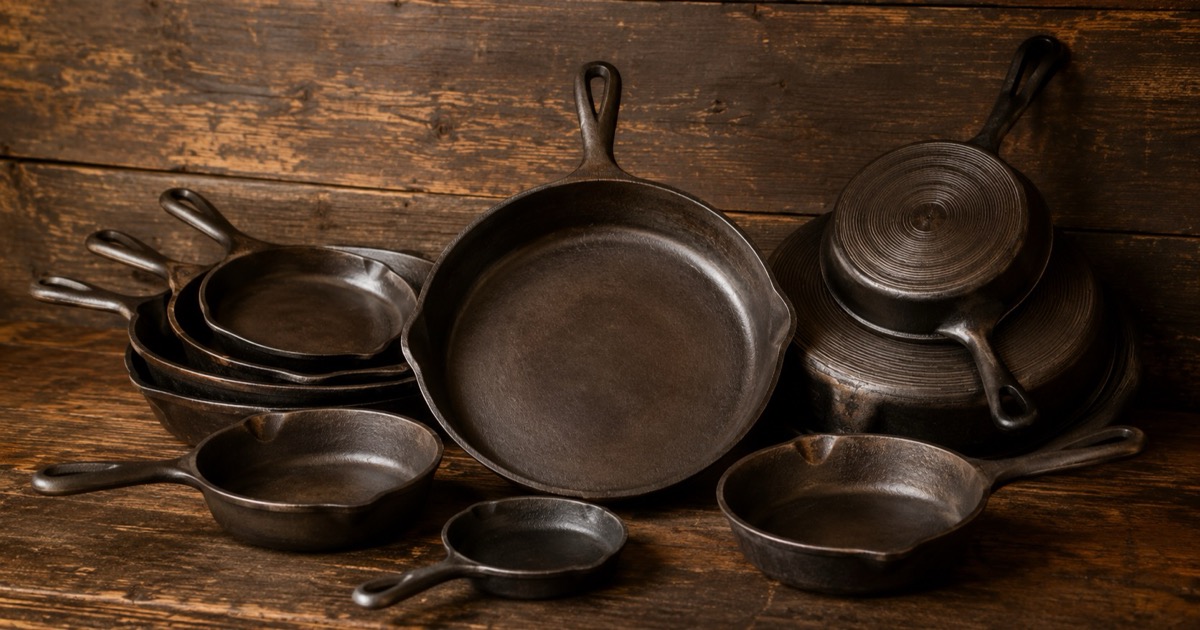
Unmarked cast iron identification is a genuinely solvable puzzle for most pieces — lack of a brand name does not mean lack of age or origin clues. The bottom of a cast iron skillet, dutch oven, or griddle carries physical evidence that can narrow its maker and era even when no logo was ever cast in. Wagner made cookware for store brands without their own name on it. BSR (Birmingham Stove and Range) ran for decades largely under house brands. Early Lodge production predates their well-known logos. The physical construction tells the story.
To identify unmarked cast iron cookware, read the construction instead of a logo: a raised gate-mark seam across the bottom signals 19th-century casting, while heat-ring style, handle profile, and a smooth machined cooking surface point to specific makers such as Wagner, BSR, or early Lodge. Start by examining the bottom under strong sidelight.
This guide covers the key features to read: gate marks, heat rings and handle geometry, size and pattern numbers, surface texture, and the condition realities that matter when buying or restoring.
Quick identification checklist
- Check the absolute bottom center for a raised line or seam: that is a gate mark, a 19th-century casting indicator
- Count and locate any heat rings on the cooking surface bottom or bottom exterior
- Look at the handle shape in profile: tapered, spouted, helper-handle position, and hang hole style vary by maker era
- Note the size number, usually cast on the skillet bottom or handle, and the pattern number if present
- Run a finger across the cooking surface: vintage machined surfaces are smooth; modern imports are often pebbled or rough
- Check for cracks at the handle-to-pan junction and around the rim before assigning any value
Gate marks: the 19th-century casting tell
A gate mark is the remnant of the sprue — the channel through which molten iron was poured into the sand mold. Foundries in the 19th century typically gated the mold from the bottom of the piece, leaving a raised seam or linear ridge running across the bottom when the gate was broken off and only partially ground down.
By the late 19th and early 20th century, most major American foundries had shifted to top-gated molds, which were then machined smooth, eliminating the gate mark. The presence of a gate mark is therefore a reasonable indicator that a piece was made in the earlier part of the cast iron cookware era, broadly before around 1900. Gate marks are not precise dateable to a year, but they reliably push origin earlier than mass-market post-1900 production.
Some pieces have a well-ground gate mark that shows only as a faint scar rather than a prominent ridge — examine the bottom under good sidelighting.
Heat rings and handle shapes as maker fingerprints
Heat rings are raised concentric rings on the bottom exterior of a skillet, designed to sit over a wood or coal stove burner opening and channel heat. Their number, width, and position varied by foundry:
- A single heat ring interrupted by three evenly spaced notches is the classic tell for unmarked pre-logo Lodge production — collectors call it the “three-notch” style
- BSR skillets from the mid-20th century have their own characteristic ring patterns, typically simpler than earlier makers
- Wagner pieces often show a smooth bottom or a single heat ring depending on the era and the brand they were made under
Heat ring presence and style alone is not definitive, but it narrows the field considerably when read with other details.
Handle shape is equally maker-specific. Tapers, thicknesses, the presence or absence of a pour spout notch on a chicken fryer lid, the exact shape of the hang hole (round, square, or keyhole), and whether the handle is flat or angled in profile all vary between foundries and across production eras. Compare your piece’s handle profile to documented examples from collector references for BSR, Wagner, Griswold, and Lodge.
Size numbers and pattern numbers
Most American vintage cast iron carries a size number, typically one through fourteen, cast into the skillet (usually on the handle or the bottom). This number corresponds to a historic stove burner size, not the pan’s diameter in inches — a number 8 skillet from different makers will measure close to the same cooking diameter but not necessarily identical.
Pattern numbers are separate from size numbers and were used by foundries for internal production tracking. When present, they usually appear as a two- or three-digit number in a different location from the size number. Pattern numbers are primarily useful for collector research — they can help pin a piece to a specific production run when cross-referenced with foundry records.
Pieces without any number at all were sometimes made for premium or department-store house brands where the brand wanted a clean bottom, or they are very early production where numbering conventions had not yet standardized.
Store brands: Wagner, BSR, and others
This is the core reason so much vintage cast iron is “unmarked” by the original maker’s name: major foundries routinely produced cookware for grocery chains, hardware stores, and mail-order catalogs under the retailer’s house name or no name at all.
Wagner Manufacturing of Sidney, Ohio made cookware under numerous store-brand names, often with their characteristic thin walls and smooth machined surfaces but no “Wagner” text. The physical construction — smooth cooking surface, specific handle taper, mold quality — is the tell, not the logo.
BSR (Birmingham Stove and Range) of Alabama produced enormous quantities of cookware under their own Century and Red Mountain labels as well as for other retailers. BSR construction tends toward somewhat heavier walls than Wagner, and the gate-mark and heat-ring patterns are documented in collector circles.
If you have a smooth, well-made vintage skillet with no maker name but with a size number and a heat ring pattern consistent with a major foundry, it is almost certainly store-brand production from one of the established makers rather than a no-name foundry.
Smooth machined surfaces vs. pebbly modern casting
One of the fastest tests for vintage vs. modern cast iron is the cooking surface texture. Vintage American cast iron — Griswold, Wagner, early Lodge, BSR — was machined after casting. The cooking surface was ground and polished to a smooth, almost glossy finish in the bare iron. Running a finger across it feels like bare metal, not sandpaper.
Modern cast iron, including imported pieces and current Lodge production (Lodge changed their process), is typically left with the rough, pebbled texture of the sand casting. This is not necessarily inferior cookware — it seasons and works well — but it is a clear modern-production indicator.
A smooth cooking surface on bare, stripped iron is the single most reliable indicator of pre-1960s American production in pieces that are otherwise hard to place.
Condition honesty: what restores and what does not
Surface rust on vintage cast iron is recoverable. Almost any piece that is surface-rusted to any degree can be cleaned, seasoned, and returned to functional use. Surface rust does not reduce authenticity or, in most cases, collector value — it is expected on unseasoned stored pieces.
What does not restore well:
Cracks. A crack in the cooking pan, the side wall, or at the handle junction is a structural failure. Cracked cast iron cannot be safely used for cooking and cannot be repaired reliably. It reduces collector value to display-only.
Warping. A skillet that rocks on a flat surface is warped, usually from thermal shock. Warped cast iron does not cook evenly on a flat electric range. This is permanent.
Deep pitting. Surface rust that was left long enough to pit the metal deeply leaves a textured surface that is difficult to cook on and may not season well, though it does not affect structural integrity.
Know these distinctions before paying collector prices for a piece being sold as “restorable.”
Watch-outs and common mistakes
- Assuming no brand name means low quality or no value: some of the best-made vintage American skillets were store brands from major foundries
- Mistaking a pebbled surface for age: pebbled texture indicates modern or import production, not vintage
- Overlooking hairline cracks at the handle junction, which are common on abused pieces and fatal to functional use
- Confusing a gate mark scar with damage: a ground gate mark is normal and expected on 19th-century pieces
Photo tips that improve identification
- Photograph the bottom under strong sidelighting to reveal gate marks, heat ring detail, and any cast numbers
- Include a shot of the cooking surface texture across the bare iron to show smooth vs. pebbled finish
- Photograph the handle profile from the side to capture taper and hang-hole shape
- Document any cracks with close-up shots before buying: photographing while asking the seller to hold it at an angle to the light will reveal hairlines that flat overhead shots miss
Common questions
Is unmarked cast iron worth anything?
Often, yes. Major foundries like Wagner and BSR produced large quantities of cookware for store brands with no maker name on it, and the quality matches their logo-bearing production. A smooth machined cooking surface, a size number, and a heat-ring pattern consistent with a known foundry indicate a desirable vintage piece regardless of the missing logo.
What does a gate mark on cast iron mean?
A gate mark is the raised seam or scar left on the bottom where molten iron was poured into the mold and the sprue was broken off. Bottom-gating was standard in the 19th century, so a gate mark generally places a piece before about 1900. It is normal casting evidence, not damage.
How can you tell vintage cast iron from modern?
Feel the cooking surface. Vintage American cast iron was machined smooth after casting, so bare iron feels like polished metal, while modern and imported pieces are usually left with a rough, pebbled sand-cast texture. Thin walls, heat rings, and size numbers tied to old stove burner openings also point to vintage production.
Related guides
- How to Identify Griswold Cast Iron Skillets
- Antique Cast Iron Toy Identification
- How to Identify Antique Hand Tools
- Antique Graniteware: How to Identify and Date Enamelware
When to use the Antique Identifier app
Photograph the full skillet (both cooking surface and exterior bottom), then add tight shots of the bottom center for gate marks, any cast numbers, and the handle profile. The app can suggest maker attribution, production era, and whether the construction details match known foundry patterns. Use it to build a working ID before researching current market values for a confirmed maker.