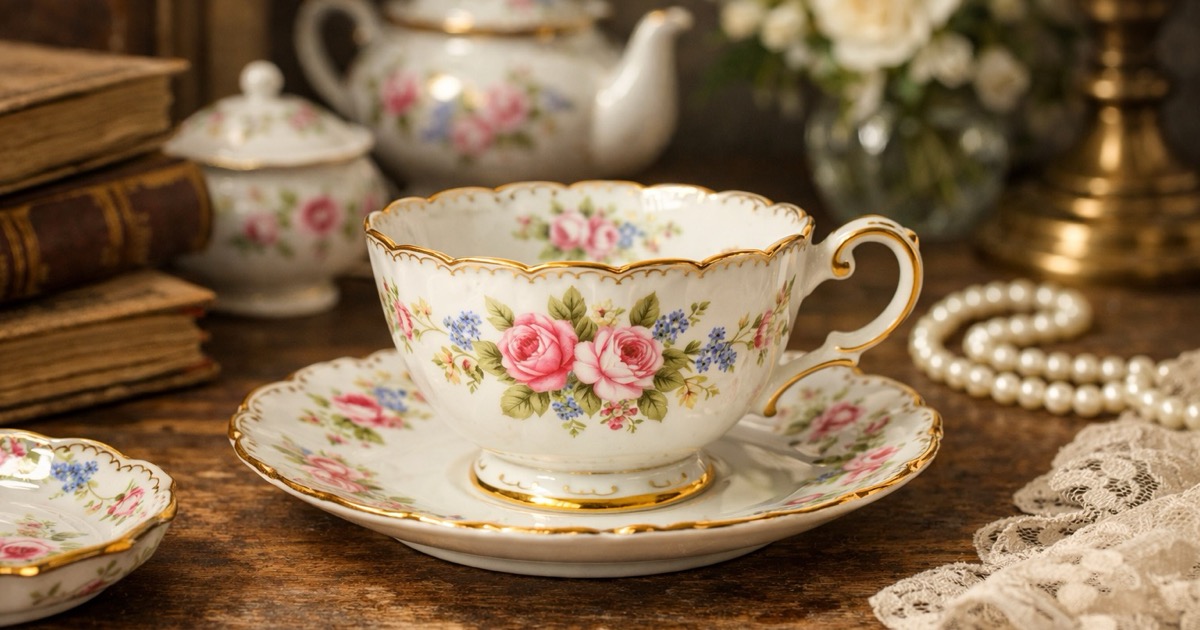
To identify an antique china pattern, work from two pieces of evidence at once: the backstamp on the underside, which names the maker and often narrows the date, and the pattern itself, which usually carries a printed name or number you can match against a reference. The maker plus the pattern name is what turns “a floral plate” into a specific, searchable identity, and most of the time both are printed right there on the base if you know how to read them.
The goal of this guide is not to promise certainty from one photo. It is to give you a repeatable workflow, show you which clues actually move an identification forward, and help you separate a common replacement piece from something worth a closer look before you research it, list it, or ask for an appraisal.
Quick identification checklist
- Flip the piece over and photograph the backstamp straight on, in good light.
- Read the maker name and country of origin from the mark, then note any pattern name or number printed near it.
- Identify the decoration method: transfer print, hand painting, decal, or a combination.
- Note the body type: earthenware, ironstone, bone china, or porcelain, since it narrows both maker and era.
- Look for a shape or style number, registration mark, or date code alongside the pattern name.
- Record wear, crazing, gilt loss, and repairs, which affect condition and value more than the pattern alone.
Start with the backstamp, not the flowers
It is tempting to search by the picture — roses, a blue scene, a gold border — but thousands of patterns share the same motifs, so decoration alone rarely resolves an identification. The backstamp is the anchor. It typically carries the maker’s name or logo, frequently a country of origin, and very often the pattern name spelled out beneath the mark. Manufacturers registered and reused marks over long runs, and reference databases of maker’s marks let you match the logo style to a maker and a date range (The Potteries — Staffordshire pottery marks).
Read the mark literally and record it exactly, including small words. “England” alone versus “Made in England” is a dating clue: the phrase “Made in” became common on export ware in the twentieth century, while “England” on its own points earlier, and a piece with no country name at all may predate the marking conventions that governed imports. Pattern names printed under the mark — script words, a numbered “pattern no.,” or a shape name — are your fastest route to a match, because those are the exact terms replacement-china references and databases are indexed by.
For a deeper walk through logo styles, country phrasing, and how registration numbers translate to dates, see our companion guides on china makers marks identification and old china marks identification.
Reading the pattern by decoration method
How the decoration was applied is one of the strongest signals of age and quality, and it is visible under a loupe or even a phone macro shot. Transfer printing — an engraved design pressed from an inked paper transfer onto the body — dominated English tableware from the late 1700s onward and shows fine, continuous lines with occasional tiny seams where the transfer overlapped. Museum collections trace transferware from the blue-and-white export boom through the multicolor patterns of the Victorian era (V&A Ceramics collection).
Hand painting shows brush strokes, slight asymmetry, and paint that sits with visible relief; it usually signals earlier or higher-end work. Decals, or lithographic transfers, are the twentieth-century workhorse and appear as a printed image with a faint dot pattern or a slightly raised film edge you can feel. Many pieces combine methods — a printed outline with hand-painted color fill, or a decal center with a gilt band added by hand. Naming the method narrows the era before you have matched a single pattern name.
Dating clues by mark and pattern feature
The mark and pattern together carry more dating information than most people realize. This table summarizes the most reliable clues; treat them as ranges that point you toward a period, not as precise birthdates, since makers reused elements and export rules varied.
| Feature on the piece | What it usually suggests | Notes |
|---|---|---|
| No country of origin in the mark | Often before country-marking conventions took hold | Absence is a soft clue, not proof; unmarked wares exist in every era |
| ”England,” “France,” “Germany” alone | Broadly late 1800s onward | Country-of-origin marking became widespread on export ware in this period |
| ”Made in [country]” phrasing | Generally twentieth century | The “Made in” wording is a later export convention |
| Printed pattern name or “pattern no.” | Aids matching more than dating | Named patterns are indexed in replacement and reference databases |
| Registration or design number | Can narrow to a date range | Systems differ by country; look up the specific series rather than guessing |
| Reign or shop marks on Asian porcelain | Points to origin and tradition, not always exact date | Marks were widely copied in homage; verify against a marks reference |
For Chinese and Japanese porcelain, the same principle applies but the vocabulary changes: reign marks and shop marks indicate tradition and often region, yet they were frequently reproduced as homage on later wares, so a mark should be checked against a dedicated Asian marks reference rather than read as a literal date (Gotheborg Chinese and Japanese porcelain marks).
Body type narrows maker and era
The ceramic body itself is diagnostic and easy to test. Hold the piece to a light: true porcelain and bone china are translucent, especially at the rim, while earthenware and ironstone are opaque. Bone china, developed in England, has a warm translucency and a characteristic ring when tapped; ironstone is a dense, durable earthenware marketed for everyday use and often carries “Ironstone China” or “Stone China” in the mark. Tapping the rim gives a clear ring on well-fired porcelain and bone china and a duller tone on chipped or lower-fired earthenware.
Matching the body to the mark keeps you honest. If a mark claims a fine porcelain maker but the body is heavy and opaque, you may be looking at a later or misattributed piece. Crazing — the fine web of surface cracks in the glaze — is common on older earthenware and not by itself a flaw or a fake; it is simply age and glaze behavior. Kovels and similar mark references pair maker logos with the bodies and date ranges they used, which helps confirm that mark, body, and pattern all tell the same story (Kovels marks database).
Watch-outs and common mistakes
- Confusing “pattern” with “maker”: the same pattern name can appear across factories, and the same maker made dozens of patterns.
- Treating decoration alone as identification; the backstamp resolves what the flowers cannot.
- Reading an Asian reign mark as a literal date rather than a tradition or homage mark.
- Assuming crazing or gilt wear means damage; on older bodies it is often just age.
- Confusing price with documented value, or treating any app or search result as formal authentication.
Photo tips that improve identification
- Photograph the backstamp straight on and in focus; it is the single most important shot.
- Add a full-piece photo so shape and proportion read clearly.
- Take a macro of the decoration to reveal whether it is printed, painted, or a decal.
- Shoot the rim against light to show translucency and body type.
- Capture any registration number, pattern name, or shape number as its own close-up.
Common questions
How do I find the name of an antique china pattern?
Start with the backstamp on the underside, which often prints the pattern name or a pattern number directly beneath the maker’s mark. If no name is printed, identify the maker from the mark first, then match the decoration against that maker’s known patterns in a reference or replacement-china database. The maker plus a clear photo of the decoration is usually enough to find the pattern name.
Are all antique china patterns marked on the bottom?
No. Many pieces carry a full mark with maker and pattern name, but plenty of older or export wares are unmarked, and paper labels fall off over time. When there is no mark, identification leans on the body type, the decoration method, and the style of the pattern, which together can still narrow the era and likely origin. An honest “unmarked, likely English earthenware, transfer-printed” is more credible than a forced attribution.
Does a rare-looking china pattern mean it is valuable?
Not necessarily. Value depends on the maker, the specific pattern’s desirability, condition, completeness of a set, and current demand, not on how ornate or unusual a single piece looks. A visually striking pattern from a common maker in worn condition can be modest in value, while a plain piece from a sought-after line can command more. Confirm the maker and pattern first, then research comparable sales before assuming worth.
Related guides
- China Makers Marks Identification
- Old China Marks Identification
- Blue Willow China Identification
- Vintage Bone China Marks Identification
- Where to Sell Antiques
When to use the Antique Identifier app
The app is most useful after you have taken one full photo, a straight-on shot of the backstamp, and a macro of the decoration. It can quickly narrow the likely maker, body type, and pattern family, which makes your follow-up matching faster. If the result points to a rare maker, a collectible line, or a mark that does not fit the body, treat that as a prompt for deeper verification against a marks reference rather than a final answer.