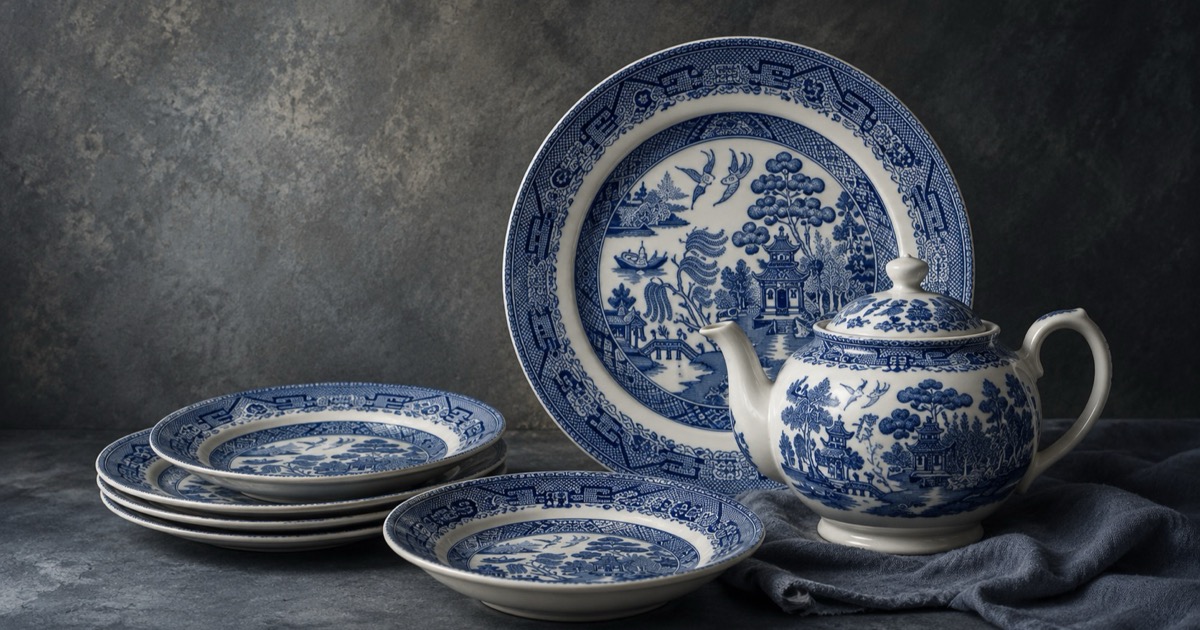
Blue willow china identification is one of the more approachable tasks in the antiques world because the pattern itself is remarkably consistent across two centuries of production. Once you know the standard scene and what variations mean, dating a piece often comes down to the backstamp and a close look at how the design was applied.
To identify blue willow china, confirm the standard scene — a teahouse on the right, a drooping willow tree, a bridge with three figures, two birds in flight, and a distant island — then read the backstamp, where country-of-origin wording such as “England” or “Occupied Japan” brackets the date. Start by photographing the front of the piece and the mark on the back.
Every legitimate willow-pattern piece carries most of those scene elements, though proportions and fine detail shift by manufacturer and era. By the end of this guide you will be able to date a piece to a broad era, narrow down likely makers, and have a realistic sense of what drives value.
Quick identification checklist
- Count the figures on the bridge — most standard patterns show three, though some simplified versions reduce this to two.
- Look for a continuous fence or rail running across the lower portion of the scene; its presence and detail level vary with quality.
- Check the back for a backstamp: color (blue, black, brown, red), text content, and crown or kite symbols all help date the piece.
- Read any country-of-origin text carefully — “England,” “Made in England,” “Japan,” and “Occupied Japan” each point to distinct date windows.
- Examine the surface with raking light for the fine dot matrix of transfer printing versus the brushwork variation of hand painting.
- Note the body color: bright stark white usually signals post-1900 production; a creamier or grayer white often indicates earlier English ware.
The standard willow pattern elements
The scene borrows loosely from Chinese decorative motifs but is not a reproduction of any specific Chinese design. The canonical version includes a large willow tree at center-left, a teahouse or pavilion at right, a bridge with three figures crossing it, a fence across the foreground, two birds above the tree, and a small island or boat in the far left background. A decorative border — typically a cell or trellis pattern — surrounds the central scene on most pieces.
The “Traditional” willow pattern is the most common form. Some makers produced a “Two Temples” variant with different architecture; others used a compressed version for smaller forms like egg cups. These are still willow pattern, but the deviation can indicate a specific maker or period.
Transfer printing: what it is and how to spot it
The vast majority of willow-pattern china was made by transfer printing, not hand painting. The design is engraved on a copper plate, inked, transferred to tissue paper, then applied to the bisque body before glazing and firing. Under magnification or raking light you will see a fine dot-and-line matrix rather than the pooling and brush variation of hand-painted work. Hairline breaks in the transfer where the tissue paper overlapped are another tell. True hand-painted willow pieces exist but are rare. Later twentieth-century pieces sometimes appear a slightly grayer blue compared to the deeper tones of Victorian-era Staffordshire.
Makers across eras
English Staffordshire
Dozens of Staffordshire potteries produced the willow pattern from the late 1700s onward. Spode, Minton, Wedgwood, Adams, Davenport, and Copeland are among the best-known names. Earlier pieces — roughly pre-1840 — often carry no country-of-origin mark, sometimes only an impressed maker’s name. Spode’s version is considered a benchmark: crisp transfer, good detail, and a consistent backstamp in blue.
Japanese production
From roughly the 1880s through the mid-twentieth century, Japanese potteries produced large quantities of willow-pattern ware for the US market. Japanese pieces are often lighter in weight and the pattern detail is sometimes simplified. Backstamps typically read “Japan”; pieces made during the US occupation (1945–1952) carry “Occupied Japan,” a mark with its own collector following.
American makers
Buffalo China of Buffalo, New York, is among the best-documented American producers; their pieces carry distinct backstamps and were widely used in restaurant service. A few other American potteries made willow-pattern lines in smaller quantities.
Modern production
Willow pattern has never stopped being made. Modern pieces show bright white bodies, perfectly consistent transfer registration, and backstamps that include a web address or “dishwasher safe.” The pattern detail is often slightly simplified compared to Victorian originals.
Reading backstamps and country-of-origin marks
The backstamp is your most reliable dating tool.
| Mark text | Approximate date window |
|---|---|
| No mark, or impressed maker name only | Pre-1840 English (general guideline) |
| “England” (without “Made in”) | 1891 onward — the US McKinley Tariff Act required origin marking on imports |
| ”Made in England” | Generally 1910s onward |
| ”Japan” | Roughly 1921–1941 and 1952 onward |
| ”Occupied Japan” | 1945–1952 |
| ”Made in Japan” | Common from 1921 onward |
These are guidelines, not hard rules. The mark text combined with mark style (printed vs impressed, color, crown symbols) builds a fuller picture. A British registry mark — the diamond-shaped “Rd” mark or a later “Rd No.” number — can date English pieces precisely using published registry tables.
Value: what actually drives it
Blue willow is one of the most-produced china patterns in history, so ordinary pieces are genuinely common. Unmarked Japanese export cups and plates typically sell for a few dollars at auction. Value rises with maker, form, age, and condition. Early documented Spode commands a premium; unusual forms — covered tureens with intact lids, large serving platters — bring more than standard plates. Buffalo China in pristine condition has a dedicated collector base. Occupied Japan pieces carry a small mark premium. Chips, cracks, and crazing reduce value substantially; restored pieces are worth considerably less than unrestored examples.
Watch-outs and common mistakes
- Assuming any blue-and-white transferware is willow pattern — flow blue, Asiatic Pheasant, and other scenic patterns are often confused with it; check for the specific willow-pattern scene elements.
- Mistaking a “Made in China” modern piece for early Staffordshire — current production from China is abundant and sometimes sold alongside genuine antiques.
- Over-relying on color alone: later pieces can be a rich cobalt blue, and earlier pieces can appear washed out if heavily used; condition varies widely.
- Assuming all unmarked pieces are old — some modern reproductions deliberately omit marks.
- Ignoring lid compatibility on covered pieces: mismatched lids are common and reduce value; check that the pattern registers consistently across body and lid.
Photo tips that improve identification
- Photograph the entire piece face-on in even light to capture all pattern elements and check the scene composition against the standard willow layout.
- Capture the backstamp straight-on with good light and high resolution — the finest text, registry marks, and color of the ink are all diagnostic.
- Use raking side-light across the surface to reveal the dot matrix of transfer printing, firing crazes, or repairs that may not be obvious in flat light.
- For plates and platters, photograph the rim border closely — border pattern style and quality often distinguish makers when the backstamp is faint or absent.
Common questions
Is unmarked blue willow china worth anything?
Sometimes, but the mark’s absence cuts both ways. Early English pieces from before roughly 1840 often carry no country-of-origin mark and can be desirable, yet some modern reproductions deliberately omit marks too. With unmarked pieces, value rests on the quality of the transfer, the body color, the border detail, and the form, so judge the piece itself rather than the blank base.
How can you tell how old blue willow china is?
Start with the backstamp wording: “England” alone points to 1891 onward, “Made in England” generally to the 1910s onward, “Occupied Japan” to 1945 through 1952, and a web address or “dishwasher safe” to modern production. A British diamond-shaped registry mark or “Rd No.” can date English pieces precisely against published tables. Body color helps too, since bright stark white usually signals post-1900 ware while creamier or grayer white often indicates earlier English production.
Is blue willow china always transfer printed?
Almost always. The vast majority was made by transfer printing, where an engraved copper-plate design was applied to the body via tissue paper, leaving a fine dot-and-line matrix visible under magnification and occasional hairline breaks where the paper overlapped. True hand-painted willow pieces exist but are rare, showing brush variation and pooling instead of the dot matrix.
Related guides
- Old China Patterns Identification
- China Makers Marks Identification: How to Read Old China Marks
- Antique English China Marks Identification
When to use the Antique Identifier app
Photograph the full face of the piece, the backstamp, and any impressed marks on the base. The app can match the pattern to known maker variants and cross-reference backstamp text against documented examples to narrow era and origin quickly. Use a strong result as a starting point for deeper research — particularly for pieces that might warrant formal appraisal.