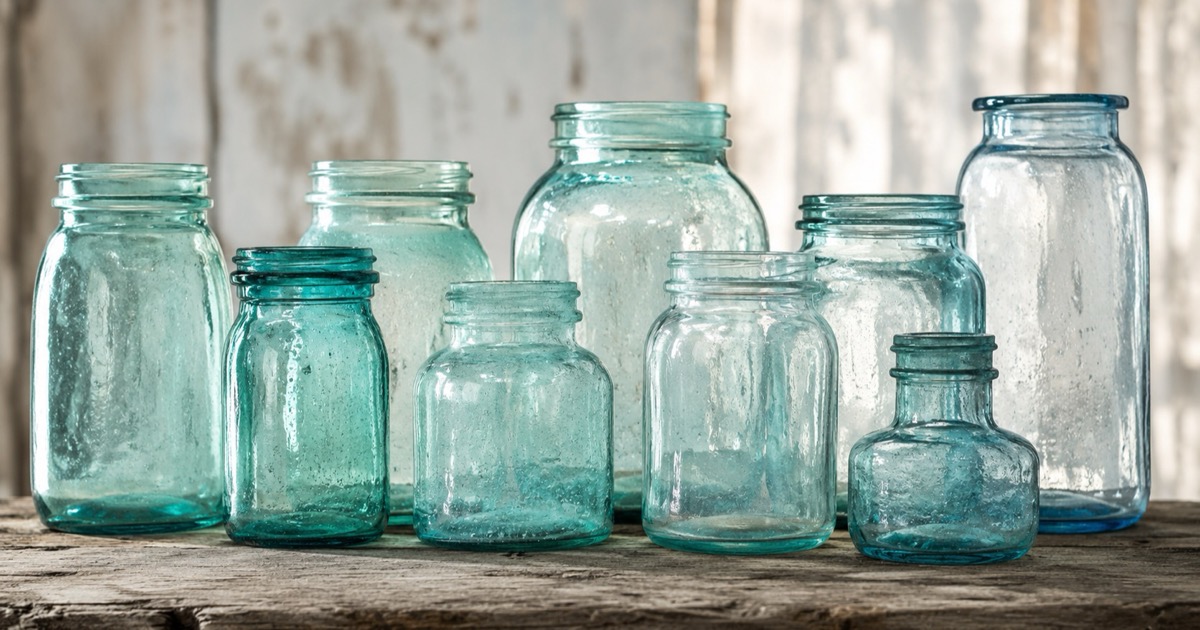
Antique mason jar identification trips up more beginners than almost any other glass category, mostly because of one embossed date: “Mason’s Patent Nov 30th 1858” appears on millions of jars made decades after 1858. The patent date names the invention, not the jar in your hand, and makers kept embossing it for half a century.
To identify an antique mason jar, read the embossed maker name and logo style, then check the closure and lip finish. A ground, frosted rim means hand finishing before fully automatic machines, and ornate, loopy Ball script is earlier than clean modern lettering. Start by recording the exact embossing, since the 1858 patent date is never a production date.
By the end of this guide you will be able to read jar embossing correctly, place a Ball script logo in its general era, use closures and mold seams as age evidence, judge color honestly, and recognize the reproductions and fantasy jars that circulate as decor.
Quick identification checklist
- Read the full embossing, and treat “Mason’s Patent Nov 30th 1858” as a patent reference, not a production date.
- Compare the Ball script style; ornate, loopy logos are generally earlier than clean modern ones.
- Identify the closure: groove-ring wax sealer, glass lid with wire bail, or zinc lid with milk-glass liner.
- Inspect the lip; a ground, rough rim means hand finishing and an earlier jar.
- Judge color honestly, since aqua and Ball blue are common while amber, olive, and cobalt are scarce.
- Check the base for the circular scars left by early jar-making machines.
Antique mason jar identification starts with the embossing
The big three names you will meet are Ball, Atlas, and Kerr, and each name carries information. Ball Brothers of Muncie, Indiana was the largest producer, and its logo evolution is the classic dating tool covered below. Atlas jars came from the Hazel-Atlas Glass Company; the embossed “Atlas Strong Shoulder Mason” advertises a reinforced shoulder that solved a cracking problem in earlier designs, and “Atlas E-Z Seal” names its glass-lid bail jars. Kerr’s “Self Sealing” jars introduced the flat metal disc lid in the early 1900s, the direct ancestor of the modern two-piece band and lid.
Read every word, because wording changes date jars. Mold-made embossing also produced famous spelling and alignment errors, and genuine oddities of that kind interest collectors, so record exactly what the glass says rather than what it should say.
Dating Ball jars by the script logo
The Ball logo changed in a documented progression, and while precise year charts exist in collector references, the general arc is enough for a first pass. The earliest Ball-marked jars used plain block lettering. The first script logos are ornate, with dropped loops and connecting flourishes that make the word look almost like it has an extra letter. Over time the script simplified: the loops disappear, an underline tail develops beneath the word and then changes shape, and the lettering moves steadily toward the clean modern logo. As a rule of thumb, the fancier and loopier the script, the earlier the jar; the closer it sits to the logo on a new jar at the grocery store, the later it is.
Wording helps as well. “Ball Perfect Mason” was the company’s flagship embossing for decades, and most blue examples belong broadly to the 1910s through the 1930s. “Ball Ideal” marks the wire-bail line. Match logo style and wording together and you can usually bracket a jar within a couple of decades.
Closures: wax sealers, bails, and zinc lids
The sealing system is independent dating evidence, and it survives even when embossing is generic.
| Closure type | General era | What it tells you |
|---|---|---|
| Groove-ring wax sealer | Mid-1800s onward | Earliest sealing method; jar mouth has a channel for wax |
| Glass lid with wire bail | Late 1800s onward | Lightning-style closure, used for decades |
| Zinc screw lid with milk-glass liner | Late 1860s onward | The classic mason closure for both hand-blown and machine jars |
| Flat metal disc with screw band | Early 1900s onward | Kerr-style self-sealing lid, still the modern standard |
Original closures add value and evidence, but lids migrate between jars constantly, so confirm the lid fits the jar’s era rather than assuming they were born together.
Mold seams, lips, and base scars
Manufacturing scars date glass independently of branding. On early hand-finished jars, the lip was ground flat after the jar was broken off the blowpipe, leaving a rough, frosted rim hidden under the lid; a ground lip is strong evidence of a jar from before fully automatic production. Machine-made jars, dominant by the 1910s, show mold seams running up and over the finished lip, with smooth rims. On bases, circular suction or valve scars are signatures of early jar machines, and they confirm a machine-era jar even when the logo is worn. Bubbles, waviness, and whittle-like texture in the glass lean older, but modern reproductions imitate them, so treat texture as supporting evidence only.
Color, value honesty, and rarity
Aqua and the famous “Ball blue” are the default colors of older jars, produced in astonishing quantities; the blue tint came from the sands used at the Muncie works, and Ball moved to clear glass by the late 1930s. That is why honesty matters here: most blue Ball Perfect Mason quarts survive in the millions and sell modestly, no matter how old and charming they are. Clear jars are later and even more common.
Genuine scarcity lives at the edges: amber and olive tones, true cobalt, milk glass, unusual sizes such as midget pints, error embossings, and early wax sealers. Be suspicious of deep purple jars; pale lavender can develop naturally in old manganese glass under sunlight, but intense purple is usually the product of artificial irradiation done to ordinary jars.
Reproductions and fantasy jars
Reproduction and fantasy jars are everywhere because old-looking jars sell as decor. Common offenders include crude, heavy “Mason’s Patent 1858” jars in cobalt, deep purple, or other colors the originals never came in, often with grayish glass and blurry embossing. Ball itself has issued commemorative and heritage blue jars in recent decades; they are attractive, clearly modern on inspection, with crisp contemporary logos and perfect machine-made finishes. Marriages of old zinc lids onto new jars complete the illusion. When color, logo style, closure, and manufacturing scars do not all point to the same era, the jar is telling you something.
Watch-outs and common mistakes
- The 1858 patent date appears on jars made into the early 1900s; it is never a production date by itself.
- Deep, saturated purple glass usually means artificial irradiation, not age.
- Logo charts date the mold style, not your exact jar, so use them as brackets rather than birthdays.
- An old lid on a new jar is a common marriage; date the glass and the closure separately.
- Modern commemorative blue jars fool beginners; check for crisp modern logos and flawless glass.
Photo tips that improve identification
- Shoot the embossing with strong raking side-light so the lettering and logo style read clearly.
- Photograph the lip and rim straight on to show ground versus machine finishing.
- Capture the base square-on for suction scars, mold numbers, and seams.
- Take one photo against bright daylight or a white background so the true glass color shows.
Common questions
How old is a mason jar that says “Mason’s Patent Nov 30th 1858”?
The 1858 date names John Landis Mason’s patent, not the year the jar was made, and makers kept embossing it for roughly half a century afterward. Most jars carrying it date from the later 1800s into the early 1900s. To narrow the age, check the lip for a ground, frosted rim, the closure type, and the mold seams rather than the embossed date.
Are blue mason jars valuable?
Usually not. Aqua and “Ball blue” were the default colors of older production, made in the millions, so a common blue Ball Perfect Mason quart sells modestly no matter how old it is. Real scarcity lives in amber, olive, true cobalt, milk glass, unusual sizes such as midget pints, and error embossings, and deep saturated purple usually signals artificial irradiation rather than age.
How can you tell a reproduction mason jar from an original?
Reproductions and fantasy jars tend to be crude and heavy, with grayish glass, blurry embossing, and colors such as cobalt or deep purple that the originals never came in. Modern commemorative blue jars show crisp contemporary logos and flawless machine-made finishes. The reliable test is consistency: on a genuine old jar, the color, logo style, closure, and manufacturing scars all point to the same era.
Related guides
When to use the Antique Identifier app
Photograph the whole jar, then take tight shots of the logo embossing, the lip, the closure, and the base. The app can quickly narrow the maker, the general era, and the jar type, which tells you which collector references matter. If it flags a rare color or an unusual variant, treat that as a reason to verify against documented examples and sold prices, not as a final answer.