


How to Identify Old Bottles
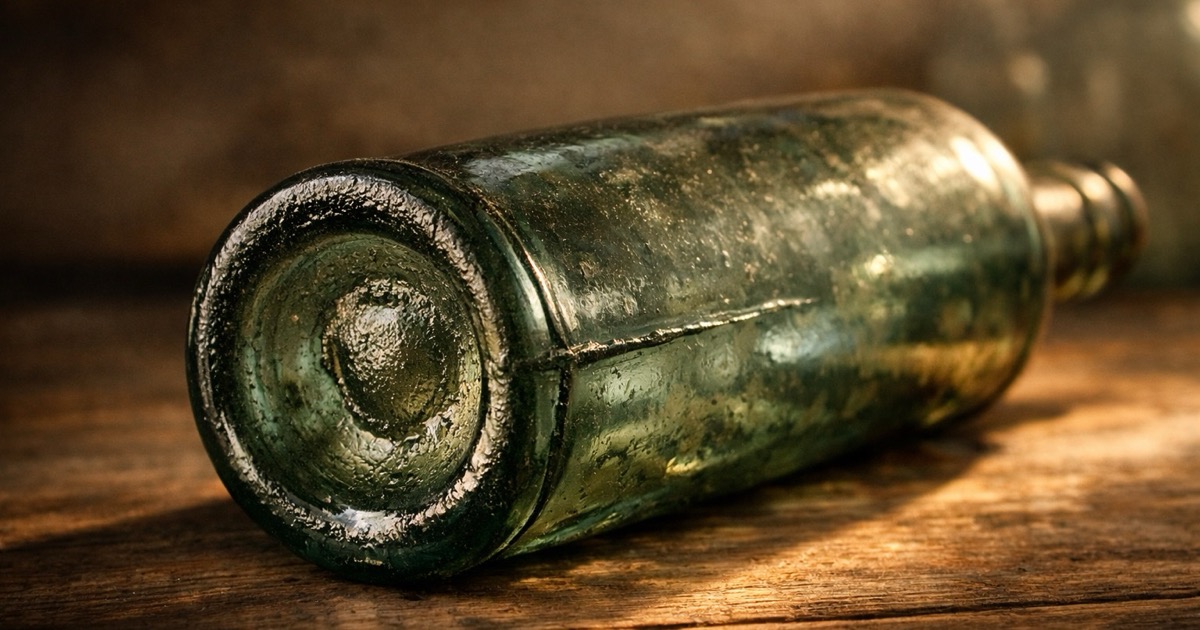
To identify an old bottle, read four things in order: how it was made (mold seams and base), what it is made of (glass color and clarity), what it says (embossing, labels, and base marks), and how it has aged (wear, patina, and residue). The single most useful test is running a finger up a side seam: if the seam runs all the way up and over the lip, the bottle was machine-made, which for American bottles usually means after about 1905 (Society for Historical Archaeology). Everything else refines the date from there.
This guide gives you a first-pass workflow so you can narrow what you have before deciding whether to keep researching, list it for sale, or ask for a professional appraisal. The goal is not certainty from one photo. It is to help you ask better questions, take better photos, and spot the clues most likely to move the identification forward.
Quick identification checklist
- Run a finger up the vertical side seam and note where it stops: at the shoulder, below the lip, or all the way over the top.
- Turn the bottle over and inspect the base for a pontil scar, a suction scar, mold seams, or embossed numbers and letters.
- Hold the glass to daylight and read the color, including any faint amethyst, aqua, or straw tint.
- Look for embossing (raised lettering molded into the glass) on the body, shoulder, and base.
- Check the lip and neck: is the finish tooled and slightly irregular, or perfectly even and machine-smooth?
- Note wear, patina, interior haze, and any remaining paper label or applied color lettering.
Start with how the bottle was made
Manufacturing method is the backbone of bottle dating because it changed on a known timeline. Before roughly 1905, bottles were mouth-blown, either free-blown or, far more often, blown into a mold. Mouth-blown bottles have vertical side seams that fade out somewhere on the neck or shoulder and never cross the lip, because the finish (the lip and rim) was formed by hand after the bottle left the mold. The seams are also softer and more rounded.
Machine-made bottles tell a different story. On a machine-made bottle, the vertical side seams usually run up to the highest point of the finish and often onto the very top surface of the rim, and there are extra seams around the neck ring that are diagnostic of machine manufacture (Society for Historical Archaeology). Automatic bottle machines, led by the Owens machine, take an effective beginning date of about 1905, and by 1917 roughly 90 percent of US bottle production was machine-made. So a seam-over-the-lip bottle is almost always twentieth century, while a seam that stops below the finish points to the 1800s or very early 1900s. If you want a broader primer on aging glass generally, see how to tell if glass is antique.
Read the base
Flip the bottle over. The base often carries the clearest single clue.
A pontil scar — a rough, chipped, or ringed mark where a rod held the bottle during finishing — signals a mouth-blown bottle, typically from roughly 1810 to the early 1860s, after which pontil rods were gradually replaced by tools that did not scar the base (Society for Historical Archaeology). A pontil scar is a strong sign of genuine early-to-mid nineteenth-century age. A suction scar — a distinctive off-center ring — is the opposite signal: it was left by the Owens Automatic Bottle Machine and marks an early machine-made bottle, generally 1905 onward. A base with clean mold seams and no pontil is later hand-blown or machine work. Embossed numbers, letters, or a maker’s logo on the base are worth recording exactly, since many can be traced to a specific glassworks and production window in reference guides such as those covered in antique glass marks identification.
Use color as a dating clue
Glass color is not decorative trivia; the chemistry was tied to specific eras. The most useful example is faint amethyst or purple glass. Clear glass decolorized with manganese dioxide slowly turns pink to amethyst when exposed to years of sunlight — collectors call it sun-colored amethyst — and manganese was most commonly used from the 1880s to about the end of World War I (Society for Historical Archaeology). So a naturally sun-purpled bottle usually dates to roughly 1890 to 1920. Note that this is a genuine slow UV change; artificially irradiated purple glass is a known modern fake, so treat vivid, even purple with suspicion.
Aqua (a light blue-green from iron impurities) was the default color for utilitarian bottles through the nineteenth and early twentieth centuries. Deep cobalt and emerald were often reserved for poisons, medicines, and specialty products. Straw or gray tints from selenium decolorizers point to the 1910s onward. Color alone never dates a bottle, but combined with the seam and base evidence it narrows the window considerably.
Manufacturing features and what they suggest
| Feature you observe | Typical implication | Rough era |
|---|---|---|
| Side seam stops on neck or shoulder | Mouth-blown, hand-finished lip | Pre-1905 |
| Side seam runs up and over the lip | Machine-made | ~1905 onward |
| Pontil scar on base | Early mouth-blown, hand-held finishing | ~1810–1860s |
| Suction scar on base | Owens automatic machine | ~1905 onward |
| Sun-purpled (amethyst) clear glass | Manganese-decolorized glass, UV-aged | ~1890–1920 |
| Applied color label (painted lettering) | Later mass production | ~1930s onward |
Treat every row as a clue to combine, not a verdict. The strongest identifications stack several features that agree with one another.
Embossing, labels, and lettering
Words carry the specific identity. Embossing — raised lettering molded directly into the glass — often names the product, druggist, dairy, brewery, or town, and those names can frequently be dated through local directories and bottle-collector references. Copy the text exactly, including punctuation and abbreviations, because a single differing word can distinguish a common bottle from a scarce local one.
Applied color labels (ACL) — painted, fired-on lettering, common on soda and milk bottles — generally indicate machine-era production from the 1930s onward. A surviving paper label is a bonus but is easily faked or swapped, so weigh it against the physical evidence in the glass. Milk bottles, canning jars, and sodas each have their own dating literature; for the jar family specifically, see antique mason jar identification.
Watch-outs and common mistakes
- Confusing “old-looking” with genuinely old. Reproduction bottles and modern décor pieces are common; the seam-and-base evidence outranks a weathered appearance.
- Trusting artificially purpled glass. Even, vivid purple can be modern irradiation rather than decades of true sunlight.
- Reading a paper label as proof. Labels are swappable; the molded features in the glass are far harder to fake.
- Confusing price with documented value. A listing price is a hope, not an appraisal.
- Treating any app or single reference as formal authentication rather than a starting point.
Photo tips that improve identification
- Take a full-bottle photo first, straight on, so the overall form and proportions read clearly.
- Shoot the base flat-on in raking light so a pontil scar, suction scar, or mold seams stand out.
- Photograph all embossing straight on; backlight the bottle or fill it with water to make raised letters legible.
- Capture the lip and neck in profile to show where the side seam ends and how the finish was formed.
- Hold the bottle against a neutral background and daylight to record the true glass color.
Common questions
How can you tell if a bottle is hand-blown or machine-made?
Run a finger up the vertical side seam. On a mouth-blown bottle the seam fades out on the neck or shoulder and never crosses the lip, because the finish was formed by hand. On a machine-made bottle the seam runs all the way up and over the top of the rim, usually with extra seams around the neck ring. For American bottles, seam-over-the-lip generally means 1905 or later.
What does a pontil mark on the bottom of a bottle mean?
A pontil mark, or pontil scar, is a rough or ringed spot where an iron rod held the bottle while the lip was finished by hand. It indicates a mouth-blown bottle, most commonly from about 1810 to the early 1860s, after which non-scarring tools replaced pontil rods. A genuine pontil scar is a strong sign of authentic early-to-mid nineteenth-century age.
Why do some old bottles turn purple?
Clear glass made with manganese dioxide as a decolorizer slowly turns pink to amethyst after years of ultraviolet exposure, a change collectors call sun-colored amethyst. Manganese was used mainly from the 1880s to the end of World War I, so a naturally purpled bottle usually dates to roughly 1890 to 1920. Beware of modern glass that has been irradiated to fake the color, which tends to be an unusually deep, even purple.
Related guides
- How to Tell If Glass Is Antique
- Antique Glass Marks Identification
- Antique Mason Jar Identification: Dating Ball, Atlas, and Kerr Jars
- How to Photograph Antiques for Identification
- Where to Sell Antiques: Best Options Compared
When to use the Antique Identifier app
The app is most useful after you have taken one full photo and a few tight detail shots of the base, the lip, and any embossing. It can help narrow the likely type, era, and glass color family, which makes your follow-up research faster. If the result points to something unusually early, embossed with a scarce local name, or otherwise high value, treat that as a prompt for deeper verification against bottle-collector references or a professional appraiser rather than a final answer.
Topics