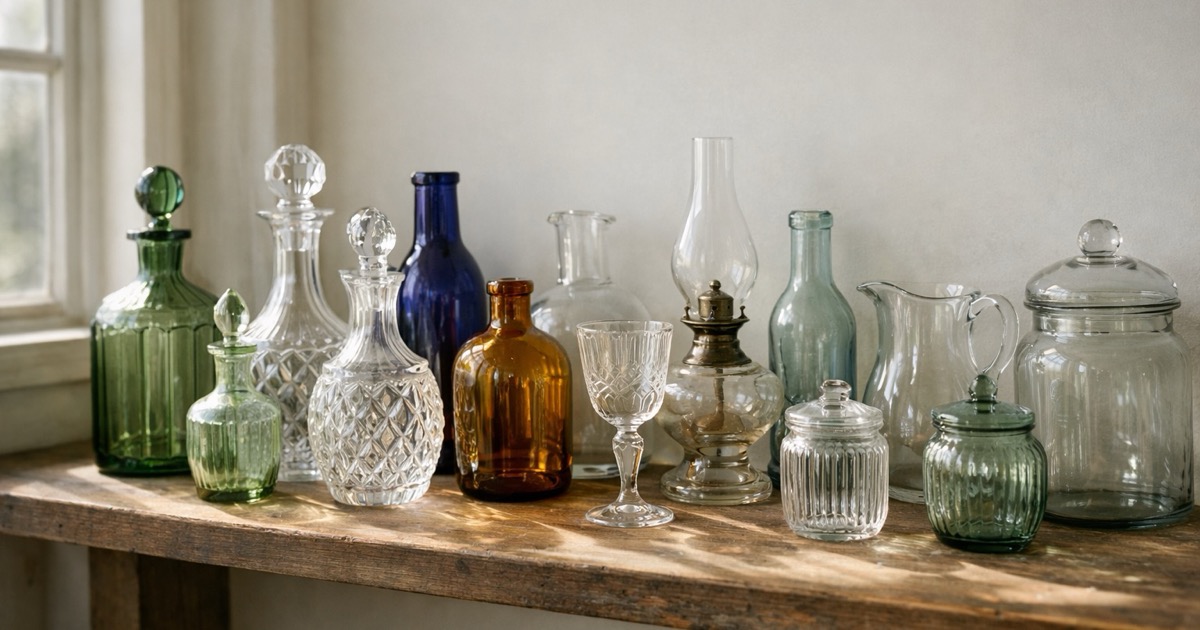
To tell if glass is antique, look for the evidence hardest to fake: a rough or ground pontil mark on the base, mold seams that stop before the rim, real wear where the piece meets a table, and a weight and ring that match hand or early-machine production. In antiques usage, “antique” means roughly 100 years or older, so the practical question is whether a piece was made before about the mid-1920s, not simply whether it looks old.
This guide gives you a first-pass workflow so you can narrow what you have before deciding whether to keep researching, list it for sale, or ask for a professional appraisal. The goal is not certainty from one photo. It is to help you ask better questions, take better photos, and spot the clues most likely to move the identification forward. Glass rarely carries a maker’s mark, so most of the work is reading the object itself.
Quick identification checklist
- Turn the piece over and check the base for a pontil mark, ground concavity, or a smooth machine-made bottom.
- Trace the mold seams: do they run all the way over the rim, or stop short of it?
- Weigh it in your hand and tap the rim; note whether it feels heavy for its size and rings or thuds.
- Look at the pattern edges to judge cut glass versus pressed glass.
- Examine the rim, foot, and base for genuine wear scratches that match real use.
- Photograph any acid-etched signature, molded number, or paper label before you clean it off.
What to inspect first
Begin with the base, because it carries the most diagnostic value on glass. Hand-blown and early glass was worked on an iron rod called a pontil, and when that rod was snapped off it left a mark: a rough scar, a ground and polished concavity, or a small raised or sunken circle roughly in the center. Free-blown and early mold-blown pieces almost always show some pontil evidence, while fully automatic machine production from the 1910s onward typically leaves a smooth base, often with a faint mold ring or a maker’s code but no pontil.
Then read the seams. On mold-made glass, the vertical lines where mold halves met tell you how the piece was formed. On mouth-blown mold work, seams fade out below the rim because the neck and lip were finished by hand. On fully machine-made glass, the seam runs continuously up and over the top of the rim, because the whole piece, lip included, was formed in one automated operation. A seam that climbs over the lip is one of the most reliable signals that a piece was made after roughly 1910, not before.
Write down exactly what you see before you start searching, and note any damage or repairs. A replacement stopper, a ground-down chip, or a repaired foot changes both the dating and your confidence in it.
Reading the base: pontil marks and seams
The base is where age hides in plain sight. Use the table below as a rough guide, remembering these are tendencies, not guarantees, and that reproductions can imitate individual features.
| Base or seam feature | What it usually indicates | Typical era |
|---|---|---|
| Rough, sharp pontil scar | Free-blown or early blown; pontil snapped, not finished | Pre-1850s |
| Ground, polished pontil concavity | Better-quality blown glass, pontil smoothed by hand | Roughly 1800s–early 1900s |
| Seams fade out below the rim | Mouth-blown into a mold, lip hand-finished | Roughly 1820s–1910s |
| Seam runs up and over the rim | Fully automatic machine production | Roughly 1910s onward |
| Smooth base with a valve or suction scar | Automatic bottle machine | 1905 onward |
| Perfectly even base, crisp mold number | Modern mass production | Mid-20th century onward |
The single most useful habit is to feel the base with a fingertip and hold it to raking light. A pontil area feels different from a machine base, and genuine base wear shows as a network of fine, multidirectional scratches concentrated on the high points that actually touch a surface, not tidy parallel lines added to fake age.
Cut glass versus pressed glass
One of the most common mistakes is confusing pressed glass with hand-cut glass, because pressed patterns were deliberately designed to imitate expensive cutting. The technique of press-molding glass with a hand-operated machine was perfected in the United States in the early 1820s and drove the first true mass production of glassware, with makers like the Boston & Sandwich Glass Co. producing “lacy” and figured patterns that mimicked cut crystal at a fraction of the cost (Victoria and Albert Museum). Genuine cut glass, by contrast, was ground into blanks on a wheel, a labor-intensive process used on higher-end pieces such as neo-Renaissance decanters (Victoria and Albert Museum).
You can usually tell them apart by touch and detail. Cut glass has sharp, crisp facet edges you can catch a fingernail on, with tiny variations because a person guided each cut, and the interior surfaces of the cuts are bright and polished. Pressed glass has softer, rounded pattern edges, occasional mold seams running through the design, and sometimes a slightly grainy or frosted texture inside recesses where the mold surface printed. Hold both to the light: cut glass throws sharp prismatic sparkle, while pressed glass reads flatter. Neither being “pressed” nor “cut” settles age on its own, since both techniques span well over a century, but it tells you which reference tradition you are researching. If you are working through a suspected cut piece, our guide on how to tell if cut glass is antique walks through the wheel-cutting tells in more depth.
Weight, clarity, and ring
Pick the piece up. Older lead or lead-crystal glass tends to feel notably heavy for its size and, when you flick the rim gently with a fingernail, produces a clear sustained ring. Ordinary soda-lime glass feels lighter and gives a shorter, duller tone. This is a hint rather than a verdict, since plenty of good antique glass is soda-lime and some modern glass is leaded, but weight and ring together with the base evidence build a picture.
Clarity and color also matter. Early glass can carry a faint gray, straw, or greenish cast from impurities and period decolorizers, and some pieces show a slight surface iridescence or “sick glass” film from long burial or storage. A subtle purple or amethyst tint in otherwise clear glass often points to manganese-decolorized glass that has been exposed to years of sunlight, a trait associated with production roughly before 1915. Absolute water-clear brilliance, on its own, leans modern. Related glass families use color as their headline clue: see uranium glass identification for the pieces that glow green under UV light.
Bubbles, wear, and common myths
Small bubbles and a few straw marks or tool lines suggest handwork, but bubbles alone are not proof of age, because studio and reproduction glass is often bubbled deliberately to look old. Treat bubbles as one supporting detail among several, never as a conclusion.
Wear is more trustworthy when you read it correctly. Genuine age wear appears where a piece was actually handled and set down: fine scratches on the base high points, softening on the foot rim, and light haze inside a decanter neck from a stopper. Wear that appears uniformly across a whole surface, or crisp parallel scratches on a part that would never touch a table, is a warning sign of artificial aging. Reproductions and marriages, where a period base is fitted with a newer stopper or lid, are common, so evaluate each component.
Watch-outs and common mistakes
- Treating a few bubbles as proof of age when modern glass is bubbled on purpose.
- Confusing pressed glass with hand-cut glass because pressed patterns imitate cutting.
- Overlooking a mold seam that runs over the rim, which points to machine production after roughly 1910.
- Assuming a smooth polished base rules out age; better blown pieces had their pontils ground away.
- Accepting a matched stopper or lid without checking that it truly belongs to the body.
Photo tips that improve identification
- Use strong side lighting to throw the mold seams and pattern edges into relief.
- Place the glass on a plain dark background so the form and any color cast read clearly.
- Shoot the base straight on, close up, to capture the pontil area, wear, and any code.
- Photograph any acid-etched signature or paper label as tightly as your lens will focus.
Common questions
Does a pontil mark mean glass is antique?
A pontil mark strongly suggests hand or early production rather than fully automatic machine manufacture, which points away from modern mass production. It does not prove a specific age on its own, because pontils were used across a long period and studio glassblowers still use them today. Read it alongside the mold seams, wear, weight, and clarity rather than treating it as a single verdict.
How can you tell antique glass from reproduction glass?
Reproductions often get one feature right but several wrong. Check whether the base wear looks genuinely random and concentrated where the piece touches a surface, whether the mold seams are consistent with the claimed era, and whether the weight, ring, and color cast all agree. A piece that looks old on top but shows machine seams over the rim, uniform fake scratches, or a suspiciously perfect base is usually a reproduction or a later copy.
What is the difference between antique and vintage glass?
In common antiques usage, “antique” means roughly 100 years old or older, while “vintage” describes newer collectible pieces, often 20 to 100 years old. So a piece from the 1960s is vintage rather than antique, even if it is genuinely collectible. The distinction matters for pricing and for choosing which reference sources and comparable sales to research.
Related guides
- How to Tell If Cut Glass Is Antique and Not Pressed Glass
- Antique Glass Marks Identification
- Depression Glass Identification
- Antique Mason Jar Identification
- Carnival Glass Identification
- Fenton Glass Identification
When to use the Antique Identifier app
The app is most useful after you have taken one full photo and a few tight detail shots of the base, seams, and any marks. It can help narrow the likely type, era, and material, which makes your follow-up research faster. Values move with condition, pattern, and rarity, so cross-check anything promising against sold comparables and pattern references such as Kovels before you set expectations. If the result points to something unusually rare, signed, or high value, treat that as a prompt for deeper verification rather than a final answer.