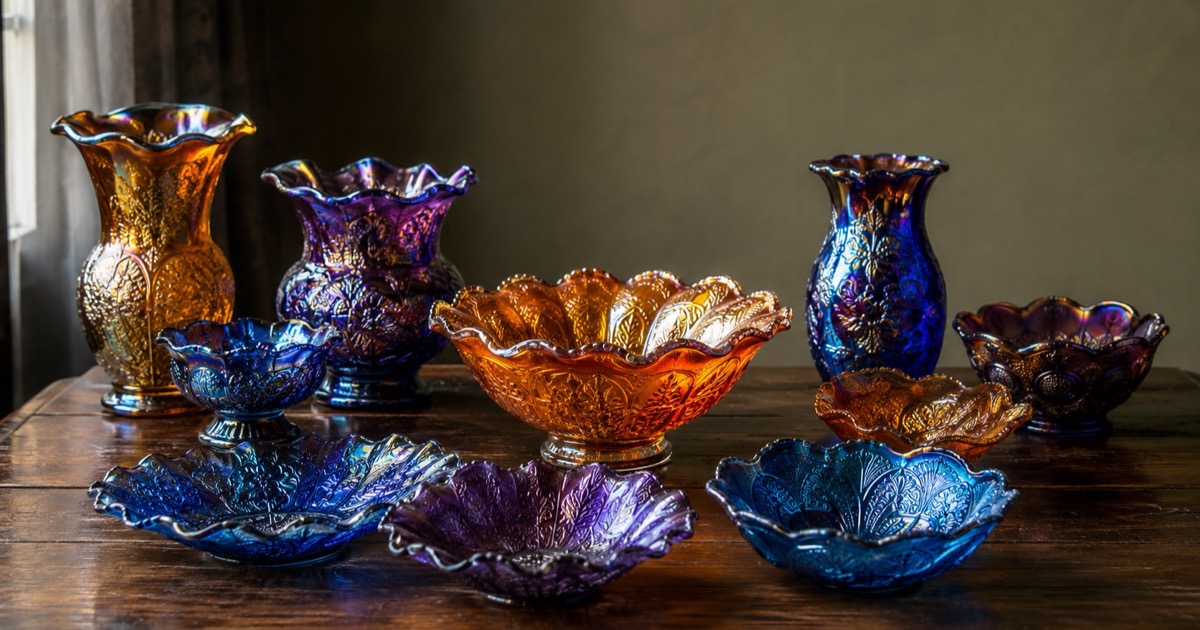
Carnival glass identification starts with a counterintuitive rule: the shimmering surface that makes this glass famous is the least useful thing about it. The iridescence was sprayed on, so what matters is the glass underneath, the pattern pressed into it, and a few maker traits that separate the classic early-1900s production from everything made since. By the end of this guide you will be able to check all three on any iridescent bowl, vase, or plate and place it in the right era with reasonable confidence.
Carnival glass is press-molded glass with a sprayed-on iridescent finish, made in quantity from about 1907 into the 1920s. To identify a piece, find an uniridized spot on the underside of the base and read the true glass color there, then match the pressed pattern to a maker such as Northwood or Fenton.
The stakes are real because the same molds, and in some cases the same factories, produced carnival glass again from the 1960s onward. Telling a 1910s Northwood bowl from a 1970s reissue is the whole game, and it is very learnable.
Quick identification checklist
- Find an uniridized spot, usually the underside of the base or collar, and note the true color of the glass itself.
- Look for a molded maker’s mark, especially Northwood’s N in a circle, but expect most period pieces to be unmarked.
- Identify the interior pattern by its dominant motif: grapes, peacocks, acorns, flowers, stars.
- Check the exterior pattern and the edge treatment too, since combinations narrow the maker.
- Study the iridescence in daylight; classic-era finishes range from light marigold to intense multicolor.
- Run a finger around the rim and base for chips that busy iridescence can visually hide.
What carnival glass actually is
Carnival glass is press-molded glass that was sprayed with metallic salt solutions while still hot, then refired, leaving a thin iridescent film bonded to the surface. American factories produced it in enormous quantities from roughly 1907 into the 1920s as an affordable answer to expensive iridescent art glass, which is why collectors sometimes call it the poor man’s Tiffany. The carnival name came later, from the years when surplus stock was handed out as fairground prizes.
Because the iridescence is a surface treatment, it pools in pattern recesses, varies across the piece, and wears at high points. That sprayed-on character is itself a clue. Glass with color running all the way through, or with a smooth satin sheen and no pressed pattern, is usually something else entirely.
Base color comes first in carnival glass identification
Collectors classify carnival glass by the color of the underlying glass, not the rainbow on top. Marigold, by far the most common type, is actually clear glass wearing an orange iridescent spray. Amethyst, purple, blue, and green bases are all reasonably common. Red, pastel shades such as ice green and ice blue, and opalescent-edged colors sit at the scarce end and account for much of the serious money in this field.
The only honest way to read base color is to find a spot the spray never reached, typically the underside of the base, and hold it to strong light. Two bowls that look identical face-up can be a common marigold and a rare pastel underneath, which is why this single check matters more than anything else you can do in thirty seconds.
The classic makers and their tells
Five American factories dominate the classic era, and their habits are worth learning in general terms. Fenton was the first major producer and made huge quantities across many patterns. Northwood is the marked exception in a largely unmarked field: many, though not all, of its pieces carry a raised N inside a circle on the base. Imperial favored bold geometric and grape designs and strong purples. Millersburg was a short-lived Ohio factory whose output is scarcer and keenly collected. Dugan, which later operated as Diamond, is closely associated with peach opalescent pieces that show milky edges.
Treat these as starting points rather than rules. Most period carnival glass carries no mark at all, so attribution usually rests on the combination of pattern, shape, edge treatment, and base color rather than on any single feature.
Patterns worth learning first
Pattern names do most of the identification work once you know a few anchors. Grape and Cable, a dense grape-cluster design bordered by a cable band, was Northwood’s flagship and appears across a huge range of shapes; Fenton made a similar grape design of its own. The peacock family of patterns, with a bird posed by an urn or fountain, was produced by several factories with small differences that pattern references document well. Once you can name the pattern, the maker and era usually follow, because most patterns were made by one or two factories within a known window.
Reissues and contemporary carnival glass
Iridescent pressed glass came back in the 1960s and 1970s and never fully left. Imperial reissued pieces from original molds, often adding marks the originals never had. Fenton produced iridescent lines for decades and began molding its name into pieces in the 1970s, so a clear molded Fenton logo points away from the classic era, not toward it. Other companies and contemporary studios still make carnival-style glass today.
Later pieces tend to give themselves away through color and surface: hues that do not match documented old production, an even glossy iridescence, crisp unworn mold detail, and pristine bases. None of these alone is conclusive, but together they usually settle the question.
What carnival glass is worth, honestly
Volume defines this market. Common marigold bowls in common patterns survive in enormous numbers, and most sell for modest sums regardless of age. Value concentrates where scarcity does: rare base colors, rare pattern-and-shape combinations, electric multicolor iridescence, and large or unusual forms such as punch sets and tall funeral vases. Condition still rules at every level, since a chip or a worn patch of iridescence cuts value sharply. If a piece seems to pair a rare color with a desirable pattern, that is the moment to slow down and verify rather than price it like its common cousins.
Watch-outs and common mistakes
- Calling every iridescent glass carnival. Stretch glass, art glass, and modern iridized pieces lack the pressed pattern under a sprayed finish.
- Judging color from the iridescence instead of the base glass underneath it.
- Treating the Northwood N as proof on its own; spurious marks appear on reproductions, so the mark must agree with pattern, shape, and color.
- Assuming unmarked means old or marked means old. For several makers the logic runs the other way.
- Missing rim flakes hidden by busy iridescence. Fingertips find what eyes miss.
Photo tips that improve identification
- Shoot the base against strong light to record the true base color at an uniridized spot.
- Photograph the interior pattern from directly above, then the exterior pattern from the side.
- Capture any molded mark straight on in raking light so the relief reads clearly.
- Take at least one photo in diffuse daylight, since flash exaggerates iridescence and hides wear.
Common questions
Is unmarked carnival glass worth anything?
Yes, and most period carnival glass is unmarked, so a missing mark says nothing against age or value. Attribution rests on the pattern, shape, edge treatment, and base color rather than a logo. Value follows scarcity: an unmarked bowl in a rare base color with strong iridescence can outsell a marked piece in a common pattern.
How can you tell old carnival glass from new?
Start with marks and color. A clear molded Fenton logo points to the 1970s or later, and reissued pieces often carry marks the originals never had. Newer glass also tends to show even glossy iridescence, crisp unworn mold detail, and pristine bases, while colors may not match documented early production. No single sign is conclusive, but together they usually settle the era.
What color of carnival glass is most valuable?
Value follows the base glass, not the rainbow on top. Marigold, which is clear glass under an orange spray, is the most common and usually the least valuable. Red, pastel shades such as ice green and ice blue, and opalescent-edged colors sit at the scarce end, especially when paired with a desirable pattern and intense multicolor iridescence.
Related guides
- Depression Glass Identification
- Uranium Glass Identification: How to Spot Real Vaseline Glass
- How to Identify Pressed Glass Patterns
- Imperial Glass Marks: Identifying IG, LIG, and Unmarked Pieces
When to use the Antique Identifier app
Photograph the whole piece, then take tight shots of the base, the pattern center, and any molded mark, and let the app narrow the likely pattern, maker, and era before you open references. That first pass saves real time with carnival glass because the pattern name unlocks everything else. If the result suggests a rare color or a scarce maker, treat it as a prompt for deeper verification rather than a final answer.