


Depression Glass Identification
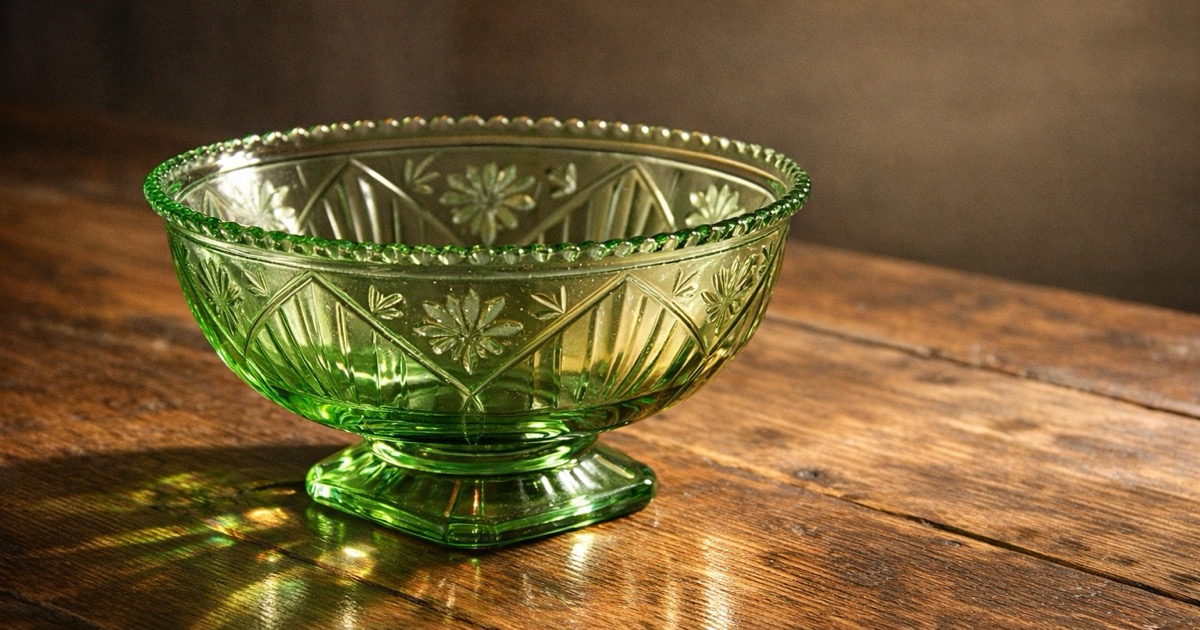
Depression glass is identified by its color, its pattern, and the marks of machine pressing rather than by a maker’s stamp, because most pieces were never signed. It is inexpensive, mass-produced, machine-pressed glassware made roughly from the mid-1920s through the early 1940s, in colors like pink, green, amber, and clear, and it was often given away free as a premium in flour sacks, at gas stations, and inside cereal boxes. The fastest path to an identification is to name the color, match the repeating molded pattern to a known one, then confirm the piece is period rather than a later reproduction.
That last step matters more with depression glass than with almost any other collectible, because the most popular patterns and colors have been reproduced for decades. This guide walks through the diagnostic evidence in the order that resolves the most cases: color, pattern, the physical tells of mass pressing, and the specific reproduction traps that catch buyers.
Quick identification checklist
- Name the color in daylight: pink, green, amber, yellow (topaz), cobalt blue, or clear crystal are the common ones.
- Photograph the repeating molded pattern straight on; the pattern name is what carries the identification.
- Look for mold seams running up the sides and a slightly wavy, bubble-flecked surface, both signs of mass pressing.
- Check the base for a straw mark, a rough or unpolished pontil-area, and honest ring wear.
- Run a UV blacklight over green pieces; period uranium-green glass fluoresces bright green.
- Compare against a reproduction list before you trust a rare color or pattern, especially cobalt and deep green.
Identifying depression glass by color
Color is the first cut because the palette is limited and each hue points at a rough era and set of makers. Pink and green were the dominant depression-era colors and remain the most collected. Amber and yellow (often called topaz) are common. Cobalt blue is scarcer and more valuable, which is exactly why it is reproduced most aggressively. Clear “crystal” depression glass exists too, but color usually does more identification work.
Green is a special case. Much depression-era green glass was colored with uranium oxide, which gives it a distinctive yellow-green cast and, more usefully, makes it glow bright green under a UV blacklight. That fluorescence is a helpful period signal, though not a guarantee on its own, since some later glass also contains uranium. Hold the color judgment until you have seen the piece in daylight, not under a warm bulb that shifts every hue toward amber.
Reading the pattern
With the color named, the pattern is what actually identifies the piece. Depression glass was sold in named patterns, each a repeating molded motif pressed into every item in the line, and there are hundreds of them. Some of the most recognized include Cameo, Mayfair, Princess, Royal Lace, American Sweetheart, Sharon, and Madrid, but the specific name matters less than photographing the motif clearly enough to match it against a reference.
Look at where the pattern sits and how it repeats: florals, geometric bands, scalloped rims, and open-lattice designs are all common families. Record the shape too, since patterns came as full dinnerware and serving sets, so a cup, a plate, and a sherbet in the same pattern will share the motif at different scales. Pattern databases and collector guides index these by name and image; the National Depression Glass Association maintains club and educational resources for exactly this kind of matching (National Depression Glass Association).
The physical tells of mass pressing
Depression glass was made fast and cheap, and the manufacturing shortcuts are diagnostic. Because it was machine-pressed in molds, you will usually find mold seams running vertically up the body, sometimes right through a handle. The metal itself is often full of small bubbles, straw marks (fine surface lines that look like light scratches but are actually flaws from the pressing process), and slight waviness. These “imperfections” are the point: they distinguish honest period production from crisp modern glass.
The base tells its own story. Depression glass typically has no polished pontil and no maker’s mark, and the underside often shows a rough or grainy area and genuine ring wear from years of sliding across shelves and tables. That wear should look random and consistent with use, concentrated on the contact ring, not scratched uniformly across the whole base in a way that suggests someone tried to fake age.
Period glass versus reproductions
This is where depression glass identification earns its reputation for difficulty. The popular patterns and colors have been reproduced since at least the 1970s, and some reproductions are decades old themselves. A few tells help. Reproductions are often heavier and thicker than the originals, with mold detail that is either too sharp or oddly soft. Colors can be off: repro cobalt and green frequently read as too dark, too even, or too clean compared with the slightly uneven, gently flawed period glass.
The safest move is to compare against a maker- or pattern-specific reproduction list before you trust a valuable identification. Colors that were never originally produced in a given pattern are an immediate red flag, and price guides that track known reproductions are worth consulting for any piece you are tempted to call rare (Kovels). If you are cross-checking colored glassware more broadly, the same reproduction caution applies to carnival and other pressed patterns; our carnival glass identification guide covers the iridescent-finish version of this same problem.
| Trait | Period depression glass | Common reproduction |
|---|---|---|
| Weight | Light to moderate for its size | Often noticeably heavier and thicker |
| Surface | Bubbles, straw marks, slight waviness | Cleaner, glassier, sometimes too sharp |
| Mold seams | Present, may run through handles | Present but detail can be too crisp or too soft |
| Color | Slightly uneven, period-correct hues | Too dark, too even, or a color never originally made |
| Base | Rough area, no mark, honest ring wear | Polished or overly uniform, faked wear |
| Blacklight (green) | Uranium green often fluoresces | Varies; not a reliable repro test alone |
Photo tips that improve identification
- Shoot the full piece in daylight so the true color reads, then a straight-on shot of the pattern.
- Capture the base showing wear, texture, and any mold marks or seams.
- Photograph an edge or rim close-up where straw marks and bubbles are visible.
- If you have a UV flashlight, add a blacklight shot of green pieces showing any fluorescence.
Common questions
How can you tell if glass is real depression glass?
Real depression glass is machine-pressed, so it shows mold seams, small bubbles, faint straw marks, and slight waviness rather than the crisp perfection of modern glass. It comes in period colors like pink, green, amber, and cobalt, usually in a named repeating pattern, and it is almost never signed. The base typically has no polished pontil, no maker’s mark, and honest ring wear from decades of use.
Is depression glass marked with a maker’s name?
Usually not. Most depression glass carries no maker’s mark at all, which is why identification relies on color and pattern instead of a signature. A few makers used small molded logos, but the reliable path is to match the repeating molded pattern to a known name and confirm the color was produced in that pattern.
Does depression glass glow under a blacklight?
Some does. Much depression-era green glass was colored with uranium oxide and fluoresces bright green under a UV blacklight, which is a useful period signal. It is not a standalone proof, though, because not all depression glass contains uranium and some later glass does, so treat the glow as one clue among color, pattern, and construction.
Related guides
- Antique Glass Marks Identification
- Fenton Glass Identification
- Carnival Glass Identification
- How to Tell If Cut Glass Is Antique
- Antique Mason Jar Identification
When to use the Antique Identifier app
Photograph the whole piece in daylight, then take tight shots of the pattern, the base, and a rim where the mold seams and straw marks show. The app can quickly narrow the likely color family, pattern, and era, which tells you whether the piece in front of you is common giveaway glass or something worth checking against a reproduction list. If it points to a rare color or a valuable pattern, treat that as a prompt to verify against a pattern-specific reference rather than a final answer.
Topics