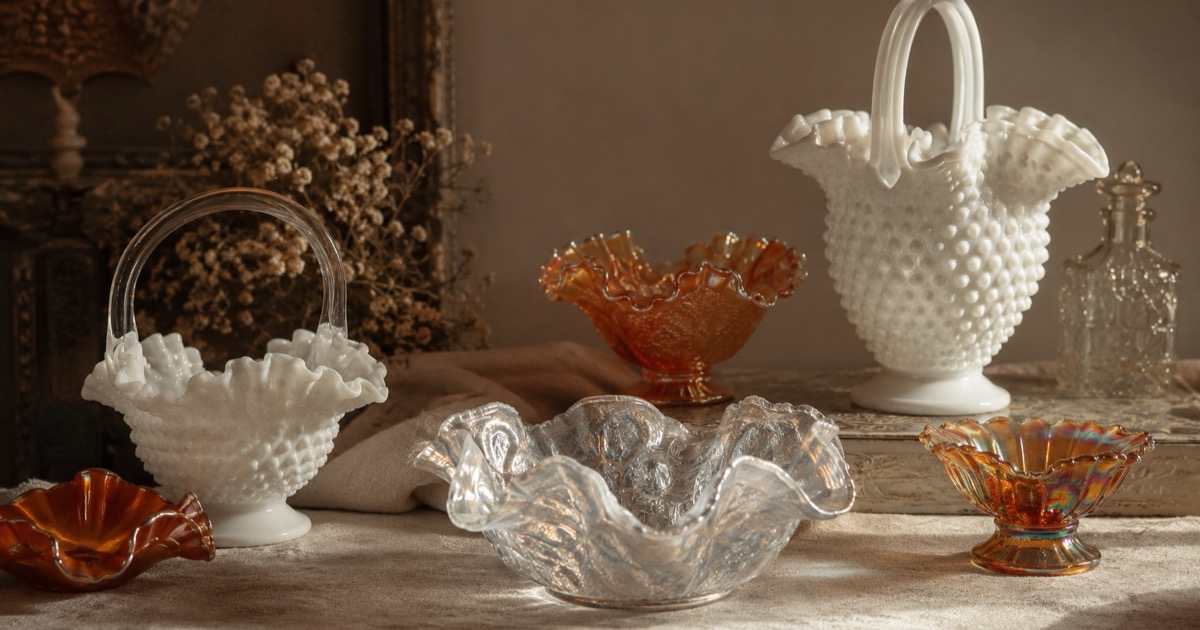
Fenton glass identification starts with understanding that the company’s marking practices changed dramatically over its history, which means the absence of a molded mark does not mean a piece is not Fenton. The West Virginia glasshouse produced art glass from 1905 until it closed in 2011, and for most of that span its pieces left the factory with paper stickers rather than permanent marks. This guide will help you read the marks that do exist, attribute unmarked pieces by form and color, and avoid common confusions.
To identify Fenton glass, check the base for a molded “Fenton” inside an oval, used from about 1970 onward, or the ghost ring of a lost paper label on earlier pieces. The most diagnostic tells are the even, hand-crimped ruffled rim and signature lines like hobnail milk glass. Start by photographing the base and rim against reference examples.
The Fenton Art Glass Company relied on paper labels almost exclusively through the bulk of its production years, so a piece from the 1940s or 1950s may have lost its label decades ago and carry no permanent mark at all. Knowing the physical characteristics of Fenton production — crimped edges, specific color formulas, mold patterns — lets you work without the stamp.
Quick identification checklist
- Check for the molded oval mark reading “Fenton” inside an oval; this appears on pieces made from approximately 1970 onward.
- Look for remnants of a foil or paper label on the base — ghost adhesive rings are common and confirm a label once existed.
- Examine the crimped or ruffled edge: Fenton used very distinctive hand-crimping that creates an even, slightly undulating rim quite different from machine-finished edges.
- Identify the color and pattern combination — certain pairings (hobnail in milk glass, Silver Crest with white crest trim, Burmese pink-to-white shading) are closely associated with Fenton.
- Check the base pontil or mold seam: Fenton hand-finished pieces have specific mold seam characteristics distinct from pressed competitors.
- Compare the color saturation and tone to reference examples — Fenton’s color formulas, particularly in milk glass and carnival glass, have a specific character.
The Fenton marking timeline
Understanding when Fenton used which type of mark is the foundation of attribution.
For most of its history through roughly the late 1960s, Fenton used paper or foil labels rather than molded marks. These labels varied in design over the decades — some collectors can narrow a date range from label style alone — but most surviving pieces have lost them. The company began molding the Fenton name into pieces in an oval frame around 1970, and this became the standard permanent mark. In later decades, decade-indicator marks were sometimes added adjacent to or within the oval mark to help collectors date production, though the specifics varied and should be verified against a current reference for any piece where dating matters for value.
Second-quality pieces sold through the Fenton Gift Shop carry a sandblasted “F” in an oval rather than the molded logo. Do not confuse that with the small molded numeral that can appear beside the oval logo — an 8, 9, or 0 there is a decade marker (1980s, 1990s, 2000s), not a seconds mark. Gift-shop seconds usually have only minor cosmetic flaws.
Signature Fenton product families
Several product lines are so strongly associated with Fenton that they serve as identification anchors even on unmarked pieces.
Hobnail milk glass is perhaps the most recognizable Fenton line. The all-over raised hobnail pattern in dense, opaque white glass was produced in a vast range of forms — baskets, vases, bowls, cruets, covered candy dishes — across multiple decades. Fenton’s milk glass has a warm, slightly creamy opacity distinct from stark-white competitors. The hobnail dots themselves have a specific profile and spacing established by Fenton’s molds.
Silver Crest features a clear or colored glass body with an applied milk-white crest (ruffle) along the rim. The white crest is hand-applied and hand-crimped, giving it a slightly organic variation from piece to piece. Silver Crest was produced for many decades and appears across a wide range of forms.
Carnival glass revival is important context: Fenton was among the original carnival glass producers in the early twentieth century, but also produced a substantial carnival glass revival line from the 1970s onward. Original Fenton carnival glass and revival carnival glass are both legitimate Fenton products, but they differ in age and often in value. Piece form, color, iridescence character, and mold pattern all help place carnival glass in the right era.
Burmese glass, with its distinctive shading from soft yellow to salmon pink, was a Fenton specialty in several periods. Authentic Burmese has a subtle, heat-reactive color transition; reproduction Burmese sometimes shows harsher color breaks.
Attributing unmarked Fenton by form and color
When no mark exists, attribution relies on physical characteristics.
Fenton’s crimped and ruffled edges are among the most reliable identification cues. The hand-crimping process creates a consistent, flowing undulation that differs from the more mechanical appearance of pressed-glass competitors. Examine the rim from a low angle — the rhythm and depth of the crimp is distinctive.
Color is another strong cue, but requires familiarity with Fenton’s specific palette. Colors like Peach Crest (pale peach with white crest), Aqua Crest, and the various opalescent shades were produced in specific formula runs. Comparing an unknown piece to a documented Fenton example in the same color is more reliable than relying on color name alone.
Mold characteristics — the shape, proportions, and surface details of baskets, vases, and bowls — are well-documented in Fenton collector references. Many patterns were used only by Fenton, while others were shared across the industry.
Lookalikes from other glasshouses
Several American glasshouses produced work in similar styles, which creates misattribution risk.
Duncan Miller produced hobnail glass with mold patterns similar to Fenton’s. The hob profiles and base characteristics differ, but the similarity is real and confuses casual buyers.
Westmoreland Glass worked extensively in milk glass with similar form vocabularies. Westmoreland often used its own WG intertwined mark but unmarked pieces circulate widely.
Imperial Glass produced carnival glass in overlapping patterns. Some Imperial and Fenton carnival patterns are easily confused; mold edge detail and iridescence quality differ between the makers.
Generic imported glass from the 1970s onward, particularly from Asia, mimics Fenton colors and forms without approaching the quality of the mold work or the color character. These pieces are often lighter in weight, show less crisp mold detail, and have colors that read slightly off compared to documented Fenton examples.
Watch-outs and common mistakes
- Assuming no mark means no Fenton — the paper label era covers most of the company’s highest-production decades; unmarked pieces are common and expected.
- Confusing the decade mark system with the main oval mark — decade indicators are additions to the main mark, not replacements; their absence on an oval-marked piece is normal.
- Mistaking Westmoreland or Imperial milk glass for Fenton hobnail — the hob profile, glass opacity, and base character differ; use reference images side by side.
- Overlooking the weight and feel — Fenton hand-finished glass has a specific heft and edge smoothness that differs from lighter pressed competitors and modern imports.
- Treating all carnival revival pieces as originals — the carnival revival started around 1970; a piece in a known Fenton carnival pattern is not automatically early-period without additional dating evidence.
Photo tips that improve identification
- Photograph the base flat-on with even light to capture any molded marks, paper label ghosts, or mold seam characteristics.
- Shoot the crimped rim from a low angle against a plain background — the rhythm and depth of the crimp is a key attribution cue.
- For milk glass, photograph in natural daylight against a white background to capture the true opacity and color tone accurately.
- For carnival glass and iridescent pieces, capture the iridescence from multiple angles — the color shift and depth of iridescence differs between makers.
Common questions
Is unmarked Fenton glass worth anything?
Yes, unmarked pieces can be just as collectible as marked ones, because Fenton used paper labels rather than molded marks through most of its highest-production decades. Attribution then rests on physical evidence — the hand-crimped rim, documented color formulas, and known mold patterns. A confident attribution from those features carries real weight with collectors even without a permanent mark.
When did Fenton start marking its glass?
Fenton began molding its name into the glass in an oval frame around 1970; before that, pieces left the factory with paper or foil labels that rarely survive. In later decades a small numeral such as 8, 9, or 0 was sometimes added near the oval as a decade indicator. A sandblasted “F” in an oval marks second-quality pieces sold through the Fenton Gift Shop.
How can you tell Fenton hobnail from other makers’ hobnail glass?
Fenton’s hobnail has a specific hob profile and spacing set by its molds, and its milk glass shows a warm, slightly creamy opacity rather than a stark white. Competitors like Duncan Miller and Westmoreland made similar hobnail and milk glass, but the hob shape, base characteristics, and edge finishing differ. Comparing the piece side by side with documented Fenton reference images is the most reliable check.
Related guides
- Carnival Glass Identification
- Uranium Glass Identification: How to Spot Real Vaseline Glass
- Antique Glass Marks Identification
- Depression Glass Identification
When to use the Antique Identifier app
Photograph the full piece from above and from the side, plus a tight shot of the base and any mark or label remnant. The app can help match form, color, and pattern against documented Fenton lines and flag common lookalikes. For carnival glass revival pieces or any result suggesting a rare color or early-period production, use the app identification as a starting point and verify against a dedicated Fenton reference before drawing value conclusions.