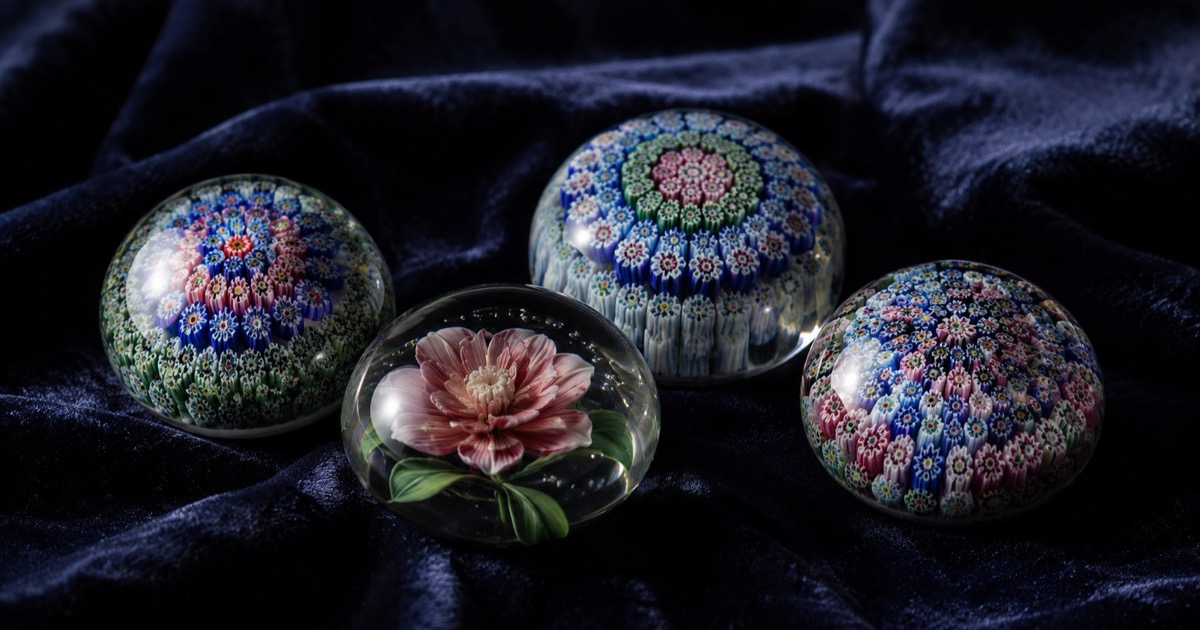
Antique paperweight identification requires working through a layered set of questions: which technique family, which factory or country of origin, which era, and what condition. The classic collecting period for studio-quality glass paperweights runs from roughly the 1840s through the early twentieth century, centered on three French factories—Baccarat, Clichy, and Saint-Louis—plus a range of Bohemian, English, and American makers. Understanding what separates these from later Chinese production and from signed modern studio work is the foundation of the field.
Antique paperweight identification starts with the base and the technique. A fine antique glass paperweight typically shows a polished concave base with a smoothed pontil scar, plus precisely cut millefiori canes or lampwork flowers in exceptionally clear glass. Turn the weight over first: a flat, rough, or unfinished base usually points to Chinese export or modern budget production.
The good news is that these physical properties leave visible evidence. Technique, base treatment, glass clarity, and the specifics of the interior design all contribute to attribution. No single feature closes an identification, but a careful inspection of all of them together narrows the field considerably.
Quick identification checklist
- Examine the base. Classic antique weights typically have a polished concave base (a shallow ground concavity) with a clean, fire-polished or ground pontil scar; Chinese export weights and inexpensive modern pieces often have flat, unfinished, or roughly ground bases.
- Look for canes or lampwork. Millefiori weights contain packed or scattered cross-sections of glass cane bundles; lampwork weights contain three-dimensional flowers, fruit, insects, or figures built from flame-worked glass.
- Check for signature canes. Some Baccarat weights contain a date cane and/or a small cane with the letter B; Clichy weights sometimes contain a small pink-and-white rose cane as a signature motif—but these features are not present in all examples.
- Assess glass clarity and color saturation. Top-tier French weights use exceptionally clear, color-stable glass; Chinese and low-grade modern weights often show a subtle greenish or yellowish cast and less precise cane cutting.
- Measure and weigh. Standard-size antique weights typically fall in the 2.5–3.5 inch diameter range; miniatures are under about 2 inches; magnums are above 3.5 inches. Substantial weight for size is a positive sign.
- Inspect for condition issues. Surface scratches, internal bruises (shock fractures), and grinding marks from past repairs all affect value significantly.
The three French houses and their signatures
The mid-nineteenth century “golden age” of French paperweights, roughly the 1845–1880 period, produced the pieces that still define what collectors mean by a fine antique weight.
Baccarat is known for crisp, precisely cut millefiori canes and for a range of lampwork subjects including flowers, insects, and snakes. Some weights include a date cane—a cane within the design that encodes a year in small numerals—and in certain examples a cane bearing the initial “B.” The presence of a date cane is a significant feature, though not all genuine Baccarat weights have one, and the absence does not rule out attribution.
Clichy is associated with exceptionally rich, saturated colors, swirl weights, and the famous “Clichy rose”—a cane made to resemble a small pink-and-white cabbage rose. The presence of the rose cane is widely cited as a Clichy signature, though it appears in only a portion of their output and should be taken as one piece of evidence rather than proof. Clichy used a distinctive soft, slightly warm glass that reads differently from Baccarat’s cooler clarity.
Saint-Louis worked in lampwork and millefiori and is known for overlay weights (opaque or lattice glass cut with windows to reveal the interior) and for mushroom weights with a gathered bundle of canes. Saint-Louis weights tend toward warmer color palettes than Baccarat.
Attribution to a specific factory without documentary evidence or established provenance should always be described as tentative. Expert opinion and auction-house specialist review are the appropriate escalation for high-value attributions.
Technique families
Understanding technique helps narrow both origin and era before you ever look at a mark.
Millefiori (Italian for “thousand flowers”) weights pack cross-sections of complex glass canes into a pattern. Close-pack millefiori fills the entire dome footprint; scattered millefiori places individual canes with space between them, often on a colored or lattice ground. The precision of cane cutting, the complexity of individual cane design, and the quality of the encasing glass all vary by factory and period.
Lampwork weights contain elements built up by a glass artist at a flame rather than assembled from cane cross-sections. Classic lampwork subjects include roses, pansies, clematis, strawberries, pears, snakes, butterflies, and lizards. The three-dimensionality of a well-made lampwork subject—petals with individual shaping, leaves with veining—is distinctly different from flat millefiori. French lampwork of the classic period shows a naturalness and precision that is difficult to match in later commercial production.
Sulphide weights encapsulate a white ceramic portrait medallion within clear glass. The subjects are typically historical figures, monarchs, or notable persons. The clarity of the glass and the quality of the ceramic portrait vary considerably.
Profile, base, and dome cues
The physical form of a paperweight carries attribution information independent of its interior design.
The dome profile affects magnification: a higher dome magnifies the interior design more dramatically. Classic French weights use carefully proportioned domes that give the interior a focused, jewel-like presentation. The underside typically shows a polished concave base that serves both visual and functional purposes—it reduces the contact area with the desk surface.
The pontil (the point where the gather of glass was attached to the glassblower’s rod) leaves a mark at the center of the base. In antique weights this is usually ground smooth and polished into the concavity; a rough or sharp pontil scar suggests a piece that was not finished to fine standards. Some weights have a completely flat polished base, which is also a legitimate finishing approach, particularly in certain English and American examples.
The diameter conventions noted above (miniature under 2 inches, standard 2.5–3.5 inches, magnum above 3.5 inches) apply to the classic French period; later and non-French pieces do not always follow these conventions.
Chinese weights and modern studio glass
Chinese export paperweights have been produced in volume since at least the mid-twentieth century. They range from obvious tourist pieces to surprisingly competent millefiori work. The distinguishing factors typically include glass with a faint warm or greenish tint, canes with somewhat less crisp cross-sections, flatter or rougher bases, and slightly softer color saturation. They are not necessarily unattractive, but they have modest collector value compared to fine French antique examples.
Modern studio glass is a distinct collecting category. Artists including Paul Stankard, Debbie Tarsitano, Chris Buzzini, and many others have produced signed, dated studio weights from the 1960s onward that are collected on their own merits. These pieces are usually signed and dated on the base—often with a flame-worked signature cane or an engraved signature—and they represent contemporary craftsmanship rather than antique examples. High-quality studio weights can be extremely valuable as contemporary art objects; the key is that they are sold and collected as such, not as nineteenth-century French production.
Condition
Condition affects paperweight values dramatically and nonlinearly. The primary condition issues are:
Surface scratches accumulated from use on a desk. Fine scratches diffuse the surface but do not affect the interior. Polishing can remove surface scratches but reduces the diameter and changes the dome profile—and an experienced eye can detect polished weights by the altered proportions.
Bruises are internal shock fractures caused by impact. They appear as white or silvery fractures within the glass and are not repairable. A bruised weight is significantly reduced in value regardless of the interior’s quality.
Grinding refers to post-production work done to remove damage from the surface or base. The tell is a flat spot or altered profile when viewed from the side, or a base that appears mechanically abraded rather than polished.
Watch-outs and common mistakes
- A date cane is supporting evidence, not authentication. Reproductions can include canes that look like date or initial canes; consistent quality throughout the piece is the stronger indicator.
- “Clichy rose” canes appear in some non-Clichy pieces. The motif was imitated; a single rose cane in an otherwise inconsistent piece should prompt skepticism.
- Modern studio weights look superficially similar to antique weights. A signed and dated base tells you it is modern production; this is not a flaw—it is just a different collecting category.
- Small flat base with rough center is a red flag. Quality antique weights have finished bases; an unpolished or flat-ground base with a rough center usually indicates low-grade production.
- Polished weights look perfect but may have altered profiles. View the dome silhouette from the side and compare to unpolished examples of the same type before assuming a pristine surface indicates original condition.
Photo tips that improve identification
- Photograph the base straight on. The base finish, pontil treatment, and any base marks or signatures are often the most diagnostic features; a clean perpendicular shot with diffuse lighting captures all of them.
- Shoot the dome from the side. The profile reveals the dome height and whether proportions are consistent with the claimed factory and period, and shows any flat spots from polishing.
- Capture the interior design from directly above. This shows the pattern layout, cane arrangement, and any date or initial canes; use a dark matte background to reduce reflections from below.
- Use close focus for cane details. Individual cane cross-section complexity and the precision of cutting are key to factory attribution; a tight shot of a representative area of millefiori or a lampwork petal reveals quality differences clearly.
Common questions
How can you tell if a glass paperweight is antique or modern?
Start with the base and the glass itself. Antique weights from the classic period typically have a polished concave base with a smoothed pontil area and exceptionally clear, color-stable glass. A signed and dated base indicates modern studio work, while a flat, rough, or unfinished base with a faint greenish or yellowish glass cast usually points to Chinese export or low-grade modern production.
What does a date cane in a paperweight mean?
A date cane is a small cane within the design whose cross-section shows a year in tiny numerals, a feature found in some Baccarat weights of the classic period. It is supporting evidence, not proof: reproductions can include canes that imitate date or initial canes, and many genuine antique weights have no date cane at all. Judge the overall quality of the canes and glass alongside it.
Are unsigned glass paperweights worth anything?
Often, yes. Most antique French weights from the classic period carry no signature at all, and attribution rests on cane style, color palette, profile, and base finish rather than a mark. Quality is what matters: crisp canes, clear glass, and a properly finished base can indicate a valuable weight, while a signature mainly distinguishes modern studio work from antique production.
Related guides
When to use the Antique Identifier app
Photograph the full weight from above to show the pattern, a side profile to show the dome, and the base straight on. The app can cross-reference the technique type, color palette, and profile against documented examples to suggest likely factory and era—useful for narrowing down before you invest in specialist consultation. For weights with potential high value, follow up with a specialist dealer or major auction house’s glass department, where hands-on examination remains the standard.