


Pontil Mark Identification: Reading the Scar on a Bottle Base
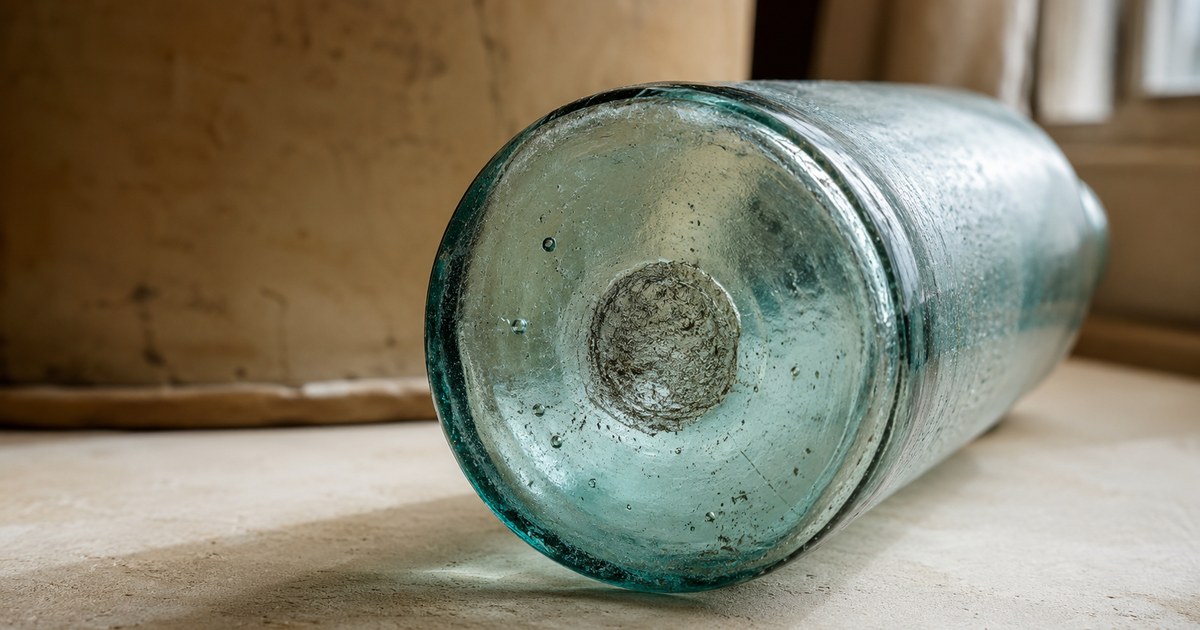
You have turned a bottle over and found a rough circular scar on the base, and now you want to know whether that scar is a pontil mark. Pontil mark identification is narrower than it sounds: it is not a way to date a bottle, and it is not a general test of age. It answers exactly one question, whether the bottle was formed by hand on a blowpipe or produced by a machine, and the reason it matters is that most people asking the question are actually looking at a machine-made base mark and do not know it yet.
A pontil mark is the scar left where an iron rod was attached to a bottle’s base to hold it while the lip was finished, then snapped away. It appears only on handmade, mouth-blown glass, never on machine-made containers. Finding one rules out machine production and generally points to a bottle made before about 1865, with exceptions.
Quick identification checklist
- Is the scar centered and roughly circular? Both real pontils and the machine marks confused with them sit near the base center, so position alone settles nothing.
- Is the glass in the scar broken or shaped? A true pontil is raw fractured glass or an iron residue deposit. Machine marks are smooth, molded, and finished.
- Is there a seam running up the side and over the lip? A mold seam that continues all the way through the finish means machine-made, which rules a pontil out completely.
- Is there a full circle ring rather than a scar? A continuous, even circular ring impressed into the base is characteristic of one type of machine bottle, not of a pontil.
- Is there a small circular disc or button in the base center? That is a valve mark, a machine feature, and it is one of the most frequently misread bases there is.
- Would it cut you? Open pontils are sometimes sharp enough to catch a fingertip. That is suggestive rather than decisive, since an early Owens scar can also feel rough, so confirm with the side seam.
- Does the rest of the bottle agree? The lip, the seams, and the glass character all have to be consistent with hand production before the scar means anything.
What a pontil mark actually is
In hand production, the glassblower forms the body of the bottle on a blowpipe, but the lip has to be finished after the blowpipe is removed. To hold the bottle during that step, a worker attached an iron rod, the pontil, to the base. When the finish was complete the rod was snapped off, and what it left behind is the scar.
That mechanism is the whole explanation for every characteristic of the mark. It sits on the base because that is where the rod touched. It is circular because the rod was round. It is rough because the separation was a fracture rather than a cut. And it is absent from machine bottles because machines never needed to hold the bottle that way.
Open or broken pontil. A circular scar of raw, broken glass, sometimes sharp enough to cut a finger. These are generally found on bottles made before about 1865, with exceptions.
Iron, improved, or graphite pontil. A usually circular black or reddish deposit left by iron residue transferred from the rod. The rough window is about 1845 to circa 1863, again with exceptions on both ends.
Smooth base with no pontil. The pontil rod was gradually phased out around the time of the American Civil War, when the snap case tool came into use. The snap case gripped the bottle without touching the base, so it left no scar at all.
The three marks people confuse: pontil, Owens scar, valve mark
This is the part that decides most identifications, and it is nearly absent from the pages that rank for this topic. Machine-made bottles carry their own base marks, and two of them are misidentified as pontils constantly.
A pontil scar is raw, broken, irregular glass, or a dark iron deposit, on a base that shows no machine characteristics anywhere. The break is uneven because it is a fracture. Under a fingertip it reads as sharp or gritty rather than as a molded shape.
An Owens scar comes from the automatic bottle machine’s suction process, where a knife shears the glass as the blank mold fills. It presents as a circular ring or arc on the base, often a full circle and usually somewhat off center. Do not expect it to be smooth. The diagnostic trait is feathering around the edge of the ring, where the cut dragged the glass, and scars from the earlier machines running from about 1905 into the 1920s can be distinctly rough. What separates it from a pontil is that the glass was cut and dragged rather than snapped, so you see feathering rather than a fracture. A bottle carrying one is machine-made by definition, which places it in the twentieth century.
A valve mark is a small circular disc or button impressed into the base center, left by a valve or ejector pin in a machine mold. Like the Owens scar it is smooth and molded, and it is often mistaken for a pontil precisely because it is a distinct circle in the middle of the base.
The test that resolves all three is the side seam, and you should run it first. Look up the side of the bottle. If a mold seam runs continuously up the side and across the lip, the bottle is machine-made and the base mark is not a pontil, no matter how rough it looks. Pontil marks occur only on mouth-blown glass, and the two categories do not overlap. Texture is the secondary check, and it is more subtle than most guides admit: a pontil is snapped glass or a gritty iron deposit with a genuine fracture surface, while a rough Owens scar shows feathering from a cut. Roughness alone settles nothing. The seam does.
Sand pontils, which leave a rougher, granular impression, add a fourth possibility and are the one type most likely to be genuinely ambiguous. Even there, the seam check usually settles it.
What a pontil mark does and does not tell you
It does tell you the bottle was mouth-blown. That is a real and useful conclusion, and it is the only one the scar delivers on its own.
It does not date the bottle to a decade. The published ranges you will find are approximations that disagree with each other, and the most careful sources hedge deliberately: before about 1865 for open pontils, roughly 1845 to circa 1863 for iron pontils, with explicit exceptions on both ends. A scar narrows a bottle to a broad period. It does not place it in the 1850s.
It does not prove age at all. A genuine pontil scar proves hand-blown manufacture, not antiquity. Studio and art glass made last month can carry a real one, because the technique never disappeared, it simply stopped being how commercial bottles were made. If someone hands you a “pontil, therefore antique” argument, the reasoning skips a step.
It does not stand alone. The scar is one piece of evidence and has to be read alongside the finish, the seams, the glass color and character, and the embossing. For the full dating checklist, work through How to Identify Old Bottles, which covers the whole sequence properly. This guide is deliberately about one base feature and nothing more.
Reproductions and faked scars
Some modern bottles carry deliberately molded or convincingly jagged imitation pontil scars, applied because the market rewards the look. The tells are consistent with fakery generally: a scar that repeats identically across multiple examples of the same bottle is molded rather than broken, since real snap breaks are individual. A “scar” with rounded, fire-polished edges was formed, not fractured. And any pontil-looking base on a bottle whose seams run over the lip is decorative rather than functional.
Reproduction bottles reproduced from period originals are common in categories with collector demand, particularly bitters, flasks, and figural bottles. Base features alone are never enough on those.
Watch-outs and common mistakes
- Calling every rough base a pontil. Base wear, manufacturing chill marks, and use damage all produce roughness that is not a pontil scar.
- Ignoring the side seams. The seam running over the lip is the fastest disqualifier there is, and checking it takes two seconds.
- Reading a full circular ring as a pontil. An even, continuous ring in smooth glass points to machine suction, not to a broken rod.
- Reading a center button as a pontil. That is a valve mark, and it means machine-made.
- Treating a hedged date range as precise. Sources conflict, and the honest ranges are broad with exceptions at both ends.
- Assuming hand-blown means old. It means hand-blown. Contemporary studio glass carries genuine pontils.
- Cleaning the base before photographing it. Iron pontil residue is a dark deposit that scrubbing can remove, taking the diagnostic evidence with it.
Photo tips
- Shoot the base straight down, filling the frame. The scar is the subject, so nothing else needs to be in the picture.
- Light it from a low side angle. Raking light throws shadows into the base and makes the difference between a fracture and a feathered machine cut readable. Flat overhead light flattens both into the same gray circle.
- Set the bottle on a plain dark surface. Glass photographs badly against pattern or clutter, and a dark background stops light bouncing back through the base.
- Take a second photo of the lip and the seam. The finish and where the seam stops are what confirm or overturn the base reading, so they belong in any set of identification photos.
- Add a scale reference. A coin or ruler beside the base establishes the diameter of the scar, which helps distinguish a large snapped-rod scar from a small valve button.
Common questions
Does a pontil mark mean my bottle is antique?
Not by itself. A pontil scar proves the bottle was mouth-blown rather than machine-made, which is a different claim from age. On a commercial bottle it generally points to production before about 1865, but hand-blown techniques are still in use today, so studio and art glass made recently can carry a genuine pontil. Confirm age through the finish, seams, and glass character.
How do I tell an Owens scar from a pontil mark?
Check the side seam first. If a mold seam runs up the side and over the lip, the base mark is machine-made and cannot be a pontil, whatever it feels like. On the base itself, an Owens scar is a circular ring or arc left by the machine’s suction cut, and its giveaway is feathering around the edge rather than a clean break. A pontil is snapped glass or a dark iron deposit with a true fracture surface. Early Owens scars can be rough, so do not rely on roughness by itself.
What is the small circle in the middle of my bottle base?
If it is a smooth, slightly raised or recessed disc, it is most likely a valve mark left by an ejector in a machine mold, which places the bottle in the machine-made era. Pontil scars are rough and broken rather than neatly circular and smooth, and they never appear on machine-made containers.
Related guides
- How to Identify Old Bottles
- How to Tell If Glass Is Antique
- Antique Mason Jar Identification: Dating Ball, Atlas, and Kerr Jars
- Imperial Glass Marks: Identifying IG, LIG, and Unmarked Pieces
When to use the Antique Identifier app
Photograph the base straight down in raking light, then the lip and the side seam. Those three images are what separate a real pontil from an Owens scar or a valve mark, and they are also what the app needs to place the bottle: it reads the base feature, the finish type, and any embossing together rather than treating the scar in isolation. That points you toward a manufacturing method and a plausible period in one pass, which is the right foundation before you start researching what the bottle is.
Topics