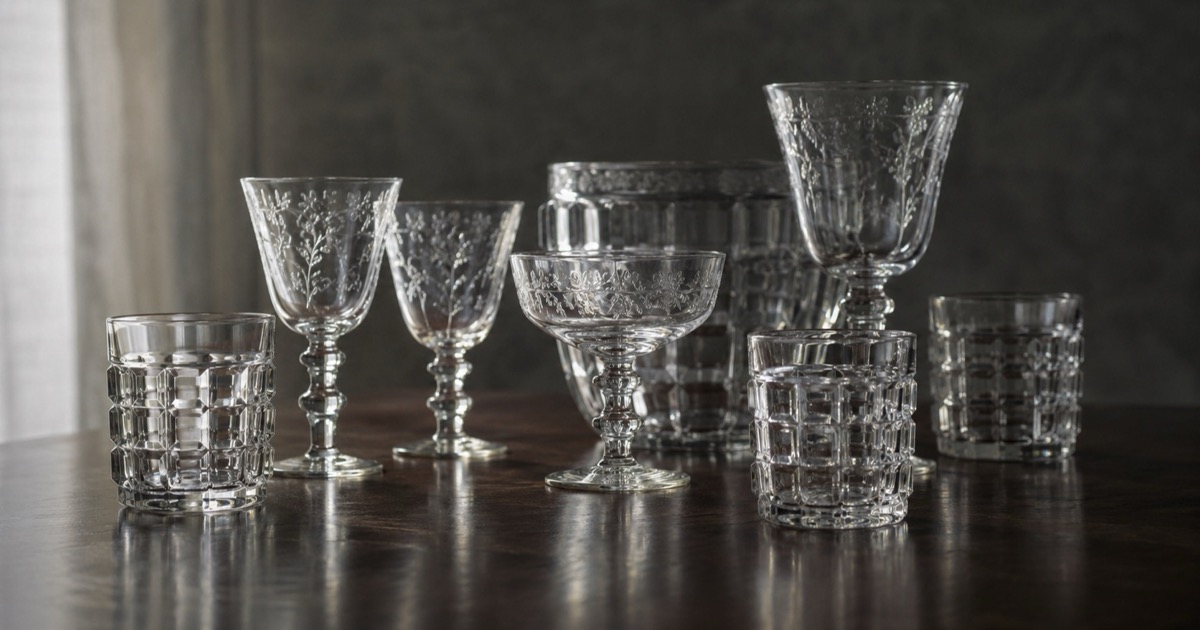
Fostoria glass patterns span nearly a century of American production, and identifying them correctly requires understanding where Fostoria sat in the market: above the cheaper machine-pressed depression glass sold at dime stores, but accessible enough to stock department store bridal registries for generations. That middle position — quality handmade glassware at a reachable price — is exactly what collectors now call “elegant glass,” and Fostoria was one of its defining makers.
Fostoria glass patterns are identified by sight, not marks: most pieces carried only a paper label, so start by noting whether the piece is pressed — sharp, crisp cube blocks signal the flagship American pattern — or acid-etched stemware like Navarre or Chintz, then match your photos against the Fostoria Glass Society’s documented pattern records.
This guide covers how Fostoria glass patterns are identified, from the American cube pattern and its many imitators to the delicate etched stemware lines that defined Fostoria’s reputation, and explains why the absence of a permanent mark is normal rather than suspicious.
Quick identification checklist
- Look for a paper oval label — Fostoria used paper labels most of the time, and they are often missing on older pieces.
- On pressed patterns, examine the sharpness and clarity of the mold details: Fostoria’s quality control was high, and fine detail should be crisp.
- On American pattern pieces, check the seam quality and the geometry of the cubes — legitimate Fostoria pieces have consistent, sharp-edged blocks.
- On etched stemware, look at the back of the stem and foot for the shape of the blank, which sometimes helps place a pattern.
- Check for the Lancaster Colony name or a plain paper label on pieces made after Fostoria was acquired in the 1980s.
- Compare against a reference: the Fostoria Glass Society of America maintains documented pattern records that are the standard resource for collectors.
Fostoria as elegant glass
Fostoria Glass Company operated from 1887 until its acquisition by Lancaster Colony Corporation in 1983. Unlike depression glass — thin, mass-produced, often sold as premiums or at dime stores — Fostoria’s output was handmade in molds by skilled glassworkers and sold through department stores. Elegant glass generally shows finer detail, heavier feel, and better clarity than machine-made contemporaries.
Fostoria produced a vast catalog — more than 300 documented patterns. Serious identification usually requires a reference book (the Weatherman Fostoria guides and the Fostoria Glass Society resources are the collector standards) because many patterns share broad visual similarities.
The American pattern and the lookalike problem
Fostoria’s American pattern, introduced in 1915 and produced for decades, is probably the best-known pressed glass pattern in American collecting. Its design consists of repeating cubes or “brilliant” blocks covering the entire surface, giving pieces a faceted, cut-glass appearance at a fraction of the price of actual cut glass. It was produced in an enormous range of forms: tumblers, pitchers, platters, vases, cake stands, punch bowls, and scores of serving pieces.
The popularity of American spawned numerous imitations. The most commonly encountered is Whitehall, made by Indiana Glass. Distinguishing American from Whitehall and other lookalikes requires close attention: Fostoria’s American tends to have very sharp, well-defined cube edges and consistently high mold quality. Imitators often show softer cube edges, slight variations in the ray pattern at the base, and differences in seam placement or glass clarity. Direct comparison against a documented reference — the Fostoria Glass Society has published comparison guides specifically for this purpose — is the most reliable method.
American was produced almost entirely in crystal (clear glass): pieces in color claiming to be Fostoria American warrant extra scrutiny.
Etched patterns: Chintz, Navarre, Romance, and others
Fostoria’s etched lines are among its most collected and most elegant. These patterns were created by applying acid or needle etching to blown or mold-blown blanks, leaving a frosted design against clear glass. The result is considerably more delicate in appearance than pressed patterns.
Chintz (introduced around 1940) features a flowing floral and scroll design and became one of Fostoria’s most popular etchings, found on stemware and serving pieces. Navarre (introduced around 1936) uses a more elaborate baroque floral scroll and is frequently encountered on the market. Romance (introduced around 1942) uses a lighter floral design on stemware and serving pieces.
Because etching is applied to the blank after forming, the same pattern can appear on different blank shapes. Identifying the etching name and the blank name are often separate research tasks.
Colors and production eras
Fostoria worked in a wide range of colors across its history, and color can help date a piece. Azure (a medium blue), Ebony (opaque black), Orchid, and Topaz were among the colors popular during the 1920s and 1930s. Milk glass production continued into later decades. Some colors were only produced for short windows, making color a useful narrowing clue when combined with pattern research.
Later production under Lancaster Colony maintained many of the Fostoria patterns, and pieces made during this period are often encountered. Lancaster Colony pieces may carry different labels or no label at all, and collector opinion on their relative desirability varies.
The paper-label reality and a pattern lookup workflow
Most Fostoria pieces left the factory with only a paper oval label. These labels do not survive washing, decades of use, or storage. Finding a piece with its original label intact is a bonus, not an expectation. The practical consequence is that most Fostoria identification relies on pattern recognition from reference materials, not marks.
A workable identification workflow: (1) note the overall construction type — pressed or etched blown glass; (2) photograph the pattern in detail, including any base rays or foot construction; (3) search the Fostoria Glass Society pattern index or a documented reference book; (4) compare against known examples, paying attention to the specific mold details that distinguish Fostoria from competitors. For etched patterns, identifying both the etching and the blank shape gets you to a definitive pattern name.
Watch-outs and common mistakes
- Assuming any cube-pattern glass is Fostoria American. Indiana Glass’s Whitehall and several other producers made similar patterns. Compare cube sharpness, ray patterns, and seam quality carefully before attributing.
- Expecting a permanent mark. The vast majority of Fostoria has no etched, molded, or stamped maker’s mark. Absence of a mark is normal, not suspicious.
- Confusing Lancaster Colony production with pre-acquisition Fostoria. Post-1983 pieces are Fostoria patterns but made under different ownership. Most collectors draw a distinction, and prices often reflect it.
- Overlooking condition. Fostoria crystal chips and scratches from normal use. Fine utensil marks in the base of serving pieces reduce value. Check under strong light.
- Misreading pattern names. Fostoria’s catalog used internal names that do not always match what dealers or online listings call things. A reference book with photographs is far more reliable than name-matching alone.
Photo tips that improve identification
- Photograph pressed patterns against a black or dark background with a single side light source to make the cube or pattern relief read clearly.
- For etched patterns, use a plain white or light grey background with diffuse light — raking light will create glare on the frosted etching.
- Shoot the base and foot separately to capture any ray patterns, pontil marks, or mold seam placement.
- If a paper label is present, photograph it flat under even light before handling further, as they are fragile and irreplaceable.
Common questions
How can you tell Fostoria American from Whitehall?
Compare the cubes. Fostoria’s American pattern has very sharp, well-defined cube edges and consistently crisp mold detail, while Indiana Glass’s Whitehall and other imitators tend to show softer edges, slight variations in the ray pattern at the base, and differences in seam placement or clarity. American was made almost entirely in clear crystal, so colored “American” pieces deserve extra scrutiny.
Is Fostoria glass marked on the bottom?
No, the vast majority of Fostoria carries no etched, molded, or stamped maker’s mark. Pieces left the factory with only a paper oval label, which rarely survives washing and decades of use. An unmarked piece is therefore completely normal for Fostoria, and identification relies on matching the pattern and blank shape against documented references instead.
Is Fostoria glass worth anything today?
It depends heavily on pattern, form, color, and condition. Common American pattern tumblers and plates survive in quantity and bring modest prices, while large or unusual serving forms, short-run colors, and popular etchings such as Navarre and Chintz attract stronger collector demand. Chips, scratches, and utensil marks reduce value, so check pieces under strong light before comparing against sold examples.
Related guides
- Depression Glass Patterns Identification
- How to Identify Pressed Glass Patterns
- Waterford Crystal Marks Identification
When to use the Antique Identifier app
Photograph the whole piece plus tight shots of the pattern details, base rays, and any labels. The app can help match the visual pattern to known Fostoria lines or flag similar elegant glass producers quickly, narrowing your research before you dig into reference books. For pieces that look significant — rare colors, documented etchings in unusual forms — treat the app’s identification as a prompt to verify against a specialized Fostoria reference rather than a final attribution.