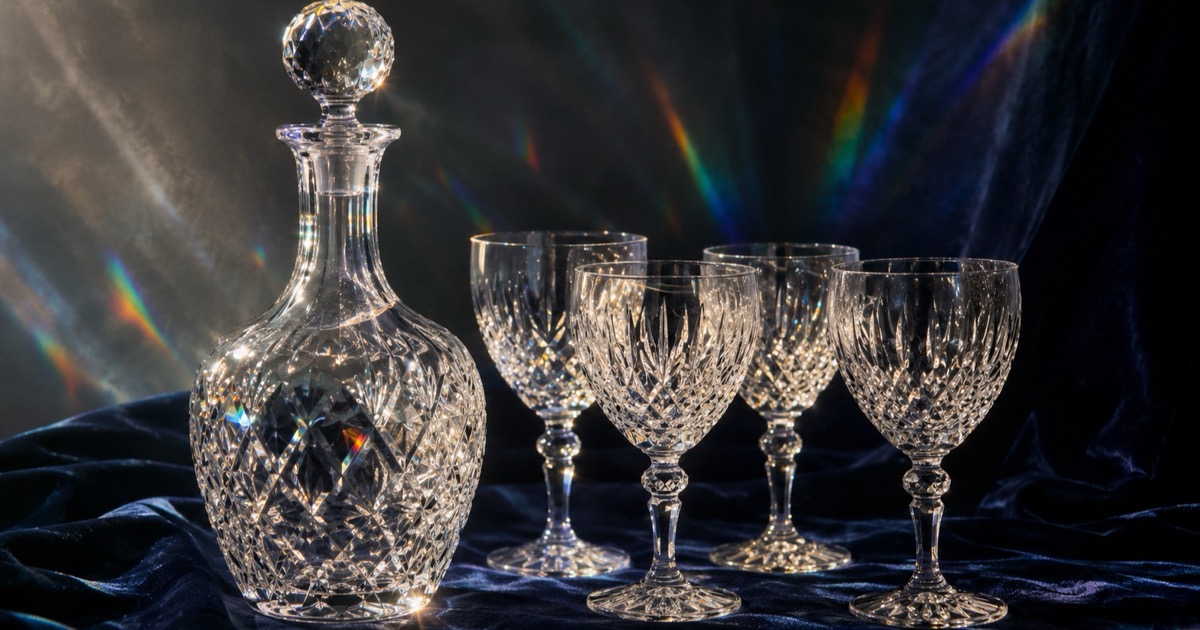
Waterford crystal marks identification is a question that comes up constantly at estate sales, because the brand is recognizable enough that buyers reach for it and sellers ask about it — yet the mark that most people think of as old is actually a product of a mid-20th century company revival, not the Georgian-era original. Knowing what you are actually looking at makes the difference between a sound purchase and an inflated price paid for ordinary cut glass.
Genuine Waterford crystal carries a subtle acid-etched “Waterford” mark on the base — a frosted, barely visible inscription rather than a bold stamp — sometimes accompanied by a small seahorse logo. To find it, tilt the base toward a strong light at an angle; if no etched mark appears, the piece is likely another maker’s cut glass.
This guide will walk you through the acid-etched mark on the base, the seahorse logo and paper labels that complement it, how to identify the most popular patterns, what genuine lead crystal feels and sounds like, and which condition problems cut value most significantly.
Quick identification checklist
- Tilt the base toward a light and look for a fine acid-etched “Waterford” script or “Waterford Crystal” mark — it should be barely visible, not boldly stamped.
- Check for a small seahorse figure etched or printed near the base mark on pieces from certain production periods.
- Look for a paper label on the interior or base — these appear on newer pieces and sometimes on older ones that were never sold or were lightly used.
- Hold the piece up and tap the rim gently; a sustained musical ring is consistent with lead crystal.
- Check heft — lead crystal is noticeably heavier than modern soda-lime glass of the same size.
- Turn the piece in light and look for prismatic rainbow dispersion from the cut facets, which is more pronounced in lead crystal than in non-lead alternatives.
The modern Waterford mark and what “old Waterford” actually means
The original Waterford Glass House in Ireland operated from the late 18th century until the 1850s, when it closed. That original operation made fine Irish cut glass for a few decades, and genuinely old pieces from that era are rare, typically unmarked, and firmly in specialist and auction-house territory. If someone is selling you “antique Waterford” at an estate sale, it is almost certainly not from the original pre-1850 operation unless the provenance is impeccable and a specialist has confirmed it.
The company was revived in Waterford, Ireland in the mid-20th century. Production from the revived company is what virtually all collectors encounter. The defining mark is an acid-etched word — typically “Waterford” in a Gothic or script font — applied to the base of each piece. This mark is intentionally subtle: you need to angle the base against light to read it clearly. It is not impressed into the glass and not deeply engraved; the acid process creates a frosted, barely-there inscription.
This mark was introduced by the revived company and serves as the standard authentication point for pieces from that production era onward. Its presence is strong evidence the piece came from the Waterford factory, but it does not make the piece old — it makes it genuine Waterford from the modern production period.
Seahorse logo and paper labels
The Waterford seahorse is the company’s heraldic symbol, drawn from the crest of Waterford city. It appears in various forms: as a small acid-etched figure near the base mark, printed on paper labels, and on swing tags and boxes. A paper label with the seahorse is common on pieces that were sold but never heavily used; the label is helpful evidence but not definitive authentication on its own, since labels can be transferred. The seahorse etching adjacent to the “Waterford” base mark is harder to fake and more meaningful.
Boxes and certificates accompany some pieces, particularly limited editions and presentation items. Original boxes with matching paperwork help document specific patterns and production periods, but the base mark is always the primary identification tool.
Pattern identification: Lismore and beyond
Waterford has produced dozens of patterns over its modern production run. The most famous and widely collected is Lismore, introduced in the mid-20th century and still in production in various forms. Lismore is defined by its combination of diamond cuts and a vertical wedge cut that creates a bright, busy surface with a slightly medieval castle window feel. It appears on nearly every form — tumblers, wine glasses, decanters, bowls, vases — and is the pattern most likely to turn up at estate sales and in thrift stores.
Other well-known patterns include Colleen, Alana, Powerscourt, and Millennium. Most patterns use geometric cut work — diamonds, wedges, and vertical cuts in various combinations — rather than floral or naturalistic engraving, which is more typical of Bohemian and continental European crystal. Identifying a specific Waterford pattern usually requires matching the cut geometry to reference images or the company’s own published pattern guides.
Lead crystal cues: heft, ring, and light
Waterford’s traditional production used a high-lead-content crystal formula. The practical result is a set of physical properties that distinguish it from ordinary glass. Weight is the first cue: pick up a Waterford tumbler and a similar soda-lime glass tumbler of the same size side by side, and the Waterford is substantially heavier. This heft comes from the lead oxide content in the glass batch.
The second cue is the ring: tap the rim of a lead crystal glass with a fingernail or a pencil and it produces a sustained, bell-like tone that decays slowly. Ordinary glass produces a flat, brief clink. The third is light dispersion: lead crystal’s higher refractive index bends light more dramatically than soda-lime glass, creating vivid prismatic rainbow flashes from cut facets. A piece that passes all three tests — heavy, rings clear, disperses light strongly — is consistent with genuine lead crystal.
Note that environmental and regulatory concerns have led some producers, including Waterford for certain product lines, to shift toward lead-free crystal formulas. These newer pieces are genuine Waterford but are physically different from the classic lead-content production.
Lookalike cut crystal
Other cut crystal houses — Irish, Czech Bohemian, German, and American — made and still make high-quality cut glass that resembles Waterford both in style and quality. Pieces from makers such as Tyrone Crystal, Galway Crystal, and Bohemian factories can be visually similar and sometimes appear at estate sales without marks. The acid-etched “Waterford” mark is not present on any of these — that mark is specific to the Waterford factory. Unmarked cut crystal of comparable quality may be genuine heavy lead crystal from another maker, which carries its own value, but it is not Waterford.
Pressed glass that imitates cut patterns is a different matter. Pressed glass shows the mold seam line, softer edges on the cuts, and less brilliance. Under close inspection the facets on pressed glass lack the sharp arrises — the crisp ridges — that wheel cutting produces.
Condition: rim chips, cloudiness, and dishwasher damage
Waterford crystal is durable but not indestructible. The most common condition issues are rim chips — tiny flakes from the top edge of glasses and bowls, often barely visible at casual glance but felt immediately when running a finger around the rim. Even minor chips reduce value significantly and can be a safety issue. Check every piece around the full rim at eye level with good light.
Cloudiness is the second major issue. Lead crystal that has been washed repeatedly in a dishwasher develops a permanent, milky haze caused by alkaline detergent etching the glass surface. This cloudiness cannot be polished out and is considered irreversible. It reduces value considerably for decorative pieces and renders drinking vessels less desirable. Hand washing with mild soap is the correct care for crystal.
Interior staining from wine or floral water, lime deposits from tap water, and scratches from silverware contact are all common and range from minor to significant depending on severity.
Watch-outs and common mistakes
- Assuming “no mark” means pre-revival and therefore antique — genuine pre-1850 Waterford is almost always unmarked, but so is every other cut glass piece without a mark.
- Confusing a paper label as the primary authentication; the acid-etched base mark is what counts.
- Paying premium prices for a Lismore piece with rim chips — chips are common and dramatically affect value.
- Buying cloudy, dishwasher-damaged crystal expecting the haze to polish out; it does not.
- Treating any heavy, ring-worthy cut glass as automatically Waterford — other quality makers exist.
Photo tips that improve identification
- For the base mark, angle the piece at roughly 45 degrees under strong directional light and photograph the base flat — the frosted acid etch will appear more clearly than in head-on flash.
- Photograph the full cut pattern on the body of the piece from straight on in even daylight to show the cut geometry clearly.
- Capture a rim shot at eye level in raking light to reveal any chips along the edge.
- Hold the piece near a window and photograph it with backlighting to show any interior cloudiness or staining.
Common questions
Where is the mark on Waterford crystal?
On the base. The mark is acid-etched — a frosted “Waterford” in script or Gothic lettering that is deliberately subtle, not stamped or deeply engraved. Tilt the base at roughly 45 degrees toward a strong light and rotate the piece slowly; the etching catches the light and becomes readable. Some pieces also show a small seahorse etched near the name.
Is Waterford crystal without a mark real?
Pieces from the modern Waterford factory carry the acid-etched base mark, so an unmarked piece is most likely quality cut glass from another maker. Genuine pre-1850 Waterford from the original glass house is typically unmarked, but it is rare, hard to attribute, and firmly specialist territory — an unmarked piece at an estate sale should not be assumed to be it.
How can you tell Waterford from other cut crystal?
The acid-etched base mark is the deciding evidence, since makers such as Tyrone, Galway, and the Bohemian factories produced visually similar cut work. Weight, a sustained ring when the rim is tapped, and strong prismatic light dispersion confirm lead crystal in general, but they confirm quality, not brand. Matching the cut geometry to a documented Waterford pattern such as Lismore adds support.
Related guides
- How to Tell the Difference Between Pressed Glass and Cut Glass
- How to Tell If Cut Glass Is Antique
- Antique Glass Marks Identification
When to use the Antique Identifier app
Photograph the full piece and then a close-up of the base mark angled under light. The app can help match the cut pattern to known Waterford patterns and flag non-Waterford lookalikes quickly. For pieces without a clear base mark that might be pre-revival or from another quality maker, treat any identification as a starting point and seek specialist confirmation before significant money changes hands.