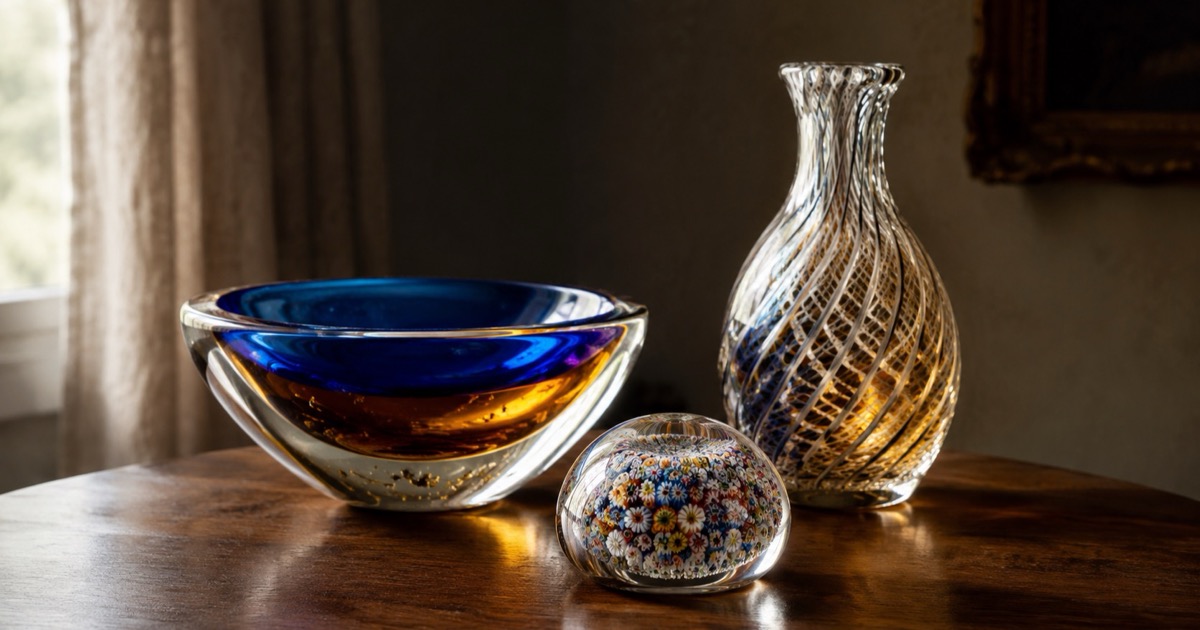
Murano glass identification is harder than it looks, and that gap between expectation and reality trips up a lot of buyers. The island of Murano, near Venice, has produced some of the most technically complex decorative glass in the world, but the absence of a durable marking system means most genuine pieces carry no lasting proof of origin — and the market is flooded with lookalikes made far from the lagoon.
Murano glass is hand-blown Italian art glass from the island near Venice, identified chiefly by its techniques — encased sommerso color layers, crisp millefiori canes, controlled bullicante bubbles — and by a ground or rough pontil scar on the base. Start by checking the base for a pontil mark and a mold seam: a seam points to a mass-produced lookalike.
The good news is that the glassmaking techniques themselves leave fingerprints in the material. Once you know what to look for in the structure of the glass, you have a framework that no sticker can fake and no import can easily replicate.
Quick identification checklist
- Look for sommerso layering: distinct, clean color strata trapped inside a clear outer casing
- Check for millefiori or latticino cane work under magnification — crisp canes indicate skilled furnace work
- Examine the pontil scar on the base: a ground or polished pontil is expected on quality pieces
- Hold the piece to a light source and look for bullicante — precisely spaced controlled bubbles in a grid pattern
- Search the base for an acid-etched stamp or diamond-engraved signature from a known house
- Weight the object in your hand — quality Murano glass is notably heavy and dense
Glassmaking techniques as the primary fingerprint
The most reliable route to Murano glass identification is understanding the major decorative techniques, because replicating them at volume and low cost is genuinely difficult.
Sommerso (meaning “submerged”) involves encasing one or more layers of colored glass within a clear or lighter-colored outer shell. The result is a piece with clean, jewel-like color pools visible beneath a smooth surface. Mass-produced imitations typically use simpler color application — a coating rather than a true encased layer — and the color boundary looks fuzzy or uneven when examined closely.
Millefiori (thousand flowers) is made by bundling colored glass rods, fusing them, slicing the bundle into cross-sections, and incorporating those slices into the finished piece. Each cane should show a crisp, repeated floral or geometric cross-section. Blurry or irregular cane shapes suggest lower-quality production or mechanical reproduction.
Latticino and filigrana techniques involve pulling and twisting thin glass threads — white or colored — into complex lace-like patterns inside the glass. Properly executed latticino is remarkably precise and three-dimensional. Cheap imitations often use surface-applied threads rather than internal ones, and the patterns feel flat.
Bullicante describes a field of controlled bubbles arranged in a regular grid, achieved by rolling molten glass over a spiked metal plate. The bubbles should be uniform in size and distribution; irregular or random bubbles are a sign of a different production method.
The label problem: why most pieces can’t be proven
The majority of genuine Murano pieces carry no surviving proof of origin. For most of the twentieth century, the main authentication tool was a paper or foil sticker on the base — and stickers fall off, get peeled off during cleaning, or deteriorate. An intact label is supporting evidence; its absence proves nothing.
A handful of famous studios — Venini, Barovier & Toso, and Seguso among them — did mark some pieces with acid-etched stamps or diamond-engraved signatures on the base. These marks are meaningful when present, but they appear on a small fraction of total production. Photograph any such mark and compare it to documented examples; the style and placement changed across production periods.
Pontil marks and weight
Turn any piece over and examine the base. A rough, slightly concave scar where the pontil rod was broken away — or a ground-flat polished area where it was finished — indicates hand-blowing at a furnace. This is consistent with Murano production but not exclusive to it. What you are eliminating is mechanically blown glass, which shows a mold seam along the side or a perfectly uniform, featureless base.
Weight is a supporting cue. Quality Murano glass is noticeably denser than casual decorative glass made for tourist markets.
Famous houses and what their marks look like
Among Murano’s major producers, Venini, Barovier & Toso, and Seguso each have documented mark histories. Their marks are subtle — deliberately understated — rather than large or prominent. A large, bold stamped label that reads like retail branding is skeptical. Most production-level Murano work came from smaller furnaces with no consistent marking practice; that work can still be genuine Murano glass, but cannot be traced to a specific maker without additional documentation.
The “Murano-style” import problem
The phrase “Murano glass” has no legally protected geographic status in most markets, which means retailers can and do use it loosely. A piece described as “Murano-style” or “Venetian-style” may be made in China, Eastern Europe, or elsewhere using simplified versions of Murano techniques.
The main visual differences: imported lookalikes frequently show mold seams along the sides or bottom edge, colors that appear painted or coated rather than layered internally, and cane work that blurs under magnification. The glass itself often feels lighter. Sommerso-style pieces from outside Murano may have the layered color look but the color boundaries will be less crisp and the outer layer less optically clear.
A word on clown and animal figurines
Clown and animal figurines — horses, fish, birds — are among the most common “Murano” pieces found at estate sales. Genuine handmade versions of these exist and were produced in quantity, but they are also among the most widely reproduced object types in the import market. The same quality checks apply: look at the pontil scar, examine the construction of internal color, and assess weight. A well-made figurine with complex internal color application and a proper pontil is more likely to be genuine; a lightweight piece with simple applied color is not.
Watch-outs and common mistakes
- Intact paper or foil stickers are supporting evidence, not proof — they can be transferred or faked
- A “Made in Murano” or “Murano Italy” stamp on a metal tag attached by a wire is a retail label, not a glassmaker’s mark
- Even genuine Murano glass from smaller studios may be worth very little — name recognition and technique quality both affect value
- Color intensity alone is not a reliable indicator; vivid colors appear in both genuine and imported pieces
- Mold seams on the body or a perfectly flat, featureless base are strong indicators of mechanical production, not hand-blowing
Photo tips that improve identification
- Photograph the base directly, flat against the camera, to capture the pontil scar clearly
- Hold the piece in front of a window or light box and photograph through it — this reveals internal layering and whether color is encased or surface-applied
- Under a daylight LED or bright natural light, photograph cane work details at close range to assess crispness
- Photograph any acid-etched marks at an oblique angle with a raking light to bring out the texture of the etching
Common questions
How can you tell real Murano glass from fake?
Look at the structure of the glass rather than labels. Genuine pieces show internally encased color with crisp boundaries, precise cane work that stays sharp under magnification, and a pontil scar on the base from hand-blowing. Imported lookalikes tend to show mold seams, color that looks coated or painted rather than layered inside the glass, and a lighter overall weight.
Is unmarked Murano glass worth anything?
It can be, because most genuine Murano glass was never durably marked — paper and foil stickers were the main identifier for decades and rarely survive. Value depends on the quality of the technique, the complexity of the work, and condition. That said, unattributed production-level pieces from smaller furnaces usually sell modestly, while documented work from major houses brings the strongest prices.
Does authentic Murano glass have a signature?
Only a small fraction does. A handful of famous studios, including Venini, Barovier & Toso, and Seguso, acid-etched or diamond-engraved some of their pieces on the base, and those marks are meaningful when they match documented examples. The absence of a signature proves nothing either way, and a large, bold retail-style stamp should make you more skeptical, not less.
Related guides
- How to Tell If Glass Is Antique
- Antique Glass Marks Identification
- Milk Glass Identification: Fenton, Westmoreland, and More
When to use the Antique Identifier app
Photograph the whole piece, including a straight-on base shot and a through-the-light shot showing internal color structure, then add a close-up of any acid stamp or signature if present. The app can help narrow the likely origin, technique, and era quickly. For pieces where you suspect a major house attribution or significant value, treat any result as a starting point and follow up with specialist research or a dealer who focuses on Italian studio glass.