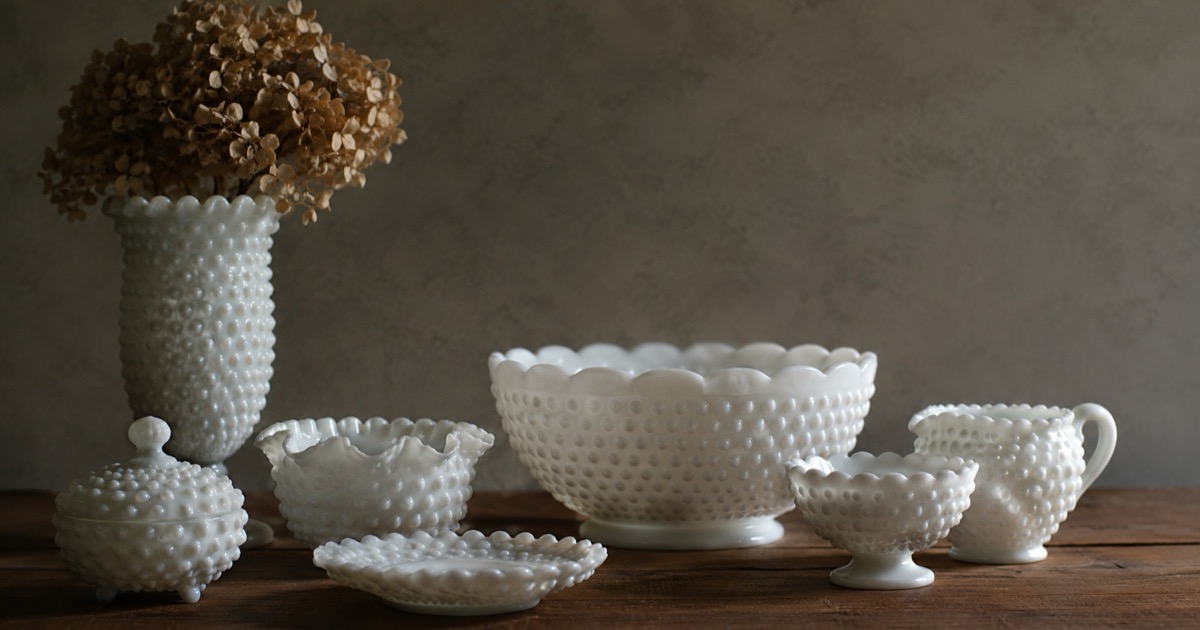
Milk glass identification gets much easier once you know that most pieces in circulation come from one of two waves: the Victorian opaque-glass craze of the late 1800s and the enormous mid-century revival that ran from the 1950s into the 1970s. By the end of this guide you will be able to place a piece in the right era, find the few molded maker marks that actually exist, and recognize the patterns that turn up constantly at estate sales.
Milk glass is opaque pressed or blown glass, usually white, made mainly in the late 1800s and again from the 1950s through the 1970s. To identify a piece, hold a thin edge up to strong light — a fiery orange glow suggests pre-1930 glass — then check the base for molded marks like Westmoreland’s WG monogram or Fenton’s oval logo.
Most milk glass is unmarked, which discourages beginners. It should not. The glow at a thin edge, the crispness of the mold work, the pattern itself, and the wear on the base do most of the identification work, and the marks that do exist — Westmoreland’s WG monogram, Fenton’s oval logo, Anchor Hocking’s anchor — take five minutes to learn.
Quick identification checklist
- Hold a thin edge up to strong light and check for a fiery orange-red glow, the so-called ring of fire seen on many earlier pieces.
- Check the base and the inside of lids for molded marks: an intertwined WG (Westmoreland), Fenton in an oval, or an anchor (Anchor Hocking).
- Name the pattern: rounded hobnail bumps, grape clusters on panels, diamond quilting, or lacy openwork edges.
- Judge the white itself; older formulas often look slightly soft and creamy next to the flat, stark white of modern craft glass.
- Look for honest, randomly scattered base wear rather than a pristine bottom or one suspiciously even ring of scratches.
- Treat hen-on-nest covered dishes as their own research project; dozens of companies made them across a full century.
What counts as milk glass, and when it was made
Milk glass is pressed or blown glass made opaque, usually white, by adding opacifying minerals to the batch. Victorian makers sold it as opal ware, and from roughly the 1880s through the 1910s it filled American homes as lacy-edged plates, dresser boxes, covered animal dishes, and vases. Early pieces often show a touch of translucency and fire at the thin edges rather than a dense, chalky white.
Production never fully stopped, but the boom that supplies most of today’s thrift-store finds came after World War II. From the 1950s into the 1970s, Westmoreland, Fenton, Anchor Hocking, Indiana Glass, and others sold milk glass by the ton: wedding bowls, compotes, candy dishes, punch sets, and florist vases. Statistically, an unmarked white piece you find today is far more likely to be mid-century than Victorian.
The ring of fire, and why it is only one clue
Collectors hold the edge of a piece up to strong light or sunlight and look for an opalescent halo of reds and oranges at the thinnest points. This ring of fire shows up on much milk glass made before about 1930, a side effect of period formulas, and it is a genuinely useful clue. It is not proof. Some later glass shows a faint glow, some genuine early pieces barely show it, and the effect changes with thickness and lighting. Treat a strong fiery edge as one vote for an earlier date, then look for agreement from mold quality, pattern, and wear. A piece that glows but has razor-sharp seams and a factory-fresh base deserves suspicion, not a Victorian label.
Milk glass identification by maker marks
Marked milk glass is the exception, so when a mark exists it does a lot of work.
| Maker | Mark to look for | Notes |
|---|---|---|
| Westmoreland | Intertwined W and G | Adopted around mid-century; earlier output relied on paper labels |
| Fenton | Fenton inside an oval | Molded logo arrived in the 1970s; 1950s-60s pieces had foil stickers only |
| Anchor Hocking | Anchor symbol, Fire-King wording on ovenware | Its opaque white kitchen lines are part of the milk glass family |
| Indiana Glass | Usually unmarked | Identify by pattern; huge mid-century output |
| Florist ware (E.O. Brody, Randall) | Company name molded on the base | Extremely common 1950s-60s vases and planters |
The absence of a mark means little. Fenton did not mold its logo into the glass until the 1970s, so classic 1950s hobnail pieces carry no mark at all unless the foil label survived, and Westmoreland used paper labels for decades before adopting the molded monogram. That is why pattern knowledge matters more than mark hunting in this category.
Patterns that come up constantly
Hobnail — evenly spaced rounded bumps covering the surface — is Fenton’s signature treatment and the most recognized milk glass pattern in America. Westmoreland’s English Hobnail is the older cousin, with more sharply faceted points and a different overall geometry. Paneled Grape, with crisp grape clusters and leaves above paneled lower bodies, was Westmoreland’s flagship line and was made in enormous quantity; similar grape patterns from other firms usually show softer detail. Add Old Quilt’s pressed diamond quilting, lacy openwork-edged plates, and covered hens, and you have covered most of what shows up at sales. Pattern plus form narrows the maker quickly, because the big firms guarded their signature lines.
Colored milk glass: blue, black, and custard
White dominates, but opaque colored glass belongs to the same family. Opaque blue appears in both Victorian novelty pieces and mid-century lines, and blue examples of common patterns often outsell their white twins. Black glass, popular in the 1920s and 1930s and revived later, reads as jet black on the shelf; many older pieces show deep purple at thin edges under strong light, which collectors call black amethyst. Custard glass, the ivory-yellow Victorian variant, often contains uranium and gives a soft green response under a blacklight, separating it from plain cream-colored later glass. Jadeite, the opaque green kitchen glass, is the same idea in green with its own collecting market.
Modern craft-store lookalikes
Two things muddy the waters. First, new decorative white glass — wedding-decor vases, craft-store pieces, mass imports — is everywhere, and it tends to be stark paper-white, light in the hand, with sharp unpolished seams and zero base wear. Second, when Westmoreland closed in the mid-1980s, many of its molds were sold, and other companies later pressed new glass from them, so a correct pattern alone cannot date a piece. Stack the clues: white tone, seam finish, base wear, edge glow, and mark. A familiar pattern with a perfect base and a flat bright-white body is probably decades younger than it pretends to be.
Watch-outs and common mistakes
- Do not date a piece by the ring of fire alone, and do not dismiss one because it lacks the glow; thickness and formula vary.
- Hen-on-nest dishes were made by dozens of firms for a hundred years; most found today are mid-century or later.
- Reissues pressed from original Westmoreland molds mean pattern-perfect pieces can be post-1985; weigh mark, wear, and white tone too.
- Faux aging happens: grime rubbed into pattern crevices above an unworn base is backwards from honest use.
- Most florist-ware vases and planters are charming but extremely common; rarity lives in specific patterns, colors, and forms.
Photo tips that improve identification
- Take one backlit shot of a thin edge to capture any opalescent glow accurately.
- Shoot the base straight on in raking light so wear scratches and any molded mark are visible.
- Get a tight, angled close-up of the pattern — hobnails or grape clusters — to show mold crispness.
- Photograph the whole piece against a mid-gray or wood background so the tone of the white reads true.
Common questions
Is unmarked milk glass worth anything?
Yes, because most milk glass was never marked at all. Value rides on pattern, maker attribution, form, and condition rather than a molded logo. A common florist vase stays inexpensive marked or not, while a documented Westmoreland or Fenton pattern in a less common form can do well even without a mark.
How can you tell how old milk glass is?
Stack several clues rather than relying on one. A fiery orange glow at a thin edge points to glass made before about 1930, while a flat, stark white body with sharp seams and a pristine base suggests recent production. Randomly scattered base wear, a slightly creamy white tone, and crisp mold detail all vote for an older piece.
What is the ring of fire on milk glass?
The ring of fire is an opalescent halo of reds and oranges visible when a thin edge is held up to strong light. It comes from the glass formulas used before roughly 1930, so it is a useful clue for earlier pieces. It is not proof of age on its own, because the effect varies with thickness and some later glass shows a faint glow.
Related guides
- Fenton Glass Identification: Marks, Labels, and Patterns
- Depression Glass Markings Identification
- How to Tell If Glass Is Antique
When to use the Antique Identifier app
Photograph the whole piece, then add tight shots of the base, any molded mark, and the pattern detail. The app is good at narrowing type, era, and likely maker from those photos, which turns an anonymous white vase into a short list you can verify. If it suggests something rare or unusually valuable, treat that as a reason to dig deeper with references or a specialist, not as a final answer.