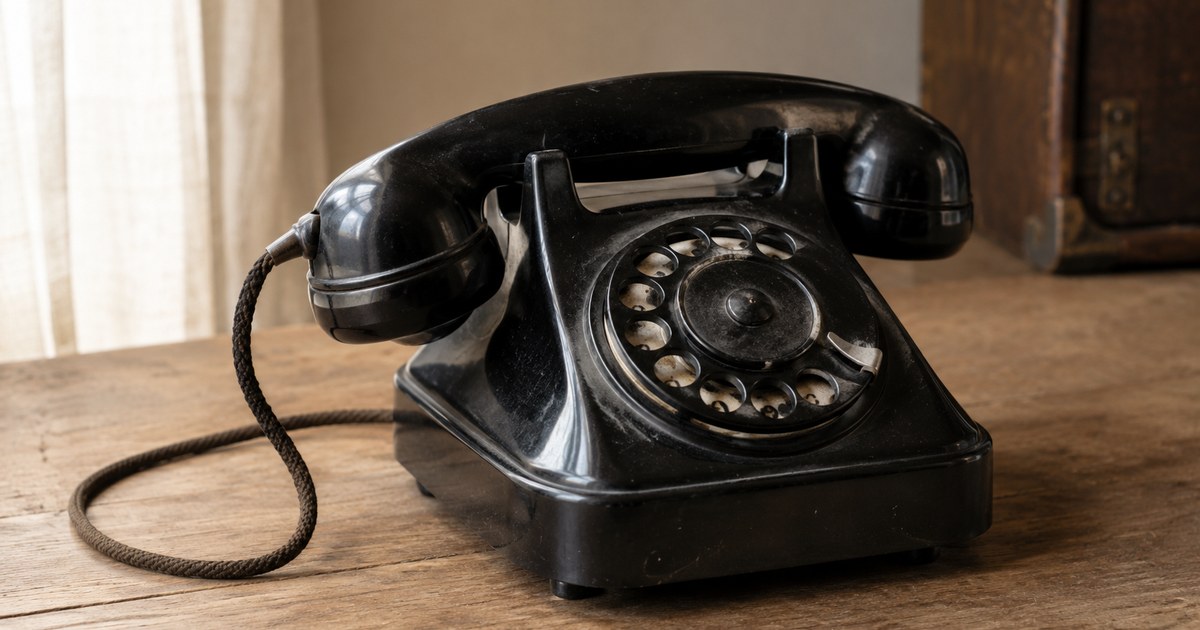
Search for antique telephones and you get shopping pages: candlesticks on marketplaces, brass-and-oak crank phones from decor shops, restoration listings with no dates attached. What you almost never get is a path from the object in your hands to an actual answer. That is a problem, because telephone silhouettes are the least reliable thing about them. The candlestick shape was reproduced for decades, the wall crank phone became a decor cliché, and the model that matters is stamped somewhere you probably have not looked yet.
Antique telephones are identified from stamped and molded data, not from their shape. Look for a model or type number on the base plate, inside the shell, or molded into the Bakelite housing, then check date stamps on the transmitter, receiver capsule, and ringer coils. The shape narrows the era; the numbers give the date, and the two often disagree.
Quick identification checklist
- Turn it over first. The base plate is where most Western Electric and Automatic Electric sets carry a stamped or embossed model designation.
- Open the housing if you safely can. Interior surfaces of Bakelite and metal shells often carry molded part numbers and date codes that the exterior does not.
- Check every removable component separately. Transmitter, receiver capsule, dial, ringer coils, and network block each tend to carry their own date stamps, and they rarely all match.
- Look at the fasteners. Modern Phillips-head screws on an assembly that should have slotted screws is a strong reproduction or later-rebuild signal.
- Check the cord exit. A modular RJ11 jack means the phone was made, or at minimum rewired, well after the period being imitated.
- Weigh it in your hand. Period metal and early thermoplastic sets are heavy and dense. Lightweight cast pot-metal that feels hollow is a decor-market tell.
- Read the markings by touch. Period markings are usually stamped, embossed, or molded in. Printed-on lettering that would rub off is a reproduction signal.
Where the identifying data actually lives
This is the step almost every ranking page skips. A telephone is not one object; it is an assembly, and each part was marked at manufacture.
The base plate is the primary source. Western Electric desk sets typically carry a model or type designation there, and it is worth photographing the plate whole rather than trying to read it in place. On wall sets and magneto boxes, look at the back board, the inside of the door, and the underside of the shelf.
The shell interior matters just as much. Bakelite and later thermoplastic housings were molded with part numbers and often a date indicator on inside surfaces. If the handset separates, the two halves of the handset shell frequently carry molded numbers as well.
Components are where dating gets precise. The transmitter (the mouthpiece capsule), the receiver capsule, the ringer coils, the induction coil or network, and the dial mechanism were each made and marked independently. Component date stamps give you a manufacture window for that part, which is the closest thing to a hard date the phone will give you.
The cord and cloth covering is a weak signal in isolation, since cords were replaced constantly, but a fully modern cord on an otherwise period set tells you the phone has been serviced for use, which is information about the assembly you are holding.
The reproduction problem, which dominates the market
“Antique-look” telephones have been sold continuously since the 1970s and 1980s, and they are the majority of what appears in image results for antique telephones. Ornate brass-and-wood crank phones with polished spun-brass bells, and gleaming candlesticks with perfect nickel, are the two most reproduced forms. They are not fakes in a fraud sense, they are decor products, but they get resold as antiques constantly.
The tells stack quickly:
- Modern Phillips screws throughout, especially where a period set would use slotted or specialty fasteners.
- A modular RJ11 jack built into the base or the cord, standard only from the modern era.
- Lightweight cast pot-metal where a period set used brass, steel, or heavy phenolic.
- Printed rather than embossed markings, including printed “brand” badges applied to the housing.
- No component date stamps anywhere. A period set almost always carries several. A reproduction usually carries none, because its internal parts are modern electronics rather than dated telephone components.
- Uniform, brand-new-looking finish on every surface, including the parts that would have been handled daily for decades.
None of these tells alone proves anything. Several together, especially the absence of component date stamps combined with a modular jack, is about as clear as evidence gets short of a specialist opinion.
Most surviving phones are parts-assembled
This is the fact that reframes the whole exercise. Telephones were repaired, cannibalized, and rebuilt for their entire service lives, and collectors have been swapping parts among them ever since. A very large share of surviving sets are assembled from several donors.
That means the honest question is not “what year is this phone” but “what does each part date to, and does the assembly hang together.” A metal shell from one era with a post-war handset and a replacement dial is a legitimate object with a real history, but it is not a single-date artifact. When shell date and component dates disagree, both readings are usually correct about their own part.
Practically: record what each part says, note the latest date you find, and describe the phone as an assembly. That is also how experienced sellers describe them, and it protects you if you resell.
Era anchors that are actually reliable
Use these to bracket, not to date precisely.
Candlestick (upright desk) telephones were common from the late 1890s into the 1940s, with some remaining in service into the 1950s. A rotary dial only appears in the base after automatic exchanges arrived in the area, so a candlestick with no dial points to operator-assisted, manual service, which is genuinely useful bracketing information.
The Western Electric handset era begins in 1927 with the A1, followed by the B1 the same year, the 102 in 1930, and the 202 in 1931. The 202 uses an anti-sidetone circuit and the 102 does not, which is a real internal distinction rather than a cosmetic one.
The Western Electric 302, introduced in 1937, was the set that made the combined design with the ringer inside the housing standard across the Bell System, removing the need for a separate bell box. Material is a useful period tell within the model: earlier 302 bodies are metal and later ones are molded thermoplastic, though the changeover began before the war rather than neatly after it, so treat the material as an approximate marker.
The Western Electric 500 arrives around 1950 and drives the mass retirement of older sets through that decade, which is why so many earlier phones entered private hands in the 1950s and 1960s.
Non-Bell dial phones are frequently misread as fakes. Strowger-type dial telephones made by Automatic Electric and others served independent, non-Bell operating companies from around the turn of the century. A dial phone that is clearly not Western Electric usually points to an independent exchange, not to a reproduction.
Watch-outs and common mistakes
- Dating by silhouette. The candlestick and wall-crank forms were reproduced for decades. Shape narrows an era at best.
- Assuming ornate means early. Heavy ornamentation, especially polished brass with decorative scrollwork, is more common on decor reproductions than on utility telephone equipment, which was built plainly.
- Treating a patent date as a manufacture date. Telephone equipment carried patent references long after the patents issued. A patent date sets an earliest possible year and nothing more.
- Assuming the parts match. They usually do not. Check each one.
- Refinishing before identifying. Stripping and repolishing destroys the wear patterns, original finish, and sometimes the stamped markings that carry the identification. Document first.
- Reading a restoration as originality. Many phones sold as antique have been rewired for modern use, which is fine but changes what you are describing.
Photo tips
- Shoot the base plate flat-on in good light, filling the frame with the plate. Angle the light across the surface so stamped characters catch a shadow and read clearly.
- Photograph each component separately with its stamps visible: transmitter face, receiver capsule, ringer coils, dial plate, network block.
- Capture the interior of the shell including any molded numbers on inside surfaces.
- Include one full profile shot with the handset in place for form and proportion.
- Photograph the fasteners and the cord exit close up. Screw heads and jack type are two of the fastest reproduction checks.
- Keep the background plain and avoid harsh direct flash, which blows out the reflective nickel and brass surfaces where markings live.
Common questions
How can you tell if a candlestick telephone is real or a reproduction?
Check the fasteners, the cord, and the component stamps. Period candlesticks use slotted or specialty screws, have no modular jack, and carry stamped or embossed markings on the transmitter and receiver components, though what those markings encode varies and is often a patent date or type number rather than a manufacturing date. Reproductions typically show Phillips screws, an RJ11 jack, lightweight pot-metal castings, printed rather than embossed markings, and no component date stamps at all.
What is the model number on an antique telephone and where do I find it?
Most Western Electric and Automatic Electric sets carry a model or type designation stamped on the base plate, molded into the housing interior, or marked on the network block inside. On wall sets, check the back board and the inside of the door. Photograph the plate whole rather than transcribing it, since worn characters are easy to misread.
Does an old telephone still work on a modern phone line?
Some do and some do not, and it depends on the internal wiring, the ringer type, and whether the set was ever converted. Pulse dialing is not supported on every modern service. Working condition is a separate question from age, and a phone that has been rewired for modern use is a modified assembly, which is worth disclosing if you sell it.
Related guides
- How to Identify Antique Radios
- How to Identify Antique Typewriters
- Vintage Singer Sewing Machine Identification
- Common Signs of Antique Reproductions and Fake Antiques
When to use the Antique Identifier app
Photograph the full profile, then the base plate, then any component stamps you can reach, and run each image through the app. It reads stamped model and type designations quickly, matches the form to known model families, and flags the material and construction cues that separate a period set from a decor reproduction. Use it to build the evidence stack: form, marking, and component dates together tell you far more than any single one of them, and the app is fastest at the step most people skip, which is turning the phone over and reading what is actually written on it.