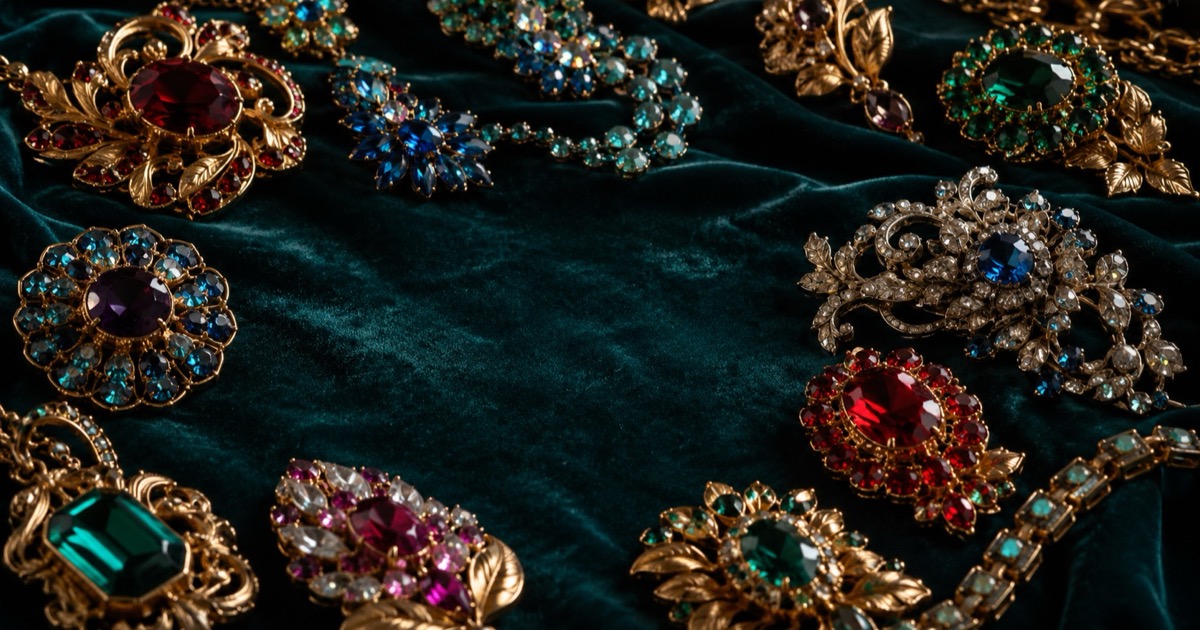
Costume jewelry marks are tiny, frequently hidden, and worth finding, because a signature can separate a five-dollar basket brooch from a piece collectors actively chase. The major American and Canadian houses signed most of their production, and those signatures, plus one small copyright symbol, let you sort and roughly date a jewelry box in an evening. By the end of this guide you will know where the marks hide, which names matter, and how to judge the quality of a piece that carries no mark at all.
Costume jewelry marks are small maker signatures stamped or cast into the metal, usually on a brooch’s back plate near the pin mechanism or on a necklace’s clasp tongue. Names like Trifari, Coro, Weiss, and Eisenberg matter most, and a © symbol suggests production after the mid-1950s. Start by flipping the piece under strong light.
The skill transfers directly to buying. Jewelry baskets at garage and estate sales are rarely sorted by anyone who flipped the pieces over, which is exactly why signed pieces keep surfacing at unsigned prices.
Quick identification checklist
- Check the back plate first, especially near the pin mechanism, for a stamped or raised signature.
- Inspect the clasp on necklaces and bracelets; many makers signed the clasp tongue or a small tag by it.
- Look for a © symbol next to the name; it generally suggests production after the mid-1950s.
- Learn the heavy hitters on sight: Trifari with a crown over the T, Coro, Corocraft, Weiss, Eisenberg.
- Remember that early Miriam Haskell pieces are often unsigned; later ones carry an oval plaque.
- Judge construction regardless of signature: prong-set stones, smooth finished backs, and real weight.
Where costume jewelry marks hide
Brooches are the easy case: turn the piece over and scan the back plate, especially around the hinge and catch of the pin mechanism, where makers stamped or cast their signatures. Marks can be tiny and worn, so tilt the piece under a strong light or use a phone macro shot to read them. Raised signatures cast into the metal and stamped impressions are both common, and both count.
Necklaces and bracelets hide their signatures on the hardware. Check the clasp tongue, the fold-over clasp surface, a small metal tag hanging near the clasp, or an end link. Earrings are the hardest, with marks on clip backs or screw backs when they exist at all. Some makers also used paper hang tags that disappeared decades ago, which is one reason perfectly good pieces turn up unsigned.
Signatures worth knowing on sight
A short list of names covers a large share of collectible American costume jewelry. Trifari is the flagship: earlier pieces can carry a “KTF” mark, and the famous crown-over-T “Crown Trifari” signature marks much of the company’s celebrated mid-century output. Coro was the volume giant, signing as Coro across many price tiers and reserving Corocraft for its higher-end lines; its Duette pin mechanisms, which split one brooch into two clips, are a collector favorite.
Weiss is known for exceptional rhinestone quality and crisp stone layouts. Eisenberg signed in several styles over the years, including “Eisenberg Original” on earlier pieces and the well-known “Eisenberg Ice” on rhinestone designs, a name the company also revived later, so the signature alone does not settle the decade. Miriam Haskell built elaborate hand-wired pieces with baroque pearls and intricate filigree; early production was typically unsigned, with the familiar oval signature plaque appearing on later work. Sherman, the Canadian house, signed its name in script and is prized for brilliant Swarovski stones and sturdy plating.
The copyright symbol as a dating clue
The single most useful dating device in costume jewelry is the small © beside a signature. After Trifari won a landmark court fight in the mid-1950s establishing that jewelry designs could be protected by copyright, major makers began adding the © symbol to their castings. As a rough rule, a © next to the maker name suggests production from the mid-1950s onward.
Use the clue in one direction only. The presence of © argues for a later date; the absence of © proves very little, since marks wear, components get replaced, and not every maker adopted the symbol immediately or consistently. Combine the symbol with style, construction, and the specific signature version, and you can usually bracket a piece within a decade or so. Collector references document how individual makers’ signatures changed over time, which tightens the bracket further.
Construction quality, with or without a signature
Quality is visible before you ever find a mark. Flip the piece and look at how the stones are held: prongs bent individually over each stone indicate hand-set work, while stones sitting in shallow glue cups mark cheaper production. Look at the back itself: good houses finished backs smoothly, plated them completely, and designed the mechanics neatly. Rhodium plating with a bright, silvery surface that has survived decades is a strong quality signal, while bubbling, flaking, or green corrosion is damage that no signature fully offsets.
Weight and detail close the case. Quality pieces feel dense for their size, with crisp casting detail, secure hinges, and stones that match in brilliance. Hand-wired construction, the Haskell hallmark, shows tiny wire wraps holding beads to a filigree frame. An unsigned piece with prong-set stones, a cleanly finished back, and real heft is worth buying on its merits; an aggressively signed piece with glued stones and raw casting flash is not.
Watch-outs and common mistakes
- Assuming unsigned means worthless; early Haskell and plenty of quality production carried no signature.
- Reading © as proof of age; copyrighted designs stayed in production for years, some into recent decades.
- Ignoring condition because the name is good; dead foil-backed stones and worn plating crush value.
- Buying counterfeit signatures; faked marks of famous makers exist, so the construction must match the name.
- Dunking rhinestone jewelry in liquid cleaners; moisture ruins foil-backed stones from behind.
Photo tips that improve identification
- Take a sharp macro of the signature area on the back plate, clasp tongue, or tag, filling the frame.
- Photograph the full back of the piece so construction, plating, and the pin mechanism are visible.
- Shoot the front in soft, indirect light; harsh flash whites out rhinestones and hides dead stones.
- Include a size reference, such as a ruler beside the piece, since scale affects identification and value.
Common questions
Is unsigned costume jewelry worth anything?
Often, yes. Early Miriam Haskell pieces were typically unsigned, paper hang tags disappeared decades ago, and plenty of quality production never carried a mark. Judge the construction instead: prong-set stones, a smoothly finished and fully plated back, and real weight for the size mark a piece worth buying on its merits, signature or not.
What does the © symbol on costume jewelry mean?
It means the design was claimed under copyright, a practice major makers adopted after a mid-1950s court ruling established that jewelry designs could be protected. As a rough rule, a © beside the maker’s name suggests production from the mid-1950s onward. Use it in one direction only: its presence argues for a later date, but its absence proves very little.
How can you tell quality costume jewelry from cheap pieces?
Flip it over. Hand-set stones held by individually bent prongs, a smooth and completely plated back, crisp casting detail, secure hinges, and dense weight all signal quality production. Stones sitting in shallow glue cups, raw casting flash, and bubbling or flaking plating mark the cheap end, and no signature fully offsets those flaws.
Related guides
- How to Identify Antique Jewelry Markings
- How to Test Antique Gold Jewelry at Home
- Sterling Silver Hallmarks: What the Marks Mean
When to use the Antique Identifier app
Photograph the front of the piece, then take tight, well-lit shots of the back plate, clasp, and any signature you can find. The app can narrow the likely maker, era, and style family quickly, which is especially useful when a mark is worn or when an unsigned piece looks better than its basket-mates. If the result suggests a sought-after name or a rare design, treat it as a cue to verify against specialist references before paying or pricing accordingly.