


Flow Blue China Identification
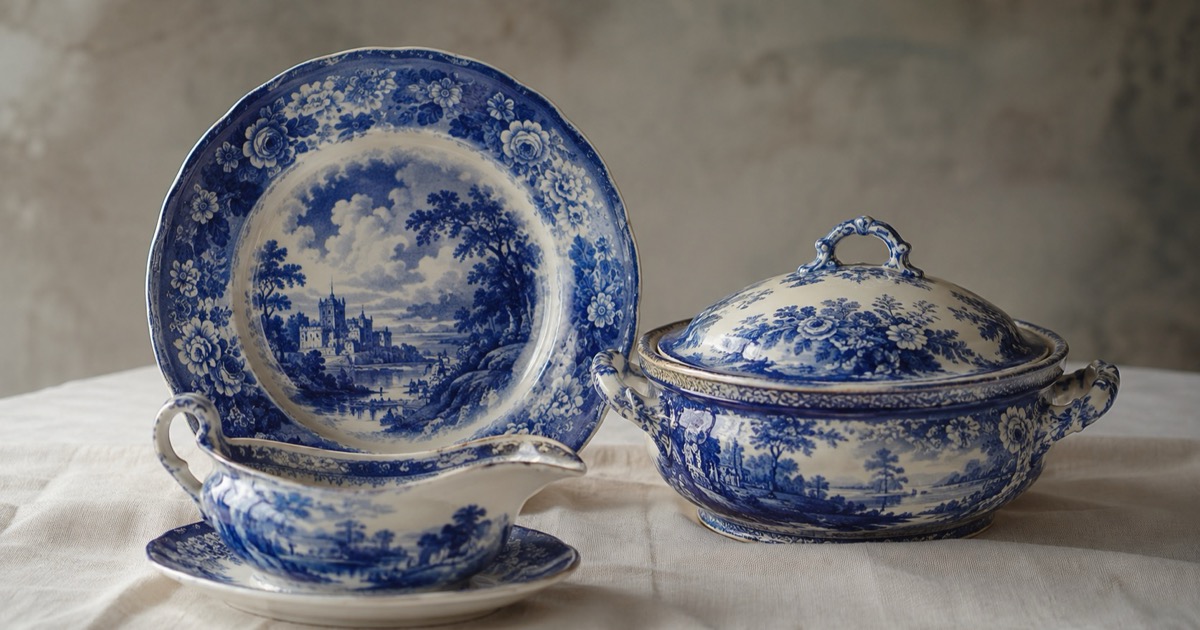
Flow blue china is immediately recognizable: cobalt decoration that bleeds softly outward from the pattern into the surrounding glaze, creating a misty halo effect rather than the crisp lines of standard blue-and-white transferware. This “flowing” was produced deliberately by adding volatile chemicals to the kiln atmosphere, and for roughly a century it was one of the most fashionable tableware styles in Britain and America. Identifying flow blue china means reading backstamps, pattern cartouches, and body characteristics across three broad production eras.
Flow blue china is Victorian transferware whose cobalt pattern was deliberately made to bleed into the glaze, leaving a soft, misty halo instead of crisp lines. To identify it, confirm the blue genuinely flows beyond the printed design, then check the backstamp for a maker’s mark, pattern cartouche, or British registry mark that brackets the date.
By the end of this guide you will be able to distinguish early Victorian pieces on heavy ironstone from later versions, read backstamp evidence for approximate date and maker, and recognize the reproductions that have been circulating since the 1990s.
Quick identification checklist
- Confirm the “flow”: cobalt decoration should bleed into adjacent glaze as a soft, diffuse halo — not sit as crisp lines like standard transferware.
- Check body weight: early Victorian flow blue is heavy ironstone; later pieces and reproductions are noticeably lighter.
- Find and photograph the backstamp: look for a maker’s mark, pattern name cartouche, and any registry marks.
- On English pieces, look for a British registry diamond (1842–1883) or “Rd No” registry number (1884 onward) — both provide a specific earliest date.
- Assess cobalt color: genuine antique flow blue has a rich, slightly muted or grayish cobalt; reproductions often show a brighter, more vivid blue.
- Check for crazing: genuine old ironstone shows fine craze lines from thermal cycling; reproductions typically have tight, clean glazes.
What “flow” actually looks like versus sharp transferware
Standard blue-and-white transferware achieves its pattern by pressing a printed tissue paper transfer onto the clay body before glazing and firing, yielding sharp, crisp lines through the glaze layer.
Flow blue uses the same process but adds lime or other volatile compounds to the kiln atmosphere, causing the cobalt pigment to run and diffuse outward before the glaze sets. Detailed elements — flowers, leaves, geometric borders — appear soft-edged or indistinct in heavily flowed examples. Background areas that should be white pick up a faint blue haze.
The degree of flow varies between makers, periods, and individual firings. Some early Victorian examples flow so heavily that the pattern is nearly lost. Later examples — particularly from the 1880s onward — tend to flow less aggressively, retaining more definition.
The three broad production eras
Early Victorian (roughly 1835–1860): Flow blue was introduced to the British market and quickly became popular for US export. Pieces are typically on heavy ironstone or earthenware — lift a dinner plate and the weight is noticeable. Cobalt flows heavily, pattern detail is often obscured, and the effect is atmospheric.
Late Victorian (roughly 1860–1900): The peak production period, supplying most of what appears in today’s antique market. Bodies became somewhat lighter as porcelain was introduced alongside ironstone. Flowing became more controlled, patterns more elaborate, and backstamps more standardized. British registry marks allow closer dating, and American importers sometimes added their own marks.
Early 20th century and later: Production continued into the Edwardian period with diminishing fashion by the 1920s. Reproductions from the 1990s onward and modern reissues also fall here but are a different category entirely.
Backstamps, pattern cartouches, and English registry marks
The backstamp is the most compact source of dating information. Look for:
The maker’s mark — a name, initials, or symbol identifying the pottery. Many major flow blue producers are well documented in reference works.
The pattern name cartouche — an ornate printed border around a word like “Touraine,” “Scinde,” or “Chapoo” — among the most reliable identifiers for matching pieces to documented series.
The British registry diamond (1842–1883) encodes the registration year, month, day, and parcel number, giving a precise earliest date for that design.
From 1884, the diamond was replaced by a sequential registry number (often preceded by “Rd No”). Published ranges allow approximate dating by decade.
A piece with none of these marks is harder to date but not automatically suspect.
Notable patterns and what they look like
Touraine is among the most commonly encountered late Victorian flow blue patterns. It features a pastoral floral scene with flowing borders; the central motif remains readable even with moderate flow.
Scinde, associated with the 1840s, features a dense Imari-influenced design that flows heavily. Identifying Scinde often involves matching the distinctive angular border design even when the center motif is blurred.
Many other pattern names — Amoy, Non Pareil, Chapoo, and dozens more — are documented in flow blue reference works and identifiable by cartouche backstamps even when the image is heavily flowed.
1990s reproductions and how to spot them
Beginning in the 1990s, significant quantities of reproduction flow blue appeared in the American market. These pieces were generally made in Asia on white porcelain or ceramic bodies quite different from Victorian ironstone.
Color: Reproduction cobalt tends to be bright and slightly cold — almost electric compared to the richer, slightly grayed cobalt of genuine Victorian pieces. Side-by-side comparison makes this apparent immediately.
Body weight: Reproduction pieces are almost always noticeably lighter than genuine Victorian ironstone. The difference is significant when you lift both.
Flowing pattern: Reproduction flowing often looks overdone or uniformly applied — a haze lacking the organic variation of genuine kiln-atmosphere flowing.
Backstamps: Reproduction backstamps sometimes approximate Victorian marks but include anachronistic text, fantasy pattern names, or marks that match no documented pottery. “Made in China” or similar origin text usually accompanies reproductions. Some reproductions carry no backstamp at all.
Crazing: Genuine old ironstone typically shows some crazing from decades of thermal cycling. Reproductions usually have clean, tight glazes, though artificial crazing can be induced.
Condition and value honesty
Flow blue was everyday tableware, and surviving examples commonly show honest wear: knife scratches, small chips at the foot rim, and crazing with slight staining — all expected and acceptable at most price levels. Cracks, significant chips, and heavy staining reduce value meaningfully. Restoration is worth disclosing when selling.
Well-documented pattern names and maker’s marks command a premium over unmarked pieces. Rare patterns, documented makers with strong collector followings, and complete matching sets represent the top of the market. Condition dominates value at every level.
Watch-outs and common mistakes
- Confusing flow blue with hand-painted blue-and-white — flow blue is transfer-printed, though heavy flowing can obscure this.
- Reading any blurred or hazy blue decoration as “flow blue” — badly fired or worn transferware can also bleed without being true intentional flow blue.
- Skipping the body weight test — it quickly separates heavy Victorian ironstone from lightweight reproductions.
- Trusting a pattern name cartouche without checking body characteristics — reproductions sometimes carry period-style pattern names.
- Assuming crazing proves age — it can be artificially induced and is confirming evidence, not proof on its own.
Photo tips that improve identification
- Photograph the backstamp in strong direct light shooting straight down — pattern cartouche text and registry marks often require high contrast to be readable.
- Capture the cobalt color in natural daylight rather than incandescent light, which warms the tone and distorts color judgment.
- Photograph the inside of a plate and the outside underside edge separately — marks are sometimes applied to the underside rim where they are easy to miss.
- If a chip or crack is present, photograph it to show body thickness — a visual aid for distinguishing heavy ironstone from lighter bodies.
Common questions
Is flow blue china worth anything?
Often, yes, though condition dominates at every level. Documented pattern names, known makers, and complete matching sets sit at the top of the market, while pieces with cracks, large chips, or heavy staining trade far lower. Honest tableware wear such as light knife scratches and mild crazing is expected and acceptable to most buyers.
How can you tell real flow blue from a reproduction?
Lift the piece first: genuine Victorian flow blue sits on heavy ironstone, while reproductions made since the 1990s are noticeably lighter. Real antique cobalt is rich and slightly grayed, where reproduction blue looks bright and almost electric, and reproduction flowing often reads as a uniform haze. Anachronistic backstamps or modern country-of-origin text settle the question.
What is the difference between flow blue and Blue Willow?
Blue Willow is a specific transfer-printed pattern — the pagoda, bridge, and birds scene — usually printed with crisp, sharp lines. Flow blue describes a technique, not a pattern: the cobalt was deliberately made to bleed into the glaze during firing, producing a soft halo. Many different patterns exist in flow blue, and a few patterns were produced both sharp and flowed.
Related guides
- Blue Willow China Identification
- Old China Marks Identification: What Backstamps Really Tell You
- Antique English China Marks Identification
When to use the Antique Identifier app
Photograph the full top surface of a plate or side of a hollow piece to capture the pattern, then take a separate close shot of the backstamp. The app can match pattern characteristics to documented flow blue series and flag likely maker and era candidates. For pieces with rare patterns or significant potential value, treat the identification as a starting point for reference-book verification or specialist consultation.
Topics