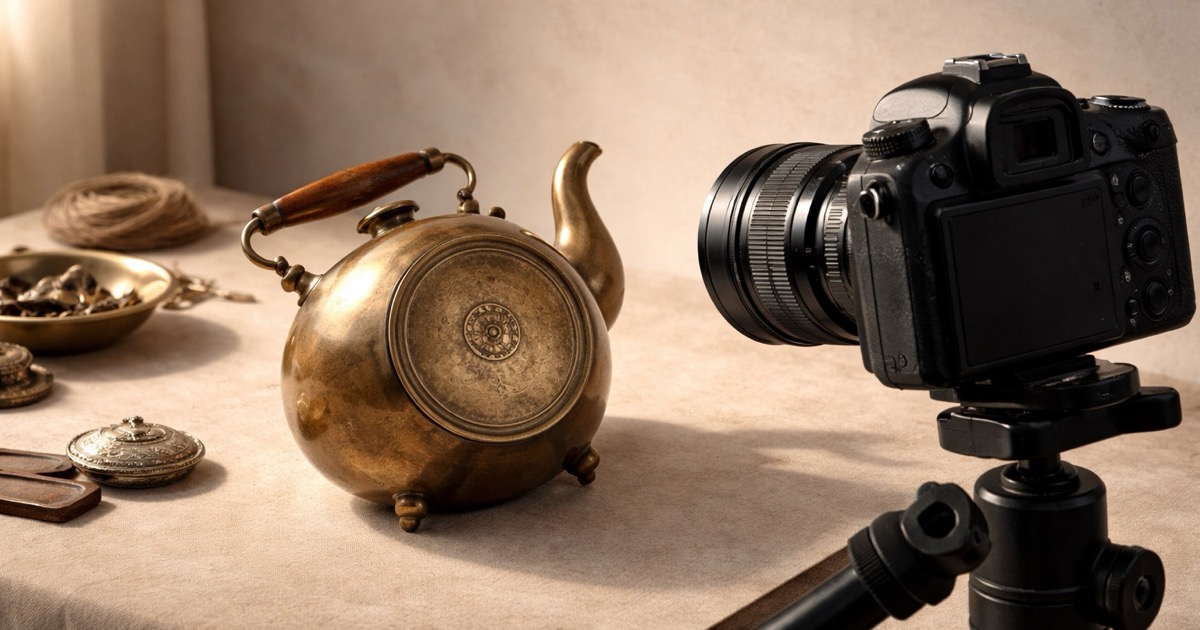
If your mark photos are blurry, reflective, or cropped too tightly, identification gets harder fast. That is true whether you are using reference books, posting in collector groups, or trying Best Antique Identification App: What to Look For. A maker’s mark that looks obvious in person can become unreadable in a rushed phone photo.
The good news is that you usually do not need special equipment. Most people can get much better results by changing light, angle, distance, and the order in which they take the photos.
What a useful mark photo should actually show
A good photo of a hallmark, backstamp, or maker’s mark does more than capture the letters. It should help the viewer understand:
- the exact wording or symbol
- how deep or shallow the mark is
- where it sits on the object
- what material surrounds it
- whether the mark looks impressed, printed, punched, etched, or engraved
That context matters because the type and placement of a mark can be almost as useful as the text itself.
Take these photos in this order
The most reliable workflow is:
- a full-object photo
- a photo of the base, back, or underside
- a straight-on close-up of the mark
- a second close-up from a slight angle
- a wider shot showing where the mark appears on the object
People often skip the first two and jump straight to the macro close-up. That is a mistake. Identification usually improves when the mark can be read in context.
Use light that reveals the mark instead of hiding it
Lighting is the biggest difference between a useful photo and a useless one.
For most objects:
- use indirect daylight near a window
- avoid a harsh on-camera flash
- move the object or the phone slightly until shallow marks become visible
- take more than one angle, especially on metal
On silver and other reflective materials, the wrong light can wash the mark out completely. On ceramics, a straight-on shot may flatten the stamp while a slight angle makes the lettering visible.
Adjust your distance before you zoom
Digital zoom often makes mark photos worse. Instead:
- move closer until the mark is large in the frame
- tap to focus on the mark itself
- hold steady or brace your hands on a table
- take several versions rather than trusting one shot
If your phone has a macro mode, use it. If it does not, back off slightly instead of pushing so close that the camera cannot focus.
How to photograph different kinds of marks
Different categories need slightly different treatment.
Hallmarks on silver
Take one image straight on and one from a shallow angle. Reflective metal often hides details unless the light skims across the surface. If you need category-specific context afterward, pair your images with Sterling Silver Hallmarks: What the Marks Mean and Silver Makers Marks Identification.
Backstamps on china and porcelain
Photograph the full base, then crop in closer. A floating close-up of the mark is less useful than a shot that also shows the foot ring and glaze around it. That extra context supports posts like Antique Porcelain Marks: How to Read Backstamps and Old China Marks Identification.
Impressed pottery marks
Shallow impressed marks often become clearer when the light comes from the side. A dead-on flash photo can flatten them almost completely.
Common photo mistakes that hurt identification
These are the main ones to avoid:
- cropping so tightly that the mark loses context
- taking only one photo
- using a bright flash on reflective metal
- photographing the object while it is still dusty
- shooting at an angle so extreme that the letters distort
Overcleaning is another issue. Gently remove dust, but do not polish away tarnish or wear just to get a brighter image. That can remove useful evidence.
What to include besides the mark itself
For the strongest first-pass identification, upload:
- one full photo of the whole object
- one underside or back photo
- one or two mark close-ups
- one detail shot of wear, damage, or repairs
That combination gives the app or the human reviewer a better chance of spotting contradictions. A mark that says one thing while the material or construction says another is often the most useful clue of all.
When a phone photo is enough and when it is not
For everyday identification, a good phone photo is usually enough. You only need specialist photography if the mark is extremely faint, extremely small, or the item is valuable enough that a better second opinion is worth the effort.
The aim is not perfection. It is clarity. If someone can read the mark, see its placement, and understand the object category, the photo has done its job.