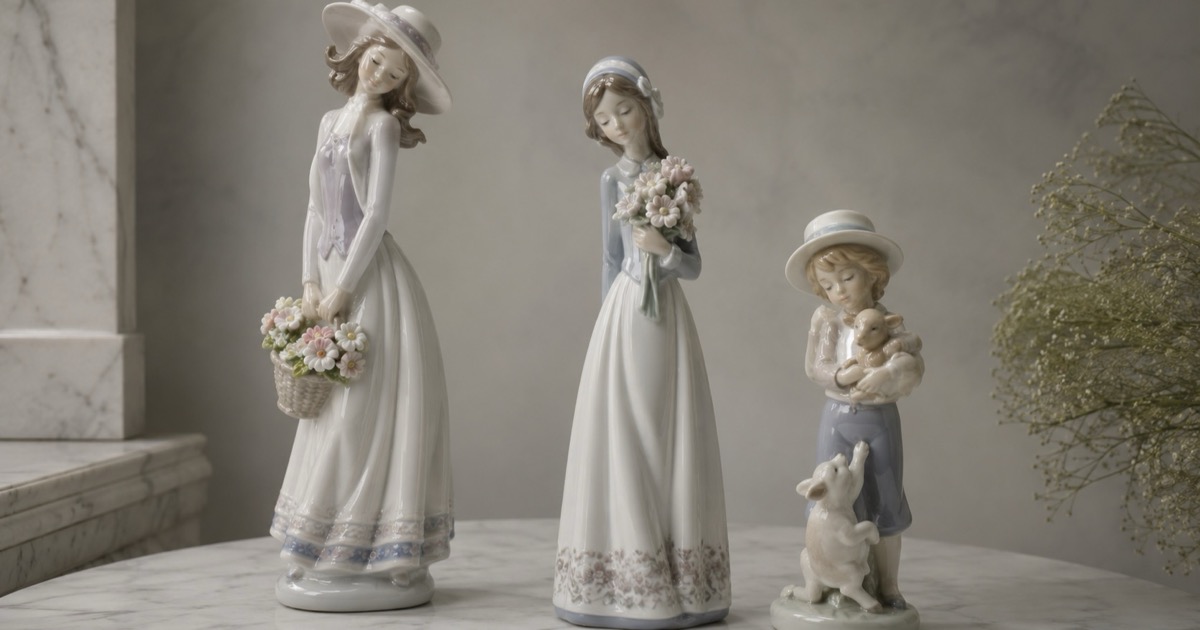
Lladró marks identification starts with the backstamp, but a complete picture of any piece also includes the model number, finish type, condition, and whether the original box and documentation survive. The Valencia-based company has produced porcelain figurines since the late 1950s, and its marking system evolved through several recognizable eras. By the end of this guide you will be able to place a Lladró piece in a broad production era, distinguish it from the NAO sister brand, and understand what drives value differences between otherwise similar pieces.
Lladró marks are backstamps on the base of Spanish porcelain figurines, the most recognizable being the blue bellflower-and-logotype mark, usually with a “DAISA” copyright line on pieces from the late 1970s (about 1977) onward. The mark style and the model number are the key dating tells. Start by photographing the full base and checking the model number against a Lladró catalog.
Lladró’s reputation rests on its porcelain quality and the detailed artistry of its figurines — elongated, graceful human figures, children, animals, and narrative scenes rendered in soft, muted palette glazes. The company’s marks are integral to authentication and dating, and the evolution from early impressed marks to the blue logotype known today gives collectors reliable era brackets.
Quick identification checklist
- Look for the Lladró backstamp on the base — the mark has evolved from early impressed formats to the distinctive blue bellflower-and-logotype mark most collectors recognize.
- Check for the “DAISA” copyright line beneath or near the main mark — this appears on most production from the 1970s onward and is a good authentication cue.
- Read the model number if present — it identifies the specific sculpture and allows confirmation in Lladró reference catalogs.
- Assess the finish type: standard glazed, matte (called “matt” in some references), or Gres (a distinctive stoneware-textured finish produced in a specific production period).
- Examine condition carefully at the most vulnerable points — outstretched fingers, flower petals, lace hem details, and thin ribbon elements are the first to chip or break.
- Check for a NAO mark or label — NAO is the sister brand and carries different value expectations.
Backstamp evolution: the general eras
Lladró’s marks went through several broad phases, and while the precise boundaries of each era are documented in specialist references, the general progression is consistent.
The earliest production used impressed or incised marks — text or symbols pressed into the clay before firing rather than painted on. These early marks are less common in general circulation and typically appear on pieces from the founding decade of production.
The blue bellflower mark — a stylized flower with the Lladró name — became the signature identifier of the company’s output. This mark was applied in blue underglaze and has gone through refinements in the logotype and flower rendering across production decades. The general shape and color are consistent enough to identify at a glance, but specialists track specific variations in the flower rendering and letterform to date pieces more precisely.
The “DAISA” copyright notice — standing for Diseños Artísticos e Industriales, S.A., the Lladró company that holds its design copyrights — appears in the backstamp area on most production from about 1977 onward. A Lladró piece without a DAISA line is likely either early production or, less commonly, a fake.
Some pieces from certain periods also carry country of origin marks such as “Made in Spain,” which are consistent with European production and US import requirements.
The NAO sister brand
NAO is a companion line produced by Lladró using the same porcelain and production standards but positioned as a more accessible, lower-price line. NAO pieces carry their own separate marks — the NAO name with a stylized flower mark — and are not mislabeled Lladró pieces. They are genuine quality porcelain.
The value distinction matters: NAO figurines generally sell for less than equivalent Lladró pieces, even when the quality and scale are similar. A buyer or seller who mistakes a NAO for a Lladró (or vice versa) based on a casual glance at a graceful porcelain figure is making a meaningful error. The marks are distinct and readable, so this confusion is avoidable with a close look at the base.
Finish types: glazed, matte, and Gres
Lladró produced figurines in several finish treatments, and identifying the finish type helps date and value a piece.
Standard glazed finish is the most common and familiar: the soft, slightly luminous surface typical of the company’s pastoral and figurative subjects. Color in glazed pieces tends to be soft and blended.
Matte finish pieces have a chalky, non-reflective surface that gives a different visual character to the same sculptural forms. Some subject matter was produced in both glazed and matte versions; the two finishes can look quite different and may have different market values.
Gres is a specific stoneware-body finish with a textured, earthier surface that Lladró introduced as a distinct product line. Gres pieces have a heavier, rougher visual character compared to standard porcelain production. They were produced in specific periods and subject matter, and pieces are marked with “Gres” in addition to or instead of standard Lladró marks in some cases.
Model numbers and retired pieces
Each Lladró sculpture has an assigned model number, typically stamped or painted on the base alongside the backstamp. These numbers allow precise identification against published Lladró catalogs and reference databases.
The distinction between active and retired models is the primary driver of secondary market value beyond condition. When Lladró retires a model — ceasing production — its scarcity on the secondary market tends to increase over time, particularly for popular subjects. A retired model in excellent condition with its original box and certificate of authenticity commands a premium over the same model still in production or sold without documentation.
Some pieces were also produced as limited editions with specific edition sizes and certificates. Confirming edition status and number for claimed limited editions requires the accompanying documentation; certificates can be separated from pieces over time.
Condition sensitivities
Lladró figurines are among the most condition-sensitive collectibles in the porcelain category because of the complexity and delicacy of their decorative elements.
Fingers and hands on human figures are thin, unsupported, and extremely prone to chipping or complete breakage. Any figure with outstretched arms or holding objects deserves very careful inspection at these points.
Flower petals and blossoms — which appear as applied elements on many Lladró pieces — chip or break at the petal tips. Inspect each petal individually; a repaired or missing petal dramatically reduces value.
Lace-effect decoration, where thin porcelain strips were applied to simulate fabric texture, is extremely fragile. Look along every edge of lace detail for chips or cracks under bright light.
Thin ribbons and bow elements break at their narrowest points. Examine from multiple angles.
Repairs on Lladró are common and can be skillfully done. Run a black light across the piece — many repair resins fluoresce differently from the original porcelain.
Boxes, certificates, and their effect on value
Original Lladró boxes, foam inserts, and certificates of authenticity are meaningful value factors. A piece sold in its original box with certificate typically commands a noticeable premium over the same piece sold without documentation, particularly for limited editions and retired models. The condition of the box matters somewhat; a crushed or heavily worn box adds less value than a clean original.
Certificates for limited edition pieces should include the edition size, piece number within the edition, and typically a signature or authentication stamp. Without the certificate, a claimed limited edition is difficult to verify.
Watch-outs and common mistakes
- Confusing NAO with Lladró — always read the full base mark; the brands are distinct in name and mark design, and confusing them is a meaningful pricing error.
- Missing repairs under ambient light — use a black light on any piece before purchase; hairline repairs and filled chips are common and may not be visible in ordinary lighting.
- Overlooking the DAISA line as an authentication cue — its absence on a claimed post-1970s piece warrants closer scrutiny.
- Assuming an original box confirms authenticity — boxes can be separated from pieces and reunited incorrectly; always confirm that the model number on the piece matches the box.
- Ignoring finish type in valuation — glazed and matte versions of the same model may have different collector values; treat them as distinct items.
Photo tips that improve identification
- Photograph the full base in even, bright light to capture the backstamp, model number, DAISA line, and any country-of-origin marks together in one shot.
- Capture any flowers, lace details, and hands from a close angle with raking side light — this reveals chips and repairs that flat frontal light conceals.
- Take a side view of the full figurine against a neutral background to capture the sculptural silhouette, which is useful for model identification.
- Under a black light, photograph the piece on a dark surface — fluorescent areas indicate repairs.
Common questions
What does DAISA mean on the bottom of a Lladró figurine?
DAISA stands for Diseños Artísticos e Industriales, S.A., the Lladró company that holds the design copyrights for its sculptures. The DAISA copyright line appears near the main backstamp on most production from about 1977 onward. Its absence on a piece claimed to be from a later era warrants closer scrutiny, since it may indicate either early production or a fake.
Is NAO the same as Lladró?
NAO is a companion brand produced by Lladró using the same porcelain and production standards, but positioned as a more accessible, lower-price line. NAO pieces carry their own distinct mark — the NAO name with a stylized flower — and generally sell for less than equivalent Lladró pieces even when quality and scale are similar. Always read the full base mark before pricing a graceful Spanish porcelain figure.
What do the numbers on the bottom of a Lladró figurine mean?
The number stamped or painted on the base is the model number, which identifies the specific sculpture in Lladró’s catalog. It lets you confirm the subject, check whether the model is active or retired, and verify that an original box matches the piece inside it. Retired models in excellent condition with their box and certificate generally command the strongest secondary market interest.
Related guides
- How to Identify Hummel Figurines
- Antique Porcelain Marks: How to Read Backstamps
- Royal Doulton Marks Identification
When to use the Antique Identifier app
Photograph the full figure plus a tight shot of the base showing the backstamp and model number. The app can help confirm the mark era and identify the model against the Lladró production catalog. For any piece identified as a retired limited edition or a rare early-production piece, treat the result as a starting point and verify against current Lladró secondary market listings or a specialist before drawing value conclusions.