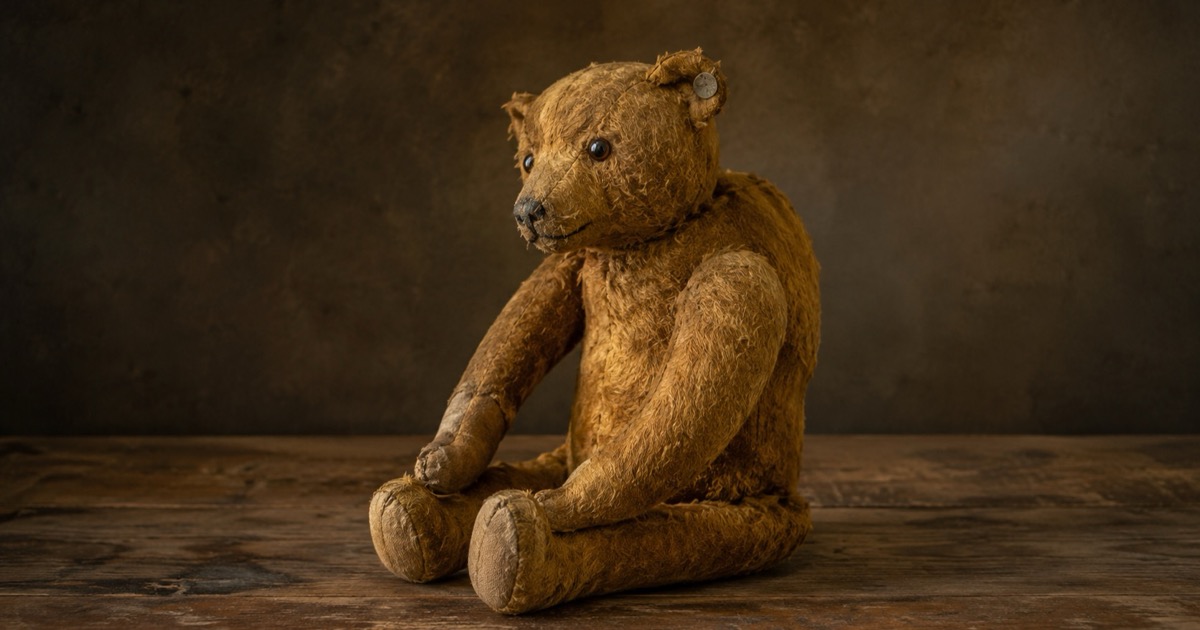
Steiff bear identification starts at the left ear, where the German company’s famous button has marked its animals for well over a century. That button — and the tags associated with it — is the single most copied, faked, and misunderstood element in vintage toy collecting. Understanding what the button actually tells you, how the tag system evolved in general terms, and what the body construction of a genuine old bear looks like will keep you from paying serious money for a replica or a later piece misrepresented as early.
A genuine Steiff bear is identified by the small metal button crimped through its left ear, often paired with a fabric ear flag whose color brackets the production era. Check the left ear first, then confirm the body matches: mohair plush, firm excelsior stuffing, and on early bears a pronounced back hump and long curved arms.
By the end of this guide you will know how to read Steiff’s ear button system, interpret ear flags and chest tags in broad terms, assess body construction for age, evaluate repairs and replacements, and separate Steiff’s own authorized replicas from genuine antique bears.
Quick identification checklist
- Check the left ear first for a button — its absence doesn’t rule out Steiff, but its presence (real or fake) is the starting point for everything else.
- Look at the button itself under good light: what metal is it, what does it say or show, and does the backing wire look period-correct or recently added?
- Check for a small fabric ear flag or tag on the same ear as the button — the flag’s color and text narrow the production era.
- Examine the body: early bears have a distinctive elongated profile with a pronounced back hump, longer curved arms, and a narrower muzzle compared to later, rounder designs.
- Look at the eyes: shoe-button eyes (black, dome-shaped, with a shank) predate glass eyes in the early Steiff timeline, and glass eyes came in before plastic.
- Check the pads on the paws and feet — original felt or velvet pads are a condition point; replaced pads are very common and affect value but do not disqualify a bear.
The button-in-ear system
Steiff adopted the button-in-ear as its registered trademark in the early 1900s, and it has remained the brand’s signature ever since. The concept is simple: every animal produced at the Giengen factory received a small metal button crimped through the left ear. The button was meant to be permanent — not a swing tag that could be removed, but a physical part of the toy.
The earliest buttons, from the very start of the system around 1904, carried a small embossed elephant. Blank buttons with no text or image followed for a few years after. The script name “Steiff” came next, and the most commonly seen vintage format is that script lettering with the tail of the final “f” trailing back to underscore the word — collectors call it the underscored or trailing-F button. Later production shifted to a raised block or printed format. The button itself evolved from a flat-topped form to a convex dome over time.
None of these eras can be pinned to a tight specific year without specialist reference, and describing precise date ranges risks more precision than the evidence supports. What matters practically: blank buttons with the correct backing wire are among the earliest; elephant buttons are rare and specialist territory; script-Steiff buttons on properly constructed bears span much of the classic collection era.
Ear flags, chest tags, and what their markings tell you
From a certain point in production history, Steiff added a fabric flag or tag threaded through the same post as the ear button. These flags are small paper or fabric labels printed with the bear’s name, size designation, and often the country of origin.
The color of the ear flag has changed over the decades, and in general terms: white flags are the earliest (up to the mid-1920s), red flags bracket the late 1920s to mid-1930s, and yellow flags run from the mid-1930s onward — with white tags reappearing on modern limited editions and replicas. This color coding is well-documented in Steiff collector guides and can be used to bracket a piece’s approximate period once you have matched the flag to a reference. Do not treat the flag alone as authentication — flags can be transferred from one bear to another or fabricated — but a matching button, flag, and body that all date to the same era is meaningful corroboration.
Chest tags and breast buttons appear on some bears as additional labels and are particularly common on mid-20th century production. A round brass chest button with the Steiff name and trademark is a secondary authentication point on certain production runs.
Body construction of early bears
The profile of an early Steiff bear is distinctive once you know what to look for. Pre-World War II bears and the earliest production tend to have a pronounced hump at the top of the back, a long tapered muzzle, and arms that are longer and more curved than later, rounder styles. The proportions feel more animal than toy, because early Steiff bears were designed to resemble real bears loosely, not to optimize cuteness.
The original stuffing material for both the body and the head is excelsior — fine wood shavings, also called wood wool — which feels firm, crinkly, and slightly irregular when you gently press the bear. Later bears may use a combination of excelsior and kapok, or kapok alone, or eventually synthetic stuffing. Original excelsior stuffing that crinkles and holds a firm shape is a positive age indicator.
The covering material is mohair: the natural fiber from an Angora goat, woven into a plush fabric with a distinctive sheen and texture that differs from synthetic plush. Old mohair may be worn, thinned, or matted; its luster fades over time. The difference in hand feel between genuine mohair and synthetic plush is significant and learnable. Early mohair sometimes shows a sparse, slightly silky pile; later synthetic copies are often denser and more uniform.
Replaced pads, eyes, and repairs
Paw pads and foot pads on antique bears are almost always the most worn or damaged elements. They were traditionally made of felt or velvet, and decades of play and storage take a toll. Replaced pads are extremely common, and a bear with replacement pads is not necessarily compromised in authenticity — it is simply a bear that received care. What matters is whether the replacement work was done sympathetically and whether it is disclosed.
Eyes are similar: shoe-button eyes can loosen or fall out; glass eyes can crack. Replaced eyes should match the period-appropriate type. A bear that was made with shoe-button eyes and now has plastic safety eyes has been altered. Repairs, including replaced pads, new eyes, stitched-up seams, and even re-covering small worn patches, are standard in the history of any bear that has been used and loved. They affect condition grades and, accordingly, prices — but they do not make a genuine bear fake.
Replicas, limited editions, and the fake-button problem
Steiff has a long tradition of producing authorized replicas of its own historic bears, including faithful reproductions of early designs sold in limited editions. These replicas are correctly marked as such: the ear button typically includes the word “Replica” or references a reproduction series, and the documentation is transparent. A Steiff replica is a genuine Steiff product and not a fraud — but it is also not an antique bear, and it should be priced as a limited-edition modern item, not as the original it references.
The more serious problem is the non-Steiff fake button. Because the button is the primary authentication point, counterfeiters create buttons that resemble Steiff’s markings and attach them to bears that were never made at Giengen. These fake buttons range from obvious to quite convincing. The tell-tale signs include metal that looks wrong (too bright, wrong alloy, wrong font on the lettering), mounting wire that appears recently applied rather than aged with the bear, and a bear body that does not match the construction expected for the era the button would imply. When button, body construction, materials, and proportions all align to the same era, confidence increases. When the button is the only claimed authentication and everything else is ambiguous, treat it with serious skepticism.
Watch-outs and common mistakes
- Assuming any bear with a button in the ear is a genuine antique Steiff — buttons can be added after the fact.
- Overlooking Steiff’s own replica bears as potential auction and estate-sale items; they are legitimate Steiff products but not antiques.
- Undervaluing a bear with replaced pads; pad replacement is nearly universal in played-with examples and does not disqualify a genuine piece.
- Treating synthetic plush as a disqualifier without checking whether the piece dates from a later production era when synthetic materials were used intentionally.
- Paying early-era prices based on button alone without checking that the construction, stuffing, and materials are consistent with the era claimed.
Photo tips that improve identification
- Photograph the left ear from directly in front to show the full button face clearly, then a second shot from the side to show the backing post and crimp.
- Capture the ear flag in a flat, well-lit close-up so all text and color are readable.
- Photograph the full bear in profile — a side view shows the hump, arm length, and muzzle taper most clearly.
- Get a close-up of the paw pad material to show whether it is original, worn, or replaced, with good light revealing the texture.
Common questions
How can you tell if a Steiff bear is real?
Start with the button in the left ear, but never stop there, because fake buttons exist and real buttons can be added to other bears. A genuine piece shows agreement across every element: the button style, the ear flag color, mohair covering, period-correct stuffing, and body proportions that all point to the same production era. When the button is the only evidence and the rest is ambiguous, treat the bear with skepticism.
What do the ear tag colors on a Steiff bear mean?
The fabric flag threaded through the ear button changed color over the decades, and the color brackets the era in general terms: white flags are the earliest, red flags bracket roughly the late 1920s to mid-1930s, and yellow flags run from the mid-1930s onward. White tags also reappear on modern limited editions and replicas, so the flag must be read together with the button and body construction.
Is a Steiff bear with replaced paw pads still valuable?
Yes. Felt and velvet pads are the most wear-prone part of any old bear, and replacement is nearly universal on played-with examples. Sympathetic, disclosed pad replacement lowers the condition grade and the price somewhat, but it does not make a genuine bear inauthentic. Replaced eyes follow the same logic, provided the replacements match the period-appropriate type.
Related guides
- How to Identify Antique Bisque Dolls
- Antique Cast Iron Toy Identification
- Vintage Marbles Identification
When to use the Antique Identifier app
Photograph the whole bear alongside a close-up of the button and ear tag, and include a profile shot showing body proportions. The app can help match the button style, flag color, and body construction to production eras quickly. If the result points to a rare early bear, treat that as a prompt for verification by a Steiff specialist or a toy auction house before making significant decisions.