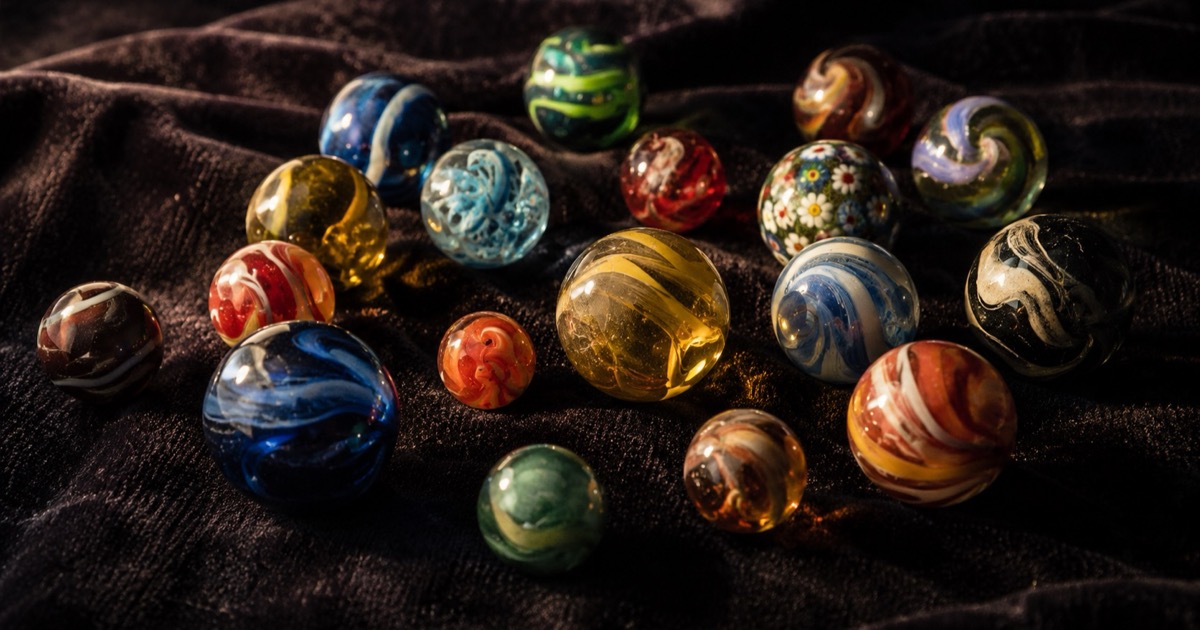
Vintage marbles identification starts with one question that immediately separates the most collectible pieces from the common ones: is this marble handmade or machine-made? That distinction carries a century of manufacturing history and separates German handmade production from American machine-era output. Once you understand the production tells, reading an individual marble becomes a matter of matching its physical characteristics to a documented type and era.
Vintage marbles divide into handmade German pieces, which show a rough pontil scar at one or both poles, and American machine-made marbles, which are perfectly round with no scar. Check the poles under good light first, then match the internal pattern — swirl, onionskin, sulphide, corkscrew, or cat’s eye — to a documented type and era.
This guide covers the key evidence — the pontil mark that defines handmade work, the major American machine-made manufacturers and their recognized types, the ubiquitous cat’s eye that anchors the common end of the market, condition grading basics, and the reproduction problem that every collector needs to understand.
Quick identification checklist
- Turn the marble slowly in good light and look at both poles for a pontil mark or scar
- Note the internal design: swirls, layered colors (onionskin), encased figures (sulphide), patchy colors, or a central cage structure (cat’s eye)
- Measure diameter: most vintage play marbles fall between roughly 9/16 inch and 3/4 inch; shooters are larger
- Examine the glass surface for wear consistent with actual play: fine surface scratches in random directions
- Look for any chipping: chips dramatically reduce value; surface pitting from age is less damaging than impact chips
- Hold it against a bright light source to see internal color structure and density
Handmade German marbles: the pontil mark as the key age clue
The most important single feature on a handmade marble is the pontil mark: a small rough spot, scar, or slightly textured area at one or both poles of the marble where the glass rod was snapped off during manufacture. German craftsmen made marbles by heating a glass rod in a flame and twisting off the molten bead; the break point left a distinctive mark.
Pontil marks range from a tiny rough nub to a slightly flattened or discolored spot at the pole. They are not perfectly round and smooth like the rest of the marble. Finding one is the single strongest indicator that you have handmade work, which in practice means German production roughly from the mid-19th century through the early 20th century, before American machine production took over the market.
Swirl marbles are among the most common handmade types: colored glass threads or ribbons are pulled through or around the body, creating spiral patterns. The variety of swirl configurations — latticinio cores, ribbon cores, corkscrews, divided cores — is wide and forms much of the collector classification system for handmade work.
Onionskin marbles appear to have a surface layer of color with a transparent outer shell; the layered construction creates a distinctive depth. They are generally considered among the more desirable handmade types.
Sulphide marbles contain a small figure — an animal, a person, a number — encased in clear glass. The figure is typically made from a white or silvery compound suspended in the center. Sulphides are consistently among the highest-value vintage marble types; the subject matter (rare animals, people, vehicles) and condition of both the marble and the internal figure drive price.
Machine-made American marbles: Akro Agate, Peltier, Christensen
American machine-made marble production began in earnest in the early 20th century. The key immediate difference from handmade work: no pontil marks. Machine-made marbles are perfectly round with no manufacturing break points, and the internal patterns were formed mechanically as molten glass streams were cut and formed.
Three makers are particularly well documented in collector circles:
Akro Agate (Clarksburg, West Virginia) produced large quantities of marbles from roughly the 1910s through the 1950s. Their recognized types include corkscrews (twisted two-color ribbons running helically through the marble), patches, and various specialty types. Akro production is usually identifiable by its specific color palettes and pattern styles documented in collector references.
Peltier Glass Company (Ottawa, Illinois) produced marbles broadly through the mid-20th century. Their slags (a marbled, swirled type in various base colors with contrasting veining) and various patch-style marbles are the most collected types. Peltier’s color combinations have been documented and cataloged by specialist collectors.
Christensen Agate (Cambridge, Ohio) operated for a shorter period in the 1920s and 1930s and is prized by collectors for intense colors and specific flame-pattern types. Genuine Christensen examples in good condition are among the most valuable machine-made marbles.
Dozens of other American factories operated over the same period, and not all machine-made marbles can be attributed to a specific maker — collector research on less-documented types is ongoing.
Cat’s eyes: the common late type
The cat’s eye marble — a clear or lightly tinted glass body with a central cage or vane of colored glass inside, creating the appearance of a cat’s pupil — is the marble most people over age forty remember from childhood. It is also the most common vintage marble type on the market and typically the least valuable.
Cat’s eye production began in Japan in the postwar period and was imported to the United States in enormous quantities starting in the 1950s, eventually displacing most American machine production. The construction is distinctive: the internal colored vane is inserted as a separate element rather than being part of the original glass flow, which is why it creates the sharp cage or fin appearance rather than the blended swirls of earlier marbles.
A box of cat’s eyes is worth understanding as a dating floor: if a collection is predominantly cat’s eyes, it is almost certainly mid-20th century or later.
Size and condition grading basics
Size matters for identification context. Standard play marbles from the American machine era cluster around a fairly consistent size range. Oversized marbles (shooters, mibs) were intentionally large. Very small marbles were sometimes made as accessories or toys within toys. Unusual sizes on handmade marbles are not uncommon.
Condition creates an enormous value gap in vintage marble collecting. The standard collector terms:
- Mint (M): no chips, no scratches, original surface luster, no manufacturing flaws other than very minor ones
- Near mint (NM): tiny surface scratches visible under close examination, no chips
- Good (G): play wear visible — surface scratches, slight dulling — but structurally intact
- Chips and breaks: significant damage that collectors classify separately, usually reducing value to a fraction of a comparable mint example
The gap between a mint handmade swirl and a played-out example of the same type can be dramatic. Buy condition honestly.
Remelts, reproductions, and “fantasy” marbles
The marble market has several categories of pieces that are not what they appear:
Remelts are old broken or cullet glass reworked into new marbles. The glass itself may be genuinely old, but the marble was made recently. A remelt will typically lack a period pontil mark in the expected style and may show slightly off color distribution compared to genuine period production.
Reproductions are newly made marbles intended to resemble valuable vintage types. Some are sold honestly as contemporary art glass; others are sold or drift into the market misrepresented as period pieces. Contemporary glass artists produce technically excellent marbles that can superficially resemble handmade German or early American machine-made types.
Fantasy marbles are modern pieces in styles that never actually existed in the period being invoked — for example, a “sulphide” with a subject that would not have been encased in the 19th century, or color combinations consistent with modern glass chemistry rather than period production.
The best defense against these is learning the documented color palettes, pontil mark styles, and surface aging patterns of genuine period marbles through collector references, auction records, and established collector communities before making significant purchases.
Watch-outs and common mistakes
- Confusing wear from tumbling (evenly polished all over, luster too perfect) with authentic age patina
- Assuming a pontil mark means great value: common handmade swirl marbles in played condition are genuinely common; condition and type drive the premium
- Overlooking that cat’s eye marbles can be 60+ years old without being particularly rare or valuable
- Buying significant pieces without reference to current auction results: the vintage marble market has active price discovery through specialist auctions
Photo tips that improve identification
- Rotate the marble slowly in a single directional light source and photograph both poles to capture any pontil marks
- Photograph against a neutral dark background to maximize color contrast in the interior design
- Use backlighting for sulphides to show the internal figure’s detail and condition
- Include a size reference (a ruler or a standard quarter-dollar coin) to document diameter
Common questions
How can you tell if a marble is handmade or machine-made?
Look at the poles. A handmade marble shows a pontil mark — a small rough nub, scar, or flattened spot where the glass rod was snapped off — at one or both ends, while machine-made marbles are perfectly round with no break point. A pontil mark generally points to German production from the mid-19th century into the early 20th century.
Are old cat’s eye marbles worth anything?
Usually very little, even when they are sixty or more years old. Cat’s eyes were made in enormous quantities, mostly in postwar Japan and imported from the 1950s onward, so age alone does not make them scarce. A collection dominated by cat’s eyes is almost certainly mid-20th century or later, and value sits at the common end of the market.
What is the most valuable type of vintage marble?
Sulphide marbles, which encase a small white figure such as an animal or person in clear glass, are consistently among the highest-value vintage types, with rare subjects commanding the strongest interest. Desirable handmade swirls and onionskins, and scarce machine-made marbles such as Christensen Agate flames, also sit at the top of the market when condition is near mint.
Related guides
- Antique Cast Iron Toy Identification
- How to Identify Antique Bisque Dolls
- Antique Button Identification Guide
When to use the Antique Identifier app
Photograph the marble against a neutral background with sidelighting, then capture a second shot with backlighting to show internal structure. Add a photo of each pole to document the presence or absence of a pontil mark. The app can classify marble type and suggest era and possible maker attribution quickly, helping you build a research baseline for further price and authenticity investigation.