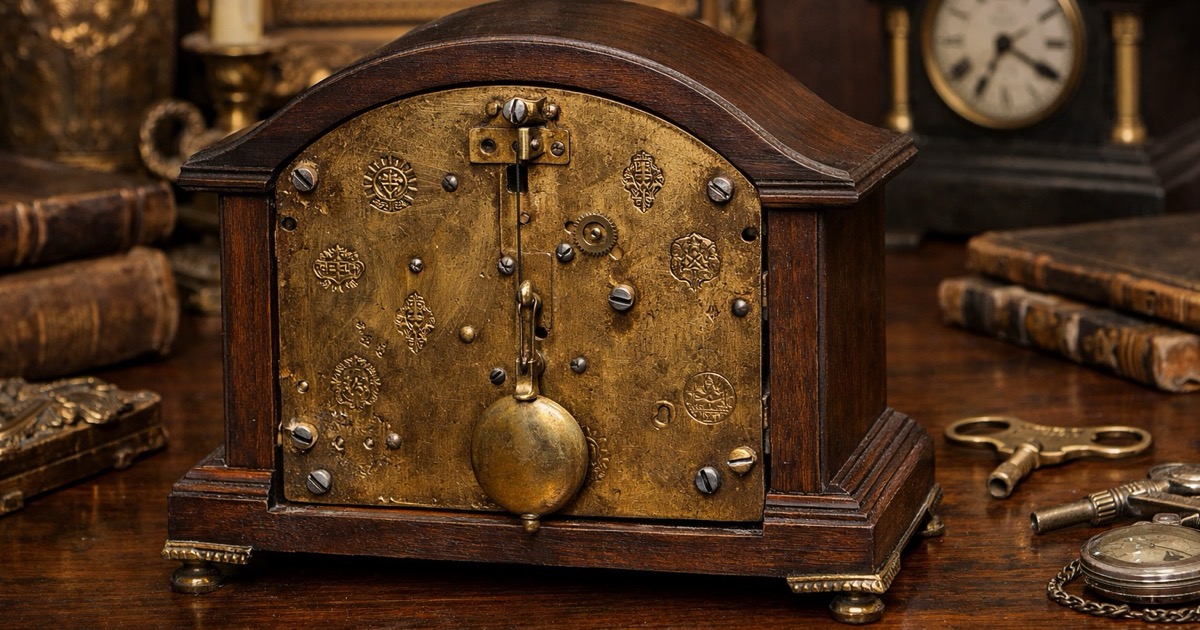
Antique clock makers marks are usually found in two places: signed across the dial (the maker or retailer name and often a town) and stamped, engraved, or punched on the movement’s backplate. Read them together, because a clock is really two objects — a case and a movement — that did not always start life as a pair. The most reliable identification comes from the movement, since dials were repainted and cases were swapped far more often than the mechanism was replaced.
This guide walks through where the marks hide, how to read a signature and turn it into a maker and a date, and the traps that trip up beginners — swapped movements, retailer names mistaken for makers, and marriage clocks assembled from mismatched parts. The goal is not certainty from one photo, but a workflow that tells you what you have and whether it is worth a specialist’s opinion.
Quick identification checklist
- Read the dial: note the exact spelling of any name and town, and whether it names a maker or a retailer (“retailed by”).
- Open the case and photograph the movement’s backplate — the signature, engraving, and any serial or batch numbers.
- Note the movement type: verge, anchor/recoil, or platform escapement, and whether it is weight-driven or spring-driven.
- Check the dial material and style: painted iron, silvered brass, enamel, or a one-piece chapter ring, since each points to a rough period.
- Look for country-of-origin and import marks, especially on American, German, and French clocks sold abroad.
- Compare the case and movement for a matching age; a Victorian movement in a Georgian-style case is a warning sign, not a bonus.
Where the marks hide
On most antique clocks the name you see first is on the dial, painted or engraved across the center, in an arch above the chapter ring, or on a small silvered plaque. Treat that name cautiously: through the eighteenth and nineteenth centuries it was common for the seller — a jeweller or clock retailer — to put their own name on a clock made by someone else, so a dial signature can be a shop rather than a workshop.
The stronger evidence is on the movement. Turn the clock and open the back or the case door, and look at the backplate: English bracket and longcase movements were often signed and sometimes elaborately engraved, while later mass-produced American and German movements carry a stamped trademark, a factory name, and frequently a patent date or serial number. French movements usually stamp a maker’s or supplier’s mark and a serial number on the back, and the best-quality ones carry medaille (medal) stamps from industrial exhibitions. Record every number exactly as struck, because on many factory clocks a serial or date code is the single most datable clue.
Do not overlook secondary spots. Paper labels pasted inside the case (standard on American shelf clocks), pendulum bobs, weights, bells, and the pillars between the plates can all carry marks, initials, or numbers. Photograph each straight on with one wider shot showing where it sits.
Reading a dial or backplate signature
A signature is usually a name plus a place: “Thomas Tompion, London” or “Jos. Ives, Bristol, Conn.” The place matters as much as the name — it narrows the search and separates makers who shared a surname. For English work, a signed and elaborately engraved brass backplate points to a serious eighteenth-century maker; the V&A’s collection includes longcase clocks by leading London makers such as Thomas Tompion, whose signed movements set the benchmark for the period (Victoria and Albert Museum).
Watch the wording. “Retailed by,” “sold by,” or a jeweller’s shop name signals a seller rather than the maker, and you will need the movement to find who actually built it. Abbreviated Christian names (“Jno” for John, “Jas” for James, “Wm” for William) are normal in older signatures. Copy the spelling, punctuation, and any address exactly, then check it against maker directories and horological references — collector societies maintain the databases and libraries that turn a name into a documented maker and working dates (National Association of Watch and Clock Collectors).
Dating clues in the movement and dial
The mark tells you who; the mechanism and dial tell you roughly when. Escapement type is one of the clearest signals: the older verge escapement (with a bob or short pendulum, often on a bracket clock) generally gives way to the anchor or recoil escapement for longer, more accurate pendulums from the late seventeenth century onward. Weight-driven movements suggest a longcase or a wall clock; spring-driven ones allowed the portable bracket, carriage, and shelf clocks that dominate later production. Museums document how escapement and drive technology evolved across the period, which helps place an unsigned movement in a rough era (Science Museum Group).
Dials evolved too. Early English longcase dials used a separate brass chapter ring applied to a matted brass plate; one-piece painted (japanned) iron dials became common from the late eighteenth century; and white enamel and silvered dials point to specific later fashions. Use the table below as a first-pass guide, then confirm against a maker-specific reference rather than dating the whole clock from one feature.
| Feature | Rough period | What it tells you |
|---|---|---|
| Brass dial with applied silvered chapter ring | Late 1600s–late 1700s | Earlier, usually higher-end English work |
| One-piece painted iron dial | Late 1700s onward | Volume production, often provincial |
| White enamel dial | 1700s–1800s | French and finer clocks; check the movement |
| Verge escapement, short pendulum | 1600s–1700s (bracket) | Earlier movement, though many were later converted |
| Anchor/recoil escapement | Late 1600s onward | Longer pendulums, improved accuracy |
| Stamped factory trademark and serial number | 1800s–1900s | Mass-produced American, German, or French clock |
Dating from marks is a best-estimate exercise, not a guarantee. Movements were repaired and swapped, dials were repainted, and factory codes were reused, so treat a single feature as a lead to verify rather than a verdict.
Retailer names, marriages, and swapped movements
The two most common ways to misread a clock both involve trusting the wrong part. The first is the retailer trap: taking a jeweller’s dial signature as the maker when the movement was bought in from a specialist workshop or a factory. The second is the “marriage” — a clock assembled from a case and a movement that never belonged together, sometimes to dress up a plain movement in a grander case, sometimes just from decades of repairs. Check that the movement’s seatboard, pendulum, and dial fit their case without fresh holes, filler, or mismatched patina. A movement that looks a century older or younger than its case deserves scrutiny before any attribution.
Import and origin marks add a final check. American, German (look for names like Junghans or the “Made in Germany” mark), and French clocks exported abroad often carry country-of-origin stamps that both help date them and flag a movement that does not match a supposedly local case. When the dial and the movement tell different stories, believe the movement — and when the value looks high, get a horological specialist to confirm before you buy, sell, or restore.
Watch-outs and common mistakes
- Reading the dial name as the maker when it is a retailer or jeweller who sold, not built, the clock.
- Dating the whole clock from one feature; movement, dial, and case can each be different ages.
- Missing a “marriage” — a fine case hiding a swapped or later movement.
- Cleaning or repainting a dial before recording the original signature, which can erase the best evidence.
- Ignoring serial or patent numbers on factory movements, which are often the most precise dating clue.
Photo tips that improve identification
- Photograph the dial signature straight on, then the full dial so the layout and hands read clearly.
- Open the case and shoot the movement backplate square-on, capturing any engraving, stamp, or serial number.
- Add a wide shot of the movement in its case so a specialist can judge fit and spot a marriage.
- Capture any case label, and photograph pendulum, weights, and bells if they carry marks.
Common questions
Where is the maker’s mark on an antique clock?
Look in two places. The dial often carries a painted or engraved name and town near the center or in the arch, but this can be a retailer. The more reliable mark is on the movement’s backplate — an engraved signature on English clocks, or a stamped trademark, factory name, and serial number on American, German, and French movements. Case labels, weights, and pendulum bobs can carry marks too.
How do I date an antique clock by its movement?
Combine several clues rather than trusting one. Escapement type (older verge versus later anchor), drive type (weights versus a spring), dial material and style, and any stamped serial or patent number together place a clock in a rough period. Factory serial and patent numbers on mass-produced movements are often the most precise, so record them exactly and check them against a maker-specific reference.
What is a clock “marriage” and why does it matter?
A marriage is a clock assembled from a case and a movement that did not originally belong together, either through old repairs or to make a plain movement look grander. It matters because it lowers value and can mislead dating, since the case and movement may be different ages. Check for fresh seatboard holes, filler, mismatched patina, or a movement that looks much older or younger than its case.
Related guides
- Antique Marks Identification: How to Read Antique Marks
- How to Photograph Makers Marks for Identification
- How to Identify a Pocket Watch by Serial Number
- How to Identify Vintage Wristwatches
- Where to Find Markings on Antique Furniture
When to use the Antique Identifier app
Photograph the full dial and, once the case is open, a square-on shot of the movement backplate with any signature, stamp, or serial number in focus. The app can narrow the likely type, era, and sometimes the maker or factory, which tells you whether the clock in front of you deserves a specialist’s reference check. If the result points to a named eighteenth-century maker or an otherwise valuable movement, treat that as the start of verification — ideally with a horological specialist — rather than a final answer.
Sources
- Identification & Dating (NAWCC Horology - The Index)
- National Association of Watch & Clock Collectors (homepage)
- British Horological Institute (homepage)