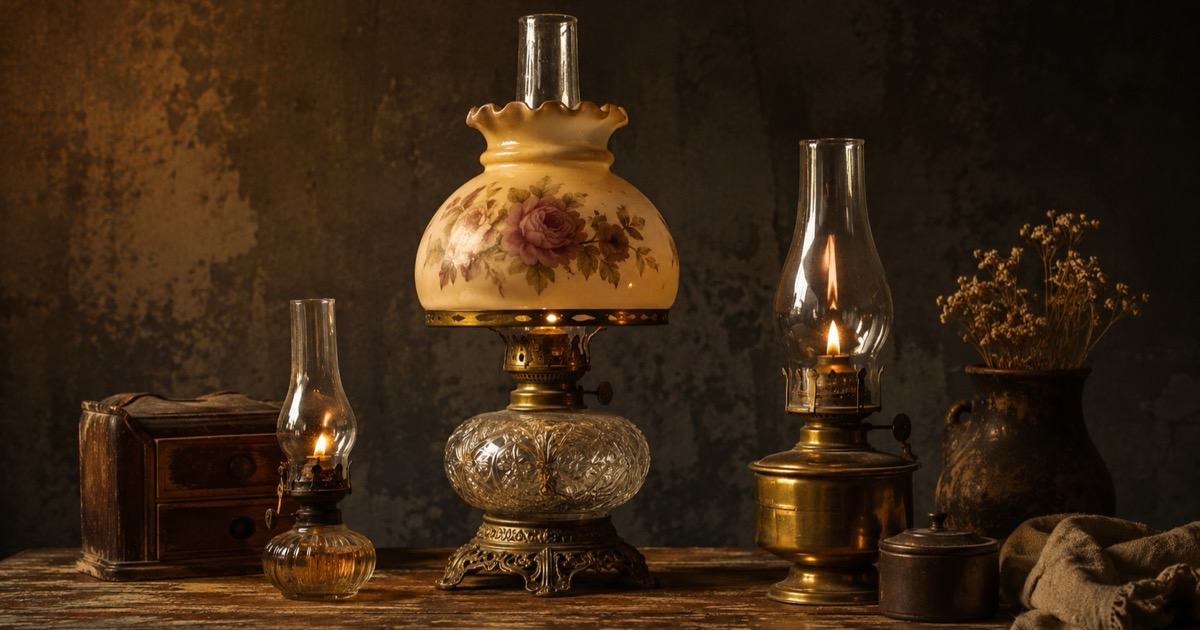
Antique oil lamp identification depends on reading several interlocking clues: the burner mechanism, the font (fuel reservoir) construction, the base material, and any patent or maker stamps. No single feature dates a lamp on its own, but together they build a picture of when and where a lamp was made and whether its parts belong together. By the end of this guide you will be able to place a lamp in a broad era, recognize the most collectible families, spot electrified conversions, and identify marriages of mismatched parts.
To identify an antique oil lamp, examine the burner for stamped patent dates or maker names and check the glass font’s seams and pontil scar, which reveal the manufacturing method and era. These two areas carry the most dating information. Start by unscrewing the burner and photographing its collar stamp, then comparing it against collector references.
Kerosene lamps became practical household objects in the 1860s as refined kerosene became widely available in the US, and the industry expanded rapidly through the 1880s and 1890s. Lamp design changed significantly in that half-century, with burner patents, wick mechanisms, and glass-forming techniques all evolving in traceable ways.
Quick identification checklist
- Examine the burner for stamped patent dates, maker names, or patent numbers — these are among the most reliable dating anchors on a lamp.
- Check the font (glass reservoir) for seams: free-blown glass is seamless; mold-blown or pressed glass shows seams; their placement and character indicate manufacturing era and method.
- Look at the base: cast iron or zinc bases were common; check for stamped maker names on the collar where the font threads on.
- Assess whether the shade, font, and base are original to each other — diameter, thread pitch, and stylistic period should align.
- Feel and examine the glass: pontil scars on blown glass, mold seam character, and glass color (including unintentional color from period glass chemistry) all provide period cues.
- Check for drilled holes in the font base, a sign of electrification conversion.
Burner types and patent dates as dating tools
The burner is often the most information-rich part of an oil lamp. American lamp burners were produced by a handful of major manufacturers — most notably Plume & Atwood and similar Connecticut and Midwest foundry operations — and their products were widely stamped with patent dates.
A patent date on a burner is a floor date, not a manufacture date: the lamp cannot predate the patent, but it may have been made significantly later. Burner styles evolved from early flat-wick designs through improved draft mechanisms into more sophisticated round-wick and mantle burners. The flat-wick burner with a simple chimney is the oldest basic type; center-draft burners with circular wicks producing a brighter, more even flame came later and represent a distinct design generation. Burner collar threads also varied, and mismatched thread pitch between a burner and its font is a reliable sign of a non-original assembly.
Maker names stamped on burner collars — even partial ones — can often be traced to specific manufacturers and approximate date ranges through collector references.
Font and base construction
The fuel reservoir (font) construction reveals the manufacturing method and era. Free-blown glass shows no mold seams and may have a rough pontil scar on the base where it was held during forming; this technique was used early but declined as pressed glass became dominant. Mold-blown glass has seams that run vertically up the body; pressed glass shows sharper seam lines and often more complex pattern work.
Pressed glass fonts with decorative patterns — Coolidge Drape, Stars and Bars, and similar geometric or floral patterns — were produced in vast quantities in the 1870s–1890s. Pattern identification follows the same principles as other pressed glass collecting.
Hand-painted or decorated glass fonts on parlor lamps can be very ornate and represent the higher-end production of the era. Transfer-printed decoration was also used on commercial grades.
Base materials provide separate dating and quality cues. Cast-iron bases with stepped or column profiles are common on mid-range lamps. Brass bases with ornate castings represent premium production. Pottery, marble, and onyx bases appear on parlor and table lamps. Stamped tin or zinc bases are typically found on simpler household lamps.
Named lamp families collectors search
Several specific lamp types have developed strong collector followings, each with its own identification markers.
Finger lamps are small, handled lamps meant to be carried room to room. They typically have a loop handle on the font, a small flat-wick burner, and a short chimney. Their scale and handle design are the primary identification cues.
Gone-with-the-Wind lamps (named by collectors, not a period term) are large parlor lamps with a rounded, ball-shaped glass shade and matching ball-shaped font, both typically decorated with floral or scenic designs. They sit on ornate metal bases. The matching shade and font with consistent decoration and compatible threading are signs that parts belong together.
Aladdin mantle lamps represent a distinct collectible category: incandescent mantle lamps that burn kerosene but produce much brighter light than wick lamps. Aladdin produced these in continuous model series from the early twentieth century onward. Model identification within the Aladdin line is a detailed specialty; the general approach involves reading model numbers or style characteristics against Aladdin collector guides rather than dating by generic oil lamp criteria. Aladdin parts, shades, and burners are actively traded and reproduced, so original versus replacement components matter for completeness.
Electrified conversions and their effect on value
The conversion of oil lamps to electric use was extremely common throughout the twentieth century, and many surviving examples have been drilled and fitted with electric hardware. For most collecting purposes, electrification reduces value compared to an intact, unaltered lamp — the drilling cannot be undone, and purists prefer original condition.
Signs of conversion include a drilled hole in the font base or shade fitter, wiring running through the base, and an electrical socket mounted in the burner collar position. Some conversions are skillfully done and easy to miss; inspect the base and font from below in good light. An original lamp should have no through-hole in the font; a period burner that accepts a chimney should be present if the lamp is represented as unaltered.
Collector value for converted lamps depends heavily on the decorative quality of the piece — an exceptional hand-painted GWTW lamp may still be quite desirable even converted, while a plain household lamp loses most of its utility value once drilled.
Marriages of mismatched parts
Because oil lamps have multiple separable components — base, font, collar, burner, chimney, shade — marriages of parts from different original lamps are extremely common. A marriage is not necessarily deceptive, but it affects originality and sometimes value.
Check the thread pitch and diameter where the font meets the base collar. Check that the shade fitter diameter matches the chimney or shade being used. Assess whether the decorative style and apparent age of all parts are consistent — a late Victorian parlor font on an earlier cast-iron base, or a shade with different paint quality from the font, are signs of assembly from different sources. On GWTW lamps specifically, matching the painted decoration between font and shade is a key originality check.
Watch-outs and common mistakes
- Trusting the patent date as a manufacture date — patent dates are floor dates only; a burner stamped with an 1870s patent may have been made twenty years later.
- Missing quiet electrification — check the font base from below with a light; small drilled holes can be hard to spot from the top.
- Over-valuing marriages — a beautifully matched-looking GWTW lamp with mismatched threading or different paint quality on font and shade is worth investigating before assuming it is all-original.
- Confusing reproduction pressed-glass fonts — common lamp patterns were reproduced heavily in the mid-twentieth century; glass color, seam character, and mold sharpness differ between period and reproduction pieces.
- Ignoring chimney fit — period chimneys had specific diameter standards; an ill-fitting chimney is another sign of a non-original assembly.
Photo tips that improve identification
- Photograph the burner from above and at an angle to capture any stamped patent dates or maker names — these are often on the flat collar face.
- Shoot the font base from directly below to reveal pontil scars, mold seam character, and any drilled holes.
- Capture the shade-to-font connection from the side to show whether the decorative treatment is continuous and consistent across both parts.
- For decorated glass, photograph in diffuse daylight from two angles — painted decoration and transfer work look different under raking versus flat light.
Common questions
How can you tell how old an oil lamp is?
Start with the burner: stamped patent dates and maker names give a floor date, since the lamp cannot predate the patent. Then read the font construction — free-blown glass with a pontil scar suggests earlier production, while mold-blown and pressed glass with visible seams point to later, higher-volume manufacturing. Base material and decorative style narrow the bracket further when all the parts agree.
Does electrifying an antique oil lamp ruin its value?
For most collecting purposes, yes, electrification reduces value compared to an intact, unaltered lamp, because the drilled hole in the font cannot be undone. The penalty varies with the lamp’s decorative quality — an exceptional hand-painted parlor lamp may still be desirable converted, while a plain household lamp loses most of its appeal once drilled. Check the font base from below for small drilled holes before assuming a lamp is original.
What do the patent dates on an oil lamp burner mean?
A patent date marks when the burner’s design was patented, not when the lamp was made. Manufacturers stamped patent dates on burners for years or decades after the patent was granted, so the date is a floor: the lamp cannot be older than the stamp, but it may be considerably newer. Combine the patent date with font construction and base style to estimate the actual manufacture period.
Related guides
- How to Identify Antique Lamps
- How to Tell If a Tiffany Lamp Is Real
- Antique Brass Makers Marks Identification
When to use the Antique Identifier app
Photograph the full lamp assembled, then separately photograph the burner stamp, the font base, and the shade-to-font connection. The app can help match the burner type and font form to documented lamp families and flag likely era. For any lamp identified as a named collectible family — particularly Aladdin models or rare hand-painted parlor lamps — treat the result as a starting point and verify against specialist references before drawing value conclusions.