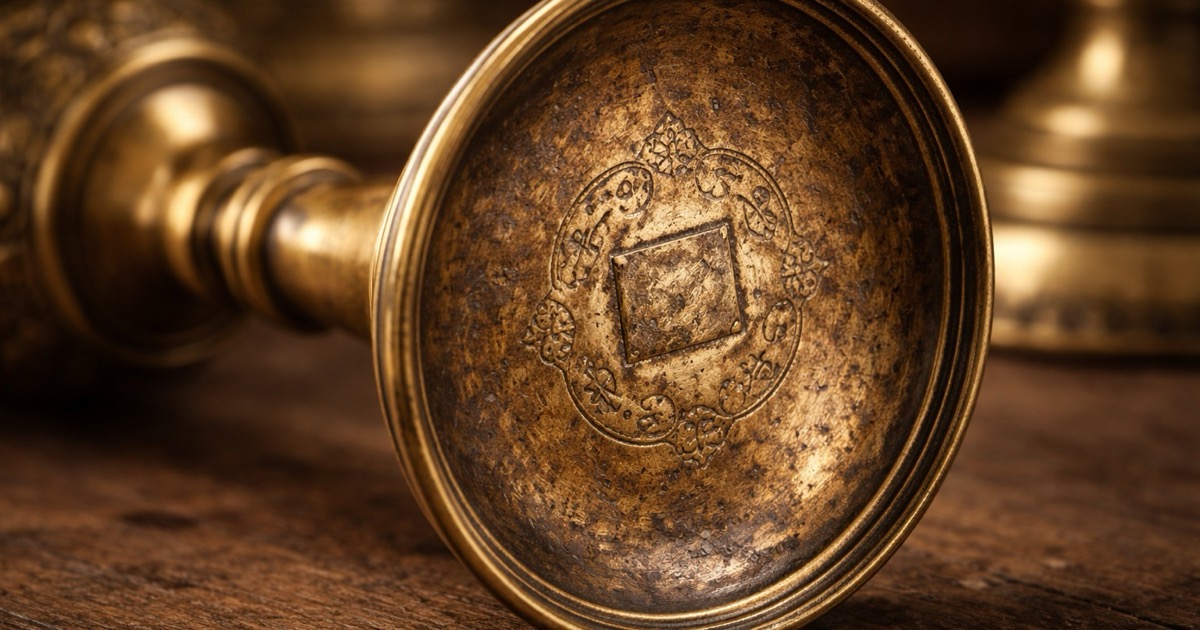
Antique brass makers marks identification means reading the stamped or cast marks on a brass object to work out who made it, where, and roughly when. Unlike silver, brass was never a hallmarked metal in most countries, so you are usually working with a maker’s name or initials, a registration number, an import or origin stamp, and a model or pattern number rather than a regulated set of assay marks. The most reliable approach is to record every mark exactly as it appears, then match it against maker archives and registration records rather than trusting a single stamp to date the whole piece.
That distinction matters more than anything else in this guide. On silver, a full hallmark can pin down city and year on its own. On brass, marks are voluntary, inconsistent, and often shared across a range of household goods, so identification is a case built from several clues rather than one decisive stamp. The goal here is to help you read what is there, know what each type of mark can and cannot prove, and take photos that let a reference or an appraiser finish the job.
Quick identification checklist
- Find every mark: check the base, the underside, inside rims, and the backs of handles and fittings, where stamps hide.
- Read the maker’s mark: a full name, initials, or a company logo, and copy it letter for letter including punctuation.
- Note any country-of-origin or import wording such as “England,” “Made in England,” or a later import mark.
- Record registration numbers: a “Rd” number or a diamond-shaped registration mark points to British design registration and helps date the piece.
- Copy model, pattern, or catalogue numbers separately; these identify a design, not necessarily a date.
- Judge material and construction: solid cast brass, seamed sheet brass, or brass plating each tell a different story about age and quality.
Why brass marks work differently from hallmarks
Brass is a copper-zinc alloy, and it was never subject to the assay and hallmarking systems that governed sterling silver and gold. That single fact reshapes the whole exercise. There is no legally required date letter, no assay-office town mark, and no standard mark for alloy purity, so a brass object can be entirely unmarked and still be a hundred years old.
What you do find are voluntary marks: a maker deciding to stamp a name or logo, a company adding a model number, a design being registered for copyright protection, or an import law requiring a country of origin. Because these are optional and unregulated, the same maker might mark one line heavily and leave another blank, and retailers sometimes stamped their own name over the actual manufacturer’s. Treat every mark as one witness among several, and let material, construction, and wear corroborate what the stamps suggest. Museum metalwork collections are a useful sanity check here, because they document how marked and unmarked brass of a given period actually looks (Victoria and Albert Museum, Metalwork collection).
Types of brass marks and what each one proves
Brass marks fall into a few recognizable families, and knowing which family a mark belongs to tells you what question it can answer. A maker’s mark speaks to who made it; a registration mark speaks to when a design was protected; an origin mark speaks to where and, indirectly, to era.
| Mark type | What it looks like | What it tells you | What it does not tell you |
|---|---|---|---|
| Maker’s name or initials | Full company name, monogram, or logo, cast or stamped | Likely manufacturer or retailer | Exact year, unless the archive dates it |
| Registration mark (diamond) | Diamond shape with letters and numbers at the corners | British design registered 1842–1883 | The manufacture date of that specific piece |
| Registration number (“Rd”) | “Rd” or “Rd No.” followed by digits | British design registered from 1884 onward | Anything about maker or material |
| Country-of-origin mark | ”England,” “Made in England,” “Foreign” | Broad era and export destination | The precise maker |
| Model or pattern number | Bare digits, sometimes with a prefix | The specific design or catalogue line | The date, on its own |
The registration marks are the most datable of these. A diamond-shaped registration mark indicates a British design registered between 1842 and 1883, while a plain “Rd” number was used from 1884 onward, and both can be looked up to find the year the design was registered (The National Archives, Registered designs 1839–1991). Crucially, the registration date is the date the design was protected, not the date your particular object left the workshop; a popular design could be manufactured for decades after registration.
Where the marks hide on brass objects
Marks on brass are placed where they will not spoil the display face, which means you rarely find them on the front. Turn the object over first. On candlesticks, jugs, and vases, check the underside of the base and the inside of the foot rim. On boxes and inkstands, look inside the lid and on the base. On fireplace tools, door furniture, and hardware, check the backs and the concealed faces that sit against a wall or door.
Handles, hinges, and applied fittings are worth separate attention, because a piece assembled from several castings may carry a mark on only one component. Bring a raking light across the surface at a low angle; a shallow stamp or a worn cast mark can vanish under flat lighting and reappear the moment the light skims across it. If a mark is filled with old polish or verdigris, photograph it before cleaning, since aggressive cleaning can erase a faint stamp entirely. For a fuller walkthrough of concealed mark locations, see our guide on where to find markings on antique furniture, many of which apply equally to metal fittings.
Reading the mark once you find it
Copy the mark exactly. Small differences in wording, spacing, and punctuation separate one maker from another and one decade from the next, so transcribe what you see rather than what you expect. “England” alone and “Made in England” often signal different periods, because import-marking requirements changed over time, and the presence or absence of that wording can bracket a date range even when the maker is anonymous.
Numbers deserve care. Keep registration numbers, model numbers, and any part numbers in separate notes, because conflating them leads to false dates. A “Rd” number can be looked up to a registration year; a model number usually cannot be dated without the maker’s catalogue. When a mark is a monogram or logo rather than a readable name, describe its shape and letters precisely, then compare it against marks databases and maker archives. General marks references such as those maintained by collector resources are a good starting point for identifying unfamiliar stamps (Kovels, marks reference). Our overview of how to read antique marks covers the general logic of working a mark from letters to a maker.
Confirming the metal is really brass
Before you attribute a mark, confirm you are actually holding brass rather than plated steel, bronze, or a modern reproduction alloy. Brass is a yellow copper-zinc alloy; bronze is a copper-tin alloy that reads browner and often shows a different patina. A common quick check is a magnet: brass and bronze are non-magnetic, so if a magnet grips firmly you are likely looking at plated steel or iron rather than solid brass. Check worn edges and the underside for a color break, where a thin brass plating has worn through to a base metal of a different color.
Construction is the other tell. Early and better-quality brass was often cast solid or worked from seamed sheet, with visible file marks, hand-finishing, and honest wear at handling points. Bright, seamless, lightweight, uniformly finished brass with a mark that looks laser-crisp is more consistent with recent manufacture. None of these tests is decisive alone, but together they keep you from attributing an antique maker’s mark to a modern decorative copy. If you are working through the metal question more broadly, our guide on how to identify antique brass covers alloy, patina, and construction in more depth.
Watch-outs and common mistakes
- Assuming brass is hallmarked like silver; there is no assay date letter or purity mark to rely on.
- Reading a registration date as a manufacture date; the design date and the object date can be decades apart.
- Confusing a retailer’s stamp with the maker’s mark, since shops sometimes marked goods they did not make.
- Mistaking bronze or plated steel for brass, which sends you toward the wrong makers entirely.
- Over-cleaning before recording, which can wipe a faint stamp off the metal for good.
Photo tips that improve identification
- Photograph each mark straight on and filled in the frame, with a second wider shot showing where it sits on the object.
- Use raking light from the side so shallow stamps and worn cast marks gain shadow and become readable.
- Shoot the same mark from two angles, because reflections on polished brass can hide characters from any single view.
- Include one full view of the whole object so shape and proportion give context to the mark.
Common questions
Do antique brass items have hallmarks like silver?
No. Brass was never covered by the assay and hallmarking laws that regulated sterling silver, so there is no official date letter, town mark, or purity stamp to read. Any marks you find are voluntary maker’s marks, registration marks, model numbers, or import stamps, and many genuine antique brass pieces carry no marks at all.
How do you date antique brass from a registration number?
A diamond-shaped registration mark indicates a British design registered between 1842 and 1883, and a plain “Rd” number was used from 1884 onward, both of which can be looked up to the year the design was registered. Remember that this is the date the design was protected, not the date your specific object was made, because a popular design could be manufactured for many years afterward.
What if the brass object has no maker’s mark at all?
Unmarked brass is extremely common, so an absent mark does not mean the piece is fake or worthless. Build the identification from material, construction, casting or seaming methods, and wear instead, and use any origin wording or registration number to bracket a date range. An honest description such as “English cast brass candlestick, late 19th century, unmarked” is stronger and more credible than a forced attribution.
Related guides
- Antique Marks Identification: How to Read Antique Marks
- How to Identify Antique Brass
- How to Photograph Makers Marks for Identification
- Where to Find Markings On Antique Furniture
- Silver Makers Marks Identification: How to Read Maker Stamps
When to use the Antique Identifier app
The app is most useful after you have taken one full photo and a few tight, well-lit detail shots of every mark you can find. It can help narrow the likely type, era, and material, which makes your follow-up research through maker archives and registration records faster and more focused. If the result points to something unusually rare, signed, or high value, treat that as a prompt for deeper verification against a specialist reference or an appraiser rather than a final answer.