Hall is one of the few American potteries where the usual advice, find the backstamp and look it up on a chart, genuinely does not work. The company used well over a hundred backstamp variants across its production, some for particular customers, some for particular product lines, and some for reasons nobody has fully documented. There is no tidy one-mark-per-decade table, and any guide presenting hall china marks that way is simplifying something that resists simplification. What does work is knowing the general direction the marks moved, knowing which other information on the base is more precise than the mark itself, and knowing that a large amount of perfectly genuine Hall carries no mark at all.
Hall china marks are the backstamps used by The Hall China Company of East Liverpool, Ohio, founded in 1903 by Robert Hall. They exist in well over a hundred variants and simplify loosely over time, moving from an early arched circular mark that often includes “Made in U.S.A.” wording toward a plainer circle with “Hall” in the middle.
Quick identification checklist
- Read the whole base, not just the logo. Wording, numbers, pattern names, and customer names all sit there and all carry information.
- Note the mark’s shape. An arched circular mark and a plain circle with “Hall” in the center belong to different general periods.
- Look for a pattern name. When a name is printed alongside the mark, it narrows the piece far more than the logo does.
- Copy any number exactly. Model and shape numbers identify the form, which is what you need for searching.
- Check for a customer name. Hotel, restaurant, and railroad names identify institutional ware, a separate and separately collected category.
- Accept an unmarked base. A great deal of Hall institutional ware was deliberately left unmarked, so a blank foot is not a red flag.
- Judge the body and glaze. Hall’s glazes are notably hard and glossy, and the ware is heavy and durable because it was engineered for commercial use.
Why hall china marks resist a simple date chart
The mark variety comes straight out of the business. Hall was founded in East Liverpool, Ohio, in 1903, in a former pottery facility, at the end of a short-lived combine of local potteries. Robert Hall died within about a year of founding it and the company continued under his son, and the East Liverpool plant ran for well over a century before closing in the early 2020s.
What made Hall unusual was that its main business through the 1920s and 1930s was institutional china: heavy, durable, hard-glazed ware for hotels, restaurants, and railroad dining cars, sold alongside the retail lines most collectors know today. Institutional customers ordered ware to specification, frequently with their own name or crest on it. Retail lines were sold under multiple arrangements, including premium programs run by other companies. Each of those channels could get its own backstamp treatment, and stamps were made and remade over a long production run.
The result is that variant counting is a specialist pursuit and matching your exact stamp to a published example is genuinely useful when you can do it, but it is not something a general guide can promise. Treat the mark as a strong maker confirmation and a loose date signal, and get your precision from elsewhere on the base.
The general shape the mark moved in
There is a real tendency underneath the variety, and it is worth knowing as a tendency rather than a test.
Earlier circular marks tend to be more elaborate. A common early form arches “HALL’S” across the top of a circle and curves “CHINA” along the bottom, with “MADE IN U.S.A.” set inside the middle. Marks in this family read as busier, with more wording packed into the circle.
Later circular marks tend to be plainer. A common later form is a simple circle with “HALL” in the middle, sometimes accompanied by “MADE IN U.S.A.” or an inventory number placed beneath the circle rather than inside it.
Read that as a direction of travel, not a per-year key. Elaborate generally points earlier and plain generally points later, but overlaps exist, stamps were reused, and specific lines had their own treatments. If you want to go further, the collector literature documents individual stamps against dated examples, and that is the only route to real precision here.
Unmarked Hall is normal, not suspicious
This is the point most guides skip, and it causes more misidentification than anything else in the category.
Institutional ware made for railroad dining cars, hotels, and restaurants was frequently left unmarked on the underside on purpose. The customer had no interest in the pottery’s branding appearing on the base of a cup, and in some cases actively preferred it absent. Blank-footed pieces from these contracts are entirely legitimate.
So an unmarked heavy cup, a thick-walled plate with a well proportioned foot, or a squat teapot with no backstamp is not evidence against Hall. Identification on those pieces runs through the form, the weight, the hardness and gloss of the glaze, any topmark or crest on the front, and comparison against documented shapes. Restaurant ware collectors identify these pieces routinely without a maker’s mark, working from shape catalogs instead.
The converse also deserves a mention. Unusual marks reading “Hall” that do not correspond to any documented stamp are worth treating with more caution than a blank base is, since a made-up mark is a decision somebody had to take deliberately and an absent one usually is not.
Pattern name and number beat the logo
If your base has a pattern name on it, that is the most useful thing on the piece, more useful than the logo above it.
A pattern name plus a shape or model number places a piece in a specific line and a specific form, which is exactly the level of detail that lets you search sold listings, match against a reference, and understand what you have. The generic circle mark tells you the maker and a wide era. The pattern name tells you the line, and lines have documented production windows, which is how a range gets tightened.
Numbers are worth recording precisely as they appear. Shape and model numbers identify tooling and form. Resist the urge to read them as years. As with most American dinnerware, a bare number on the base is a manufacturing reference rather than a date code.
Autumn Leaf and the customer connection
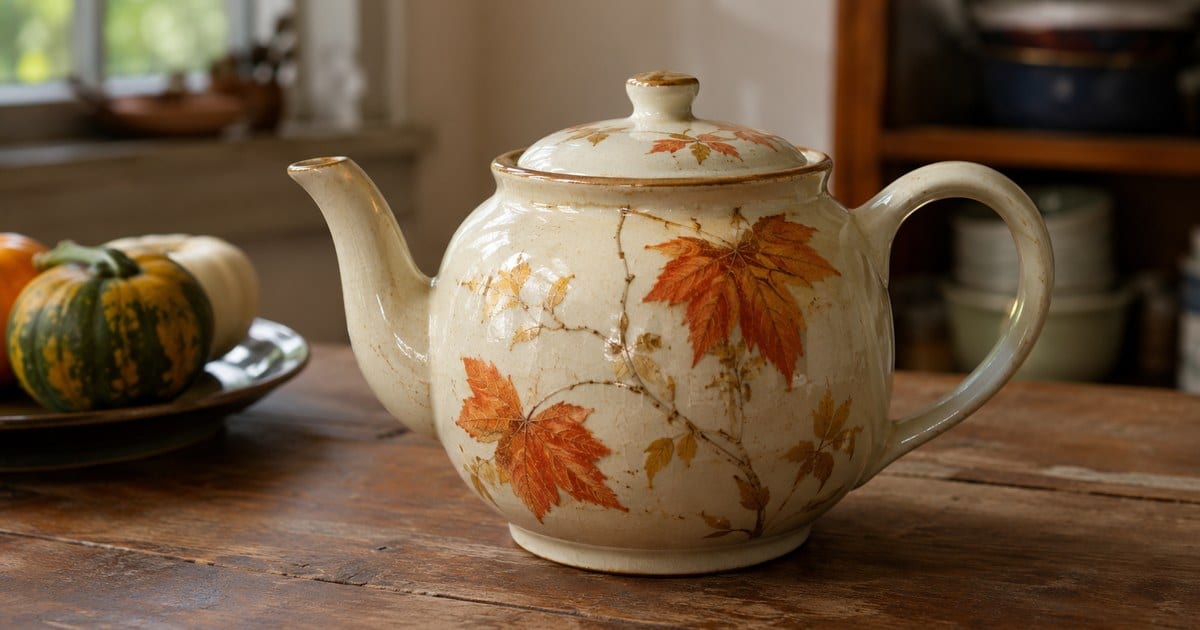
The most widely recognized Hall pattern is Autumn Leaf, introduced in 1933 and produced as a premium for the Jewel Tea Company, whose relationship with Hall continued for decades. It is a well documented, heavily collected line, and it is the pattern most likely to be sitting in an American kitchen cabinet without the owner knowing who made it.
Autumn Leaf is useful here for a structural reason, not just a decorative one. It illustrates how much of Hall’s output reached the public through somebody else’s brand. A piece can be Hall-made and reach a household under another company’s program, which is exactly why the customer name on a base is worth reading rather than dismissing. The same logic applies to the hotel and railroad ware: the name that matters commercially may not be the name of the pottery that made it.
Hall’s decorated teapots are the other category worth knowing. The company built a strong reputation in teapots across many shapes and glaze treatments, and shape identification does more work there than the backstamp does, since a given shape was produced in many colors and finishes.
Watch-outs and common mistakes
- Expecting a single chart to date the mark. Variant counts run well past a hundred and no compact table covers them.
- Reading an unmarked base as a problem. Institutional ware was often deliberately unmarked.
- Reading numbers on the base as years. They identify shapes and models.
- Ignoring the pattern name. It is more informative than the logo it sits next to.
- Assuming heavy means old. Hall built heavy, hard-glazed ware for commercial durability across its whole history, so weight indicates purpose rather than age.
- Confusing Hall with other East Liverpool potteries. Several American potteries operated in the same region and era with similar glazes and forms, and the shape catalogs are how collectors separate them.
- Overcleaning a piece before researching it. Abrasive cleaning damages gold decoration and printed pattern work permanently.
Photo tips
- Photograph the base square-on and close enough that every word and number in the mark is readable rather than merely present.
- Take a second base shot at a low raking angle, since impressed elements and worn stamps only show when light throws a shadow into them.
- Shoot any pattern name or customer name separately, in focus, because these are the highest-value pieces of text on the object.
- Photograph the whole piece against a plain background, with a profile view, since shape is how unmarked Hall gets identified.
- Photograph the foot ring in profile so the glaze finish and wear are visible.
- Document condition deliberately: chips, hairlines, crazing, utensil marks, and any wear to gold decoration each get their own frame.
Common questions
My Hall piece has no mark at all. Is it still Hall?
Possibly, and an unmarked base is not evidence against it. Institutional ware made for hotels, restaurants, and railroads was frequently left unmarked on purpose. Identification then runs through the shape, the weight, the hard glossy glaze, any crest or topmark on the front, and comparison against documented shape references, which is exactly how restaurant ware collectors work.
Can the backstamp tell me the exact year my Hall piece was made?
Not on its own. Hall used well over a hundred backstamp variants, and while the marks simplify loosely over time, there is no reliable per-year key that a general guide can hand you. A pattern name, a shape number, and a customer name narrow a piece far more effectively, and matching your exact stamp against documented dated examples in the collector literature is the route to real precision.
What is the most collected Hall pattern?
Autumn Leaf is the best known, introduced in 1933 and distributed as a premium through the Jewel Tea Company over a long partnership. Hall’s decorated teapots are the other major collecting area, where shape identification matters more than the backstamp because a single shape was produced across many glazes and finishes.
Related guides
- Shawnee Pottery Marks: How to Identify and Date Shawnee
- Fiestaware Marks: How to Identify and Date Fiesta Dinnerware
- Blue Willow China Identification
- Antique Marks Identification: How to Read Antique Marks
When to use the Antique Identifier app
Hall is a category where the first question, what am I even looking at, is harder than the research that follows. Photograph the base, any pattern or customer name, and the whole piece in profile, and the app suggests the likely maker family, line, and era so you have real search terms instead of a description of a circle. That matters most on unmarked institutional pieces, where shape carries the identification. Confirm the promising pieces against shape references and sold listings before you price anything.