


Fiestaware Marks: How to Identify and Date Fiesta Dinnerware
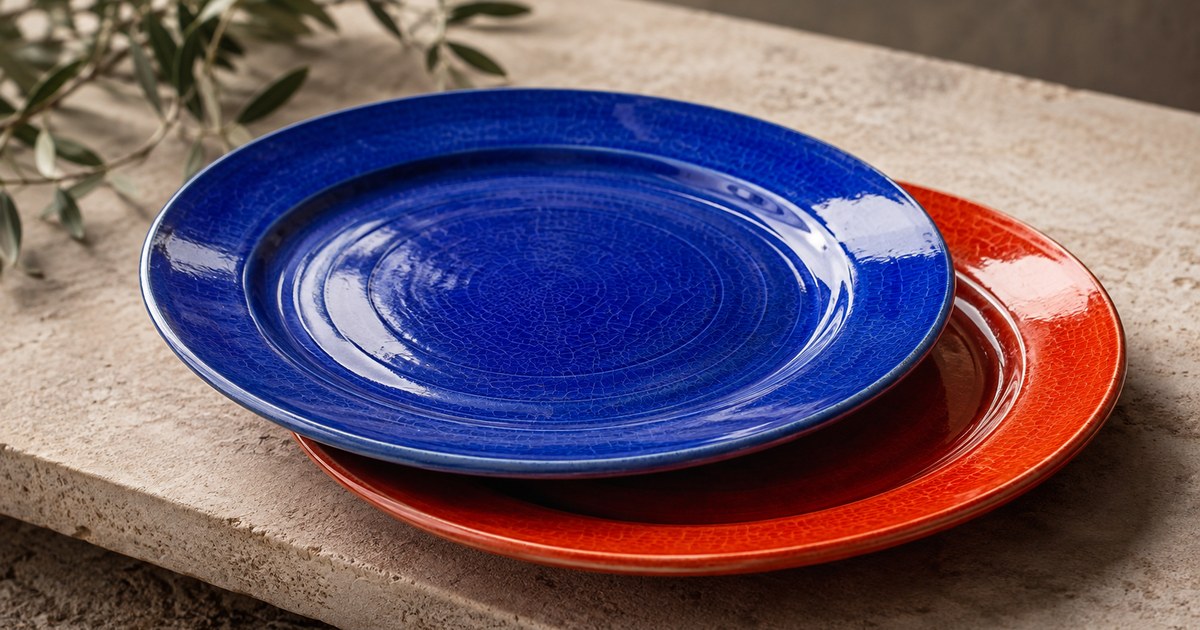
Almost every guide to Fiestaware marks gives you the same thing: a color chart arranged by decade, as if the shade of a plate settled its age. It does not. Homer Laughlin brought the line back in 1986 and reissued several of the original colors along the way, which means a cobalt plate could have left the factory in the 1930s or in the 1990s. What actually separates the two eras is the backstamp family, the finish of the foot ring, and the weight and body of the piece in your hand. Those are the things a reseller needs, and they are the things the color charts skip.
Fiesta was introduced by the Homer Laughlin China Company in 1936 and produced until the early 1970s, then relaunched in 1986. Vintage pieces carry a lowercase molded or ink-stamped “fiesta” mark, often paired with the word “GENUINE” and “HLC” and “USA” wording. Post-1986 pieces instead use a looped capital “Fiesta” wordmark with a trademark symbol and a lettered date code, and they are heavier, whiter-bodied, and show a dry, unglazed foot ring.
Quick identification checklist
- Read the wording, not just the logo. The clearest single tell is the word “Genuine,” spelled out as “GENUINE fiesta”: when it appears, the piece is vintage. Its absence does not rule out vintage, since some vintage pieces carry only the plain lowercase in-mold mark, but a looped capital “Fiesta” with a trademark symbol always signals the 1986-forward relaunch.
- Decide whether the mark is molded into the clay or printed on top of it. Larger vintage hollowware (pitchers, vases, carafes) usually carries an in-mold mark pressed into the base. Plates and flatware were more often ink stamped.
- Run a fingertip around the foot ring. A glazed ring, sometimes with small stilt-pin marks left by kiln supports, points vintage. A dry, unglazed, slightly gritty ring points to the modern line.
- Weigh it against something you know. Relaunch Fiesta is noticeably heavier and denser for its size, with a bright white body where it shows through.
- Look for a date or letter code. Modern production carries a lettered date code worked into the printed backstamp. Vintage production does not.
- Treat the color as the last piece of evidence, never the first. Several vintage colors were reintroduced after 1986 in close but not identical shades.
The three families of Fiestaware marks
Vintage Fiestaware marks fall into two practical families and the relaunch adds a third.
The first is the in-mold mark. On larger vintage hollowware the name was cut into the mold itself, so the lettering sits recessed into the clay and the glaze pools very slightly in the strokes. It is lowercase, reads “fiesta,” and is usually accompanied by “HLC” and “USA” in the same molded lettering. Because it is part of the mold rather than applied afterward, it survives decades of dishwashing intact, which is why it is the mark most vintage pieces still show clearly.
The second is the ink stamp. Plates, saucers, platters, and other flat pieces were more often marked with a printed stamp applied under or over the glaze. These stamps wear. A faint, partly rubbed lowercase “fiesta” stamp on a plate is normal and is not a sign of a problem. What matters is the wording and the letterform, not the crispness.
The third family belongs to the relaunch. From 1986 onward the backstamp was redesigned around a looped capital “Fiesta” wordmark, typically with a trademark symbol, “Lead Free” wording, and a lettered date code worked into the same ink stamp. It drops the word “Genuine” entirely, since that wording belongs to the earlier vintage stamp, not the relaunch mark. If you are holding a mark with a capital, trademarked “Fiesta” and a date code, you are holding a modern piece. That is not a defect and it is not a fake, it is simply a different production era with a different market.
Vintage era versus the 1986 relaunch
The vintage era runs from the line’s introduction in the mid-1930s to the end of original production in the early 1970s. The relaunch begins in 1986 and continues, which means modern Fiesta has now been in production longer than the original run was. That single fact explains why so much of what turns up at estate sales reads as vintage to a casual eye and is not.
The body changed. Original Fiesta was a lighter, softer-looking ware with a warm cast where the clay shows. Relaunch Fiesta is a fully vitrified, dense, bright white body made for restaurant-grade durability. Set a modern plate on top of a vintage one of the same size and the weight difference is obvious before you have looked at either base.
The glazing changed with it. Vintage bases commonly show a glazed foot ring with small stilt-pin marks left by the kiln supports that held the piece during firing. Modern pieces are wiped clean before firing and show a dry, unglazed foot ring instead. Neither rule is absolute across every form and every year, so treat the foot as strong evidence rather than a verdict, but on a table of mixed pieces it sorts them faster than anything else.
Radioactive red as a dating tell
The original red glaze is the one genuinely checkable historical marker in the line. Fiesta’s early red, the strong orange-red often called radioactive red, was produced using uranium oxide as a colorant. Uranium became restricted during the Second World War and the red glaze was withdrawn in the early 1940s. It returned later, in the late 1950s, and was discontinued again as the original line wound down. The glaze was reformulated in the modern era without uranium.
That history gives you a physical test rather than an opinion. Original uranium-bearing red registers on a Geiger counter, while later red glazes do not. Collectors who handle a lot of Fiesta often carry one for exactly this reason. If you do not have a detector, the practical takeaway is still useful: red on a piece whose mark, foot, and weight all read modern is a reformulated red, and red on a piece whose mark and foot read vintage is worth checking properly. Many collectors display rather than serve on original red pieces, which is a reasonable precaution regardless of how you value the risk.
Why glaze color alone will mislead you
The color-chart approach fails because Homer Laughlin reintroduced colors. Turquoise, cobalt, yellow, and red all exist in both eras. The reissued shades are usually close rather than identical, and the differences are the kind you can see only with a known-vintage piece sitting beside the one you are holding. Without that reference, color comparison from memory or from a photo on a screen is guesswork.
The reverse error is just as common. Some genuinely vintage colors look unexpectedly contemporary, and buyers talk themselves out of good pieces because a shade “looks too new.” Let the mark, the body, and the foot decide the era, then use the color to narrow within it.
The check most posts never give you: base and glaze feel
Here is the sequence that actually resolves the reseller’s question at a booth, in order, using nothing but your hands and eyes.
Turn the piece over. Look for a capital, trademarked “Fiesta” wordmark with a date code. If it is present, you are modern and you can stop. If the mark is a lowercase “fiesta,” with or without “Genuine” wording, continue.
Run a thumb around the foot ring. A glazed ring, possibly with small stilt-pin marks, is a vintage signal. Dry and slightly abrasive underneath is a modern signal.
Now weigh it. Pick it up and put it down twice. Vintage feels lighter than its size suggests. Relaunch ware feels like commercial restaurant china, because that is what it was engineered to be.
Finally, look at the glaze surface in raking light. Older glazes often show fine crazing, a soft slightly uneven pooling in the concentric rings, and genuine utensil wear inside the well of plates. Modern glaze tends to be flatter, more uniform, and cleaner in the ring detail. Four agreeing signals is a confident read. Two agreeing and two contradicting means you keep looking rather than committing.
Watch-outs and common mistakes
- Treating cobalt or turquoise as automatic proof of age. Both were reissued. Color is corroboration, never identification.
- Assuming a worn stamp means an older piece. Printed marks wear at very different rates depending on how a piece was used and washed.
- Reading “Made in USA” as a vintage signal. Country-of-origin wording is common on modern production and is not a period marker here.
- Ignoring the lid. Lidded forms were made in both eras and mismatched sets circulate constantly. Check the mark and foot on the lid separately.
- Confusing Fiesta with the many ringed lookalikes. Concentric-ring dinnerware was widely imitated by other American potteries and by later import ware, so the rings alone identify a style, not a maker.
- Buying on the strength of one photo of the front. The front of a Fiesta plate carries almost no dating information. The base carries nearly all of it.
Photo tips
- Shoot the whole base square-on in soft daylight, close enough that the mark fills a good share of the frame, so the wording is readable rather than merely present.
- Take a second base shot at a low raking angle. In-mold marks are recessed and only show properly when the light throws a shadow into the lettering.
- Photograph the foot ring on its own, in profile, so the glazed or unglazed finish is visible rather than inferred.
- Capture the glaze surface across the rings in angled light, which is where crazing and wear show up and where a flat modern glaze gives itself away.
- If you have a known piece of either era, photograph the two together for scale and color reference. A side-by-side frame is worth several isolated shots.
Common questions
How can I tell vintage Fiestaware from the 1986 relaunch?
Check three things together. Look at the backstamp: a lowercase “fiesta,” often with “GENUINE” spelled out, indicates vintage, while a capital, trademarked “Fiesta” with a date code indicates modern production. Feel the foot ring, since vintage pieces commonly have a glazed ring with small stilt-pin marks and modern ones are usually dry and unglazed underneath. Then weigh it, because relaunch ware is markedly heavier and whiter-bodied. When all three agree, the era is settled.
Is all red Fiestaware radioactive?
No. The original red glaze made with uranium oxide belongs to the early production years and a later stretch of the vintage run. Red was withdrawn during the war years and the modern red introduced after the relaunch is a reformulated glaze without uranium. A red piece is therefore not automatically old, and an old red piece is not automatically uranium-bearing.
Does an unmarked piece mean it is not Fiesta?
Not necessarily. Small forms, some cups, and certain accessory pieces were marked lightly or not at all, and printed stamps can rub away entirely. On an unmarked piece the identification runs through the form, the ring spacing, the glaze color family, and the foot finish, compared against documented examples of the same shape.
Related guides
- Van Briggle Pottery Marks: How to Identify and Date Van Briggle
- Vintage Pyrex Patterns Identification
- Jadeite and Fire-King Identification
- Antique Pottery Marks
When to use the Antique Identifier app
Fiesta is a category where a photo-based first pass is genuinely useful, because the questions are visual and comparative. Shoot the base square-on, the base at a raking angle, and the foot ring in profile, and the app can suggest which mark family you are looking at and which era the piece most resembles. That narrowing step is the slow part when you are standing in front of a shelf of mixed ware with no reference piece to compare against. Treat the result as a lead to confirm against the foot, the weight, and sold-listing photos of the same form rather than as a finished attribution.
Topics