


Jadeite and Fire-King Identification
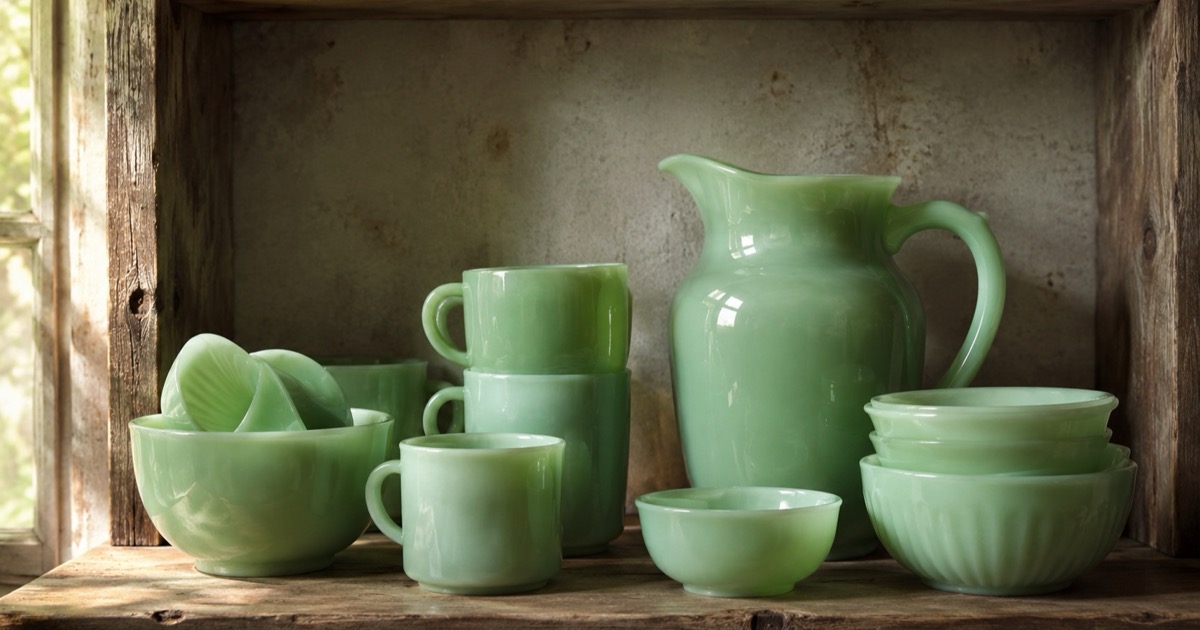
Jadeite identification starts with understanding that the opaque milky-green glass you are looking at could have come from one of three manufacturers across roughly forty years — and that a fourth wave of production began in the early 2000s precisely because the originals had become so collectible. Getting the maker and era right changes the story considerably, whether you are buying, selling, or simply trying to understand what has been sitting in a kitchen cabinet for decades.
To identify jadeite, flip the piece and read the base mark: McKee used a block-letter mark, Jeannette often a simple J or no mark at all, and Anchor Hocking’s Fire-King line carried evolving FIRE-KING backstamps. Weight is the other key tell, since vintage jadeite is heavy and dense while modern reissues are lighter and often carry copyright or licensing language.
By the end of this guide you will know the three classic producers and their mark styles, how Fire-King backstamps evolved, why restaurant ware is a category of its own, what UV fluorescence tells you and what it does not, and how to separate old pieces from the reissues flooding the market today.
Quick identification checklist
- Flip the piece and read any mark under strong light: mold-incised marks, raised letters, and paper labels each point to different makers and eras.
- Hold the piece up to a bright light source; thick spots and mold seams should be visible through the glass.
- Check weight and wall thickness — early hand-finished pieces tend to be heavier and less uniform than later pressed production.
- Examine color under natural daylight; original jadeite ranges from soft sage to a more saturated jade, but the hue should be even throughout, not mottled or streaky in ways typical of cheap modern glass.
- Try a UV flashlight in a dark room; some older jadeite produces a faint yellow-green glow, which is a supporting clue, not proof.
- Look for seam lines and mold parting edges; their position and sharpness can indicate production method and era.
The three classic makers
McKee Glass
McKee, operating out of Jeannette, Pennsylvania, produced an opaque green glass it called Skokie Green, and separately sold a jadite-colored line under the McKee name. McKee pieces are typically marked with a molded “McK” inside a circle on the base, though not every piece carries a legible mark. McKee production runs through the 1930s and into the mid-century period. The glass tends toward a slightly softer, more muted green compared to Anchor Hocking’s line.
Jeannette Glass
Jeannette Glass Company, also based in Jeannette, Pennsylvania, produced its own opaque green glass used in kitchenware lines. Jeannette pieces often carry a simple “J” mark or no mark at all, which makes unambiguous attribution harder. Collectors generally rely on pattern recognition — specific bowl shapes, canister profiles, and measuring cup styles that Jeannette is documented to have made — to assign pieces when the mark is absent or ambiguous.
Anchor Hocking’s Fire-King Line
Anchor Hocking is the name most closely associated with the term jadeite among collectors today. Their Fire-King line, produced from roughly the 1940s through the early 1970s, is the primary source of the restaurant-style mugs, bowls, and plates that define the category in popular imagination. Early Fire-King pieces used a simple block-letter stamp; the backstamp evolved over the production run to include the words “FIRE-KING” in various configurations, sometimes accompanied by “OVEN WARE” or pattern names. The marks were applied as fired-on enamel on early pieces and mold-incised on others, depending on the line and era. Because these stamps changed, and because the variations have been extensively documented by collectors, describing the exact form of the mark you have is more useful than guessing the decade without checking.
Fire-King restaurant ware and why it matters
The mugs, plates, and platters Anchor Hocking made for commercial food service are heavier and thicker than domestic pieces, and many show “utensil marks” — light surface scratches from silverware contact that collectors consider normal and expected. Restaurant ware pieces carry a backstamp identifying them for oven and commercial use. The iconic D-handle stackable mug is the most recognized form, but the line extended to soup bowls, bread-and-butter plates, and serving pieces. A completely scratch-free restaurant mug in an estate-sale context can actually raise questions about whether it is an original or a later example.
UV fluorescence: a supporting clue, not proof
Some older jadeite emits a faint yellow-green glow under a shortwave UV light in a dark room, a result of earlier glass batch formulations. The degree varies and the presence or absence of glow is not a reliable single-factor test — it does not distinguish between McKee, Jeannette, and Fire-King, and a non-glowing piece is not automatically modern. Use it as one data point, not a pass/fail gate.
The 2000s revival and modern reissues
Jadeite’s popularity surged in the late 1990s and early 2000s, driven partly by prominent use in lifestyle media. Two categories of new production followed, and both circulate widely today.
Anchor Hocking revived the line as “Fire-King 2000,” new jadeite pieces sold through Cracker Barrel stores and other retailers beginning around 2000. These pieces carry the Fire-King name but were made for a retail gift market, not a kitchen one. They are generally lighter in weight, more uniform in color, and their backstamps reflect modern production — the mark often includes copyright or licensing language absent from original pieces.
Separately, authorized licensed production occurred in Japan under the Fire-King brand. Japanese Fire-King pieces carry their own backstamps indicating country of origin and are collected in their own right in some markets, but they are not American originals.
To tell modern reissues apart from originals: check the backstamp for copyright dates or licensing language; compare weight and wall thickness (originals are heavier and denser); and compare mold details against documented original forms, since reissue proportions sometimes differ subtly.
Color, weight, and seam cues
Original jadeite is dense and substantial in the hand. Batch formulations varied slightly, so genuine pieces show gentle tone variation — some lean gray-green, others more saturated. Modern decorative glass sold as jadeite-style tends toward either too-even color or slight streakiness. Mold seams on older pressed pieces are generally more pronounced than on later fire-polished production, and slight rim or foot irregularities from hand-finishing are production signatures, not flaws.
Watch-outs and common mistakes
- Not all opaque green kitchen glass is jadeite or Fire-King; Pyrex made similar-looking pieces in avocado and other greens that are unrelated.
- The term “jadeite” is used loosely in casual resale listings and does not guarantee any particular maker or era.
- Reissues with the Fire-King name are genuine licensed products but are not vintage; always check for copyright dates and compare weight.
- UV fluorescence varies by piece even within genuine vintage production — absence of glow does not disqualify a piece.
- Surface chips on the rim or foot ring significantly affect value; examine edges carefully before purchase.
Photo tips that improve identification
- Photograph the base mark straight-on with strong directional light to make mold-incised letters legible.
- Capture a side profile shot that shows wall thickness and the weight of the piece relative to its size.
- In a dark room, hold a UV flashlight directly below or behind the piece and photograph any glow for documentation.
- Shoot the color in natural daylight, not under incandescent or cool-white LED light, which can skew the green tone significantly.
Common questions
How can you tell real vintage jadeite from a modern reissue?
Check the backstamp first: marks on modern licensed pieces, such as the Fire-King 2000 and Japanese Fire-King reissues, typically include copyright dates or licensing language that original mid-century pieces never carried. Then compare weight, because originals are noticeably heavier and denser than retail-market reissues. Mold details and proportions on reissues also sometimes differ subtly from documented original forms.
Does all real jadeite glow under UV light?
No. Some older jadeite produces a faint yellow-green glow under UV light in a dark room because of earlier glass batch formulations, but the effect varies from piece to piece even within genuine vintage production. A glow is a supporting clue, not proof of age, and a piece that does not glow is not automatically modern. Treat the UV test as one data point alongside the mark, weight, and form.
Is unmarked jadeite worth anything?
Often, yes. Jeannette Glass frequently left pieces unmarked or used only a simple J, and some lines from other makers relied on paper labels that were lost long ago. Collectors attribute unmarked pieces by matching the form, such as a documented bowl shape, canister profile, or measuring cup style, against marked examples. A confident attribution to a known maker and line supports normal collector interest even without a base mark.
Related guides
- Vintage Pyrex Patterns Identification
- Depression Glass Identification
- Milk Glass Identification: Fenton, Westmoreland, and More
When to use the Antique Identifier app
Photograph the whole piece on a neutral background, then take a tight shot of the base mark and another of the rim profile showing wall thickness. The app can narrow the likely maker and line quickly, which points you toward the right collector reference for that specific producer. If the result suggests a rare early form or an unusual pattern, treat that as a prompt for deeper verification rather than a final answer.
Topics