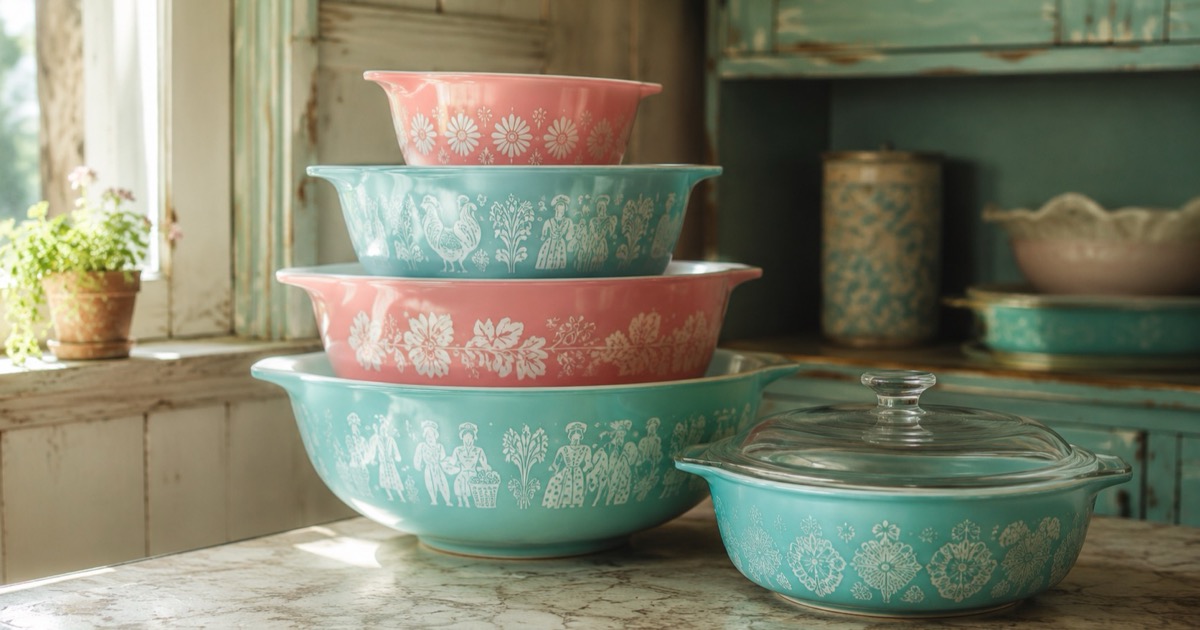
Vintage Pyrex patterns are one of the friendliest entry points in all of kitchen collecting: the pieces are everywhere, the pattern names are well documented, and the numbers molded into the glass tell you exactly what you are holding. The hard parts are dating a piece honestly, telling standard patterns from short-run promotional items, and grading condition the way collectors actually do. By the end of this guide you will be able to name the famous patterns, decode the model numbers, read a backstamp for a rough age bracket, and spot the dishwasher-dulled pieces that look fine in a dim kitchen but fail in a listing photo.
Vintage Pyrex patterns are screen-printed designs like Butterprint, Gooseberry, and Snowflake on opal ware, the opaque white glass Corning produced from the mid-1940s onward. The two diagnostic tells are the backstamp and the molded model number on the base. Start by flipping the piece and reading both before matching the pattern to references.
One distinction underlies everything: collectible patterned Pyrex lives on opal ware, the opaque white glass, while the clear ware that shares the brand name is a different collecting lane entirely.
Quick identification checklist
- Confirm the substrate: patterned collectible Pyrex is opal ware, an opaque white glass, not clear glass.
- Read the backstamp on the base; wording and layout changed over the decades and give a rough bracket.
- Find the model number molded into the base, such as 401 through 404 on round mixing bowls.
- Match the design to a named pattern like Butterprint, Gooseberry, Snowflake, or Pink Daisy.
- Grade the gloss: shiny, saturated color brings strong prices, while dull, chalky surfaces signal dishwasher damage.
- Check for Fire-King, Federal, and Hazel-Atlas backstamps; similar white kitchen glass came from other makers.
Opal ware versus clear Pyrex
Pyrex began as clear ovenware, introduced by Corning in the 1910s, and clear bakeware, measuring cups, and lids ran alongside everything that followed. The colored and patterned kitchenware that drives today’s collecting boom is opal ware: a durable opaque white glass that Corning produced from the mid-1940s onward, sold in solid colors first and then in screen-printed patterns.
The distinction matters for value and for search strategy. Solid-color and patterned opal ware is what collectors mean by “vintage Pyrex patterns,” and pattern, color, and condition set the price. Clear vintage pieces have their fans and their uses, but they trade in a much quieter market. When sorting a cupboard, separate opal from clear first and spend your research time on the opal.
Vintage Pyrex patterns worth knowing by name
A handful of standard patterns anchor the market and teach your eye quickly. Butterprint shows a folk-style farming couple with crops and roosters, most famously in turquoise on white and white on turquoise. Gooseberry pairs berries and leaves, best known in pink on white, a colorway that collectors compete for. Snowflake, one of the earliest screen-printed designs, scatters stylized snowflakes in combinations like white on charcoal and white on turquoise. Pink Daisy spreads a simple floral across pink and white pieces. All of these were standard catalog patterns produced for years, which is why complete sets can still be assembled.
Promotional pieces are the other half of the chase. Corning regularly issued short-run items, often a single casserole or chip-and-dip set in a decorated colorway, sometimes tied to holidays or gift seasons. Because promos were made briefly rather than for years, certain ones are dramatically harder to find than any standard pattern. If a piece matches no standard pattern reference, check promotional listings in collector guides before concluding it is rare or, worse, repainted.
Backstamps and model numbers, read cautiously
The backstamp molded or stamped into the base changed in wording and layout over the decades, and collector references use those changes as rough dating brackets. Early opal pieces typically carry trademark-registration language in a circular arrangement, later marks shift wording and add ovenware and dishwasher phrasing, and the typography evolves over time. Treat any backstamp date range as approximate: molds stayed in service, transitional marks exist, and the pattern itself often dates a piece more tightly than the stamp does. Use backstamp plus pattern together, never the stamp alone.
Model numbers are more straightforward. The classic round mixing bowls run 401 through 404, from the small bowl up to the large four-quart size. The Cinderella bowls, with a pouring spout on one side and a gripping tab on the other, run 441 through 444. Casseroles and refrigerator dishes carry their own three-digit numbers, and lids have separate numbers ending in a letter code.
| Number | Piece |
|---|---|
| 401 | Small round mixing bowl |
| 402 | Medium round mixing bowl |
| 403 | Large round mixing bowl |
| 404 | Largest round mixing bowl, four quart |
| 441 to 444 | Cinderella spout-and-tab bowl set, small to large |
Condition language collectors use
Condition vocabulary is where buyers and sellers misunderstand each other most. The big one is DWD, dishwasher damage: repeated machine washing strips the fired-on color, leaving a dull, chalky, faded surface where there should be gloss. DWD is permanent, it cannot be polished back, and it moves a piece from collectible to daily-use money. Hold the piece in good light at an angle; healthy vintage Pyrex shows a glossy, almost wet-looking sheen with saturated color.
Beyond gloss, collectors grade utensil marks inside bowls, rim flakes and chips, scratches across the printed pattern, and staining inside casseroles. The same pattern can vary in price several times over between a DWD example and a glossy one, which is why condition words belong in every listing and every offer you make.
Reissues and lookalikes
Two traps catch new collectors. The first is other makers’ white kitchen glass: Fire-King by Anchor Hocking, plus Federal, Hazel-Atlas, and others, produced patterned opaque ware in the same era. Some of it is collectible in its own right, but it is not Pyrex, and the backstamp settles the question in seconds. Unmarked white pieces deserve extra skepticism before any brand name goes in a listing.
The second is modern production. The brand has issued commemorative and reissue pieces inspired by vintage patterns, and contemporary marks and packaging identify them; their backstamps do not match vintage ones. Lowercase-logo modern kitchenware is current product, not a collectible find. As with all reproductions, the base tells the truth: read the stamp before believing the pattern.
Watch-outs and common mistakes
- Calling any white patterned kitchen glass Pyrex; Fire-King, Federal, and Hazel-Atlas made convincing neighbors.
- Paying mint-condition prices under dim garage lighting; DWD only shows clearly in good angled light.
- Treating backstamp date brackets as exact years instead of rough, overlapping ranges.
- Assuming an unfamiliar design means rare; check promotional pieces and other makers before celebrating.
- Missing the lid: correct, undamaged original lids account for a surprising share of a set’s value.
Photo tips that improve identification
- Shoot the backstamp straight on, filling the frame, with light angled so the molded text reads.
- Photograph the pattern side in soft daylight at a slight angle to show gloss honestly.
- Capture the model number on the base; it confirms the piece and size instantly.
- For sets, include one stacked group shot plus individual base shots of each bowl.
Common questions
How can you tell how old your Pyrex is?
Combine the backstamp with the pattern. The wording and layout of the base stamp changed over the decades, and collector references map those changes to rough date brackets, while the pattern itself often dates a piece more tightly because production runs are documented. Treat any single backstamp range as approximate, since molds stayed in service and transitional marks exist.
What do the numbers on the bottom of Pyrex mean?
They are model numbers identifying the piece and size. The classic round mixing bowls run 401 through 404 from smallest to largest, the spout-and-tab Cinderella bowls run 441 through 444, and casseroles and refrigerator dishes carry their own three-digit numbers. Lids use separate numbers ending in a letter code.
Is faded vintage Pyrex worth anything?
Far less than glossy examples. A dull, chalky surface usually means dishwasher damage, called DWD by collectors, where repeated machine washing has permanently stripped the fired-on color. It cannot be polished back, and it moves a piece from collectible pricing to daily-use money. The same pattern can sell for several times more in glossy, saturated condition.
Related guides
- How to Identify Griswold Cast Iron Skillets
- Depression Glass Patterns Identification
- How to Tell If Glass Is Antique
When to use the Antique Identifier app
Photograph the whole piece, then take tight shots of the backstamp, the model number, and a section of the pattern in good light. The app can narrow the pattern name, era bracket, and piece type quickly, which is especially handy when you are staring at an unfamiliar promotional item or a suspiciously similar lookalike from another maker. If it flags something rare, confirm against collector references and honest condition grading before setting a price.