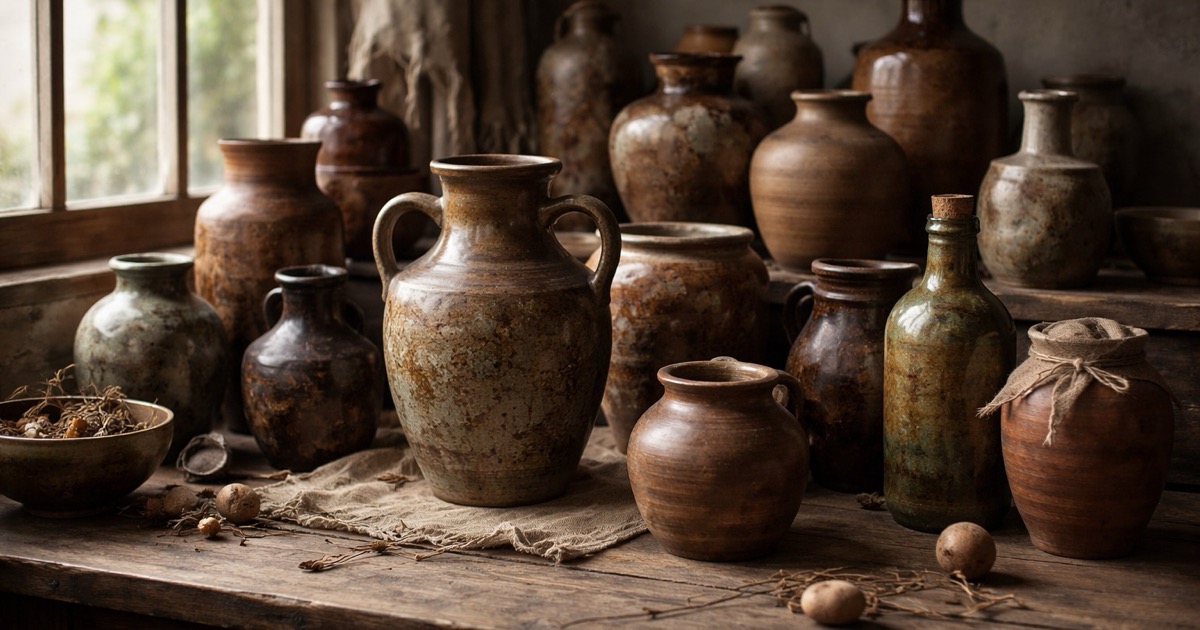
Antique pottery marks are the maker’s stamps, symbols, letters, and numbers found on the base of a piece, and reading them means matching the exact mark to a documented maker while cross-checking the clay body, glaze, and construction so a reproduction stamp cannot fool you. The single most useful move is to record the mark precisely — every word, letter, symbol, and its method (impressed, printed, or painted) — before you start searching, because a one-word or one-symbol difference often separates a genuine early piece from a later reissue or an outright fake.
No single mark identifies a piece with certainty on its own. Marks were copied, retired, revived, and forged, so the mark tells you what to test next rather than closing the case. This guide walks through the kinds of marks you will meet, how their style shifts across eras, and the material clues that either confirm or contradict what the mark claims.
Quick identification checklist
- Photograph and transcribe the full mark exactly — words, initials, symbols, numbers, and their arrangement.
- Note the method: impressed (pressed into wet clay), printed/transfer, painted by hand, or an applied paper or foil label.
- Check the clay body color and texture at an unglazed spot, usually the foot ring.
- Read the glaze: color, gloss, and any crazing (the fine crackle in the surface).
- Look for country-of-origin wording and registration numbers that pin down a date range.
- Compare hand-painted versus transfer-printed decoration, since it separates studio work from mass production.
The main kinds of antique pottery marks
Marks were applied in a handful of ways, and the method itself is a dating clue before you even read the wording. Impressed marks are stamped into the clay while it is still soft, leaving a recessed, slightly soft-edged impression; they are common on early earthenware, stoneware, and many nineteenth-century wares. Incised marks are scratched in by hand, often on studio and art pottery, and show the irregular line of a tool drawn through clay. Painted marks are brushed on under or over the glaze and vary from careful factory hands to loose artist signatures. Printed or transfer marks are applied as inked designs and became widespread with industrial production, growing more detailed and text-heavy over the nineteenth and twentieth centuries.
The method interacts with the glaze in ways you can feel and see. An underglaze mark sits beneath the glassy surface and is protected from wear; an overglaze mark can rub thin at the edges with age and handling. A printed mark that looks crisp and sits on top of a suspiciously flawless glaze deserves a second look, because that combination often signals a modern reproduction rather than a genuinely old piece.
How mark style shifts across eras
Wording and format changed with trade law and manufacturing, which is why a mark’s style can bracket a date even when the maker is unclear. The table below sketches the broad tells; treat these as clue ranges to verify against a maker-specific reference, not as precise stamps of a single year.
| Mark feature | Rough era it suggests | What to check |
|---|---|---|
| Impressed maker name or symbol only, no country | Often pre-1890 | Confirm against the maker’s documented impressed marks |
| ”England,” “France,” etc. (country of origin) | Commonly 1891 onward | US import rules required country marking from 1891 |
| ”Made in [country]” wording | Commonly early 1900s onward | The fuller phrasing tends to be later than the country alone |
| British diamond registration mark | Roughly 1842–1883 | The diamond encodes a registration date, not the year made |
| ”Rd No” (registered number) | 1884 onward in Britain | The number maps to a registration year in published tables |
| Printed backstamp with pattern name and “bone china” | Late 19th–20th century | Cross-check the specific mark version and clay body |
Country-of-origin wording is one of the most reliable brackets. The requirement that imported goods be marked with their country of origin, tied to United States tariff law from 1891, means a piece marked only “England” without “Made in” often predates the “Made in England” phrasing that became routine later (Kovels — pottery and porcelain marks). British registration marks are similarly datable: the diamond-shaped registration mark used roughly from 1842 to 1883 encodes the date a design was registered, and the later “Rd No” system that followed maps a printed number to a registration year through published tables. None of these tells you the exact year of manufacture, but together they narrow the window considerably.
For attributing the maker behind a mark, museum and specialist references are the backbone. The Victoria and Albert Museum’s ceramics holdings document makers, marks, and production techniques across centuries and are a strong reference for placing a mark in context (V&A — ceramics collection). For British factory marks in particular, databases of Stoke-on-Trent potters catalog the backstamps of hundreds of makers and their date ranges (The Potteries — pottery marks identification). Matching your transcribed mark against these documented versions — down to the exact wording and symbol — is what turns a guess into an identification. If you are working through a printed pattern rather than a maker’s symbol, our guide to antique china patterns identification covers how pattern names and numbers fit alongside the backstamp.
Reading the material, not just the mark
The clay body is evidence that is far harder to fake than a stamp. Examine an unglazed area, usually the foot ring, for color and texture. Earthenware is porous and typically buff, red, or cream; stoneware is denser and often gray or brown; porcelain is fine, hard, and frequently translucent when thin. A mark claiming a fine porcelain maker on a coarse, porous body is a contradiction worth taking seriously. For handmade utilitarian wares, the body and salt-glaze surface carry much of the story — our guide to antique stoneware crock identification marks walks through reading those pieces where the mark alone rarely settles it.
Glaze and wear round out the picture. Crazing — the fine network of cracks in the glaze — can accompany age, but it is not proof of it, since crazing can be induced and many old pieces never craze at all. Look instead for wear that matches real use: soft scratching on the base and foot ring where a piece was set down and slid, honest dulling on high-touch areas, and settled grime in recesses rather than fresh-looking dirt painted into crevices. A piece that looks a century old on the mark but shows no plausible wear anywhere is telling you to slow down.
Watch-outs and common mistakes
- Dating a piece by crazing alone; crazing can be faked and many genuine pieces never craze.
- Assuming all blue-and-white ware is old; the Blue Willow pattern, for one, has been produced continuously for well over two centuries.
- Ignoring reproduction stamps that copy famous marks; a copied symbol on a modern body is a classic tell.
- Reading a country mark as a maker; “Made in Japan” or “England” narrows origin and date, not the factory.
- Trusting a crisp printed mark on a flawless glaze without checking the clay body and wear.
- Forcing a rare attribution from a partial or worn mark instead of recording it and researching further.
Photo tips that improve identification
- Photograph the base and foot ring straight on, filling the frame with the mark.
- Shoot the mark twice: once with even light, once with raking side light so impressed and incised marks read clearly.
- Capture the unglazed clay at the foot ring so the body color and texture are visible.
- Take a close-up of the decoration to show whether it is hand-painted or transfer-printed.
- Show translucency only if the piece is sound and it is safe to backlight it.
Common questions
How do I identify an unmarked piece of pottery?
Work from the physical evidence when there is no mark. Examine the clay body color and texture at the foot ring, the glaze and any wear, the construction method, and the decoration style, then compare those traits to documented examples of makers and regions. Many genuine pieces were never marked, so an honest description of body, glaze, and form is more useful than forcing an attribution.
Does a country name on the mark tell me how old the pottery is?
It gives a helpful date bracket rather than an exact year. Under United States tariff rules from 1891, imported goods generally had to show their country of origin, so a piece marked only with a country name often predates the fuller “Made in [country]” phrasing that became routine in the early twentieth century. Use the wording to narrow the window, then confirm the maker and period against a specialist reference.
How can I tell a reproduction mark from a genuine antique mark?
Compare the mark against documented genuine versions and then test it against the piece itself. Reproductions often copy a famous symbol but sit on a clay body, glaze, or wear pattern that does not match the era they imitate — a crisp printed mark on a flawless, un-worn glaze is a common warning sign. Checking the mark, the body, and the wear together catches most fakes that any one of them alone would miss.
Related guides
- Antique Ceramic Marks Identification
- Antique Stoneware Crock Identification Marks
- Limoges China Marks Identification
- Roseville Pottery Marks Identification
- Blue Willow China Identification
When to use the Antique Identifier app
The app is most useful after you have taken one full photo and a few tight detail shots of the base, the mark under raking light, and the unglazed foot ring. It can help narrow the likely type, era, and maker, which makes your follow-up research against a marks database far faster. If the result points to something unusually rare, signed, or high value, treat that as a prompt for deeper verification against a specialist reference rather than a final answer.