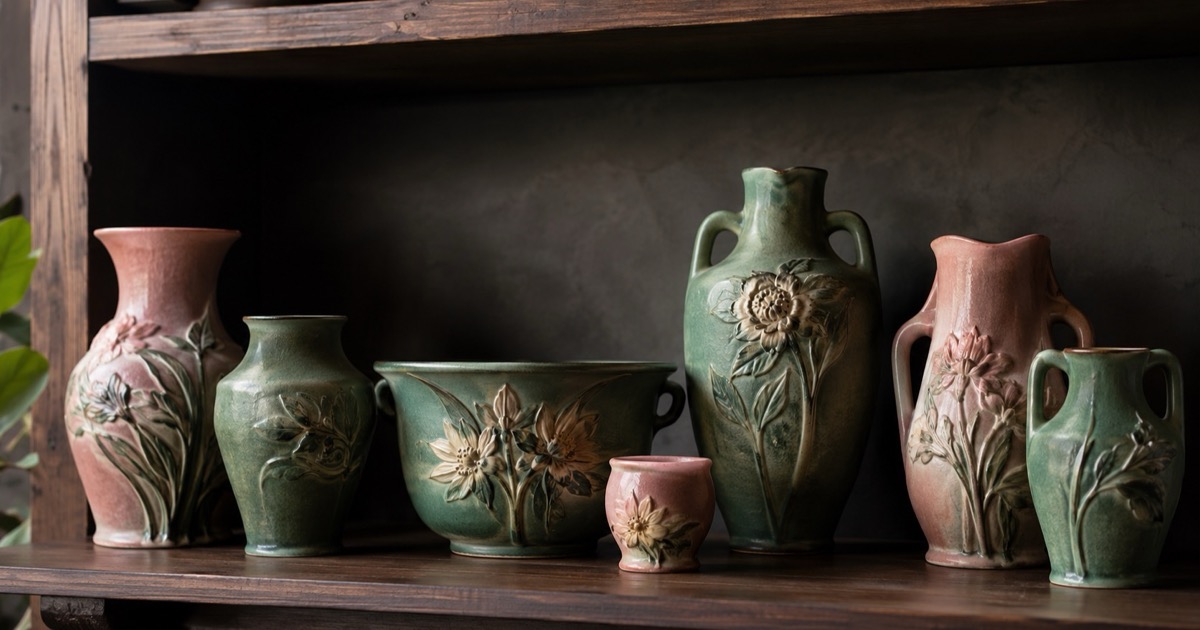
Roseville pottery marks changed several times between the company’s founding in Ohio in the 1890s and its closing in 1954, and those changes are the fastest way to date a piece. The catch is that Roseville did not mark everything. Whole production eras left the factory wearing nothing but a paper or foil label, which means a completely blank base can still be the real thing.
Roseville pottery marks identify American art pottery made in Ohio from the 1890s to 1954. The two most diagnostic marks are the raised script “Roseville U.S.A.” with a molded shape-and-size number on pieces from the mid-1930s onward, and the applied round “Rozane Ware” wafer on early art ware. Start by matching the mark style on the base to its production era.
By the end of this guide you will be able to place a mark in its era, read the shape-and-size numbers molded into later bases, recognize the most famous pattern lines on sight, and spot the reproductions that have flooded the market since the 1990s.
Quick identification checklist
- Look for raised script “Roseville U.S.A.” with a shape-and-size number molded into the base of later pieces.
- Check early art-ware pieces for a round applied “Rozane Ware” wafer seal.
- Treat an unmarked base as normal: label-era pieces lost their paper and foil stickers decades ago.
- Match the molded decoration to a named line such as Pine Cone, Zephyr Lily, or Magnolia.
- Compare mold crispness and glaze colors against documented originals before trusting any mark.
- Heft the piece: reproductions usually feel lighter than authentic examples of the same size.
Roseville pottery marks by era
Roseville’s marking habits fall into a few broad eras, and getting the era right does most of the dating work for you. The boundaries are soft, because the factory phased markings in and out over years rather than switching on a fixed date, so treat the table below as orientation rather than law.
| Era (approximate) | Typical marking |
|---|---|
| Early art ware, around the 1900s | Round applied “Rozane Ware” wafer seals, sometimes naming the line |
| 1910s through the 1920s | Small ink stamps, occasional impressed marks, paper labels |
| Late 1920s to mid-1930s | Black paper labels and silver or gold foil labels, usually now missing |
| Mid-1930s to 1954 | Molded raised script “Roseville” with “U.S.A.” and a shape-and-size number |
The Rozane wafer is the prestige mark of the early art lines. It is a small raised disc applied to the base before firing, so it sits proud of the surface rather than being stamped into it. Ink stamps from the middle years are often faint or partly worn, and impressed marks from the transitional 1930s can be shallow. None of this is sloppy faking; it is just how the factory worked.
Unmarked Roseville is often genuine
For long stretches of production, especially the label decades from the 1920s into the mid-1930s, the only factory identification was a sticker. Paper labels soaked off in the first wash, and foil labels rarely survived years of handling. The result is that an enormous amount of authentic Roseville carries no mark at all.
This cuts both ways. A blank base does not disqualify a piece, but it also is not evidence in its favor, because reproductions and lookalike pottery are blank too. With unmarked pieces, identification shifts entirely to shape, molded pattern, and glaze. Roseville’s lines are well documented in collector references, so a piece that matches a known shape in a known line with a period-correct glaze is far more persuasive than any single mark.
Reading the raised script mark and shape numbers
From roughly the mid-1930s onward, most Roseville left the factory with the company name molded into the base in raised cursive script, usually accompanied by “U.S.A.” and a two-part number such as 45-8. The first part identifies the mold shape, and the second part states the nominal height in inches, so a vase with an 8 after the dash should stand close to eight inches tall. Measure it. A piece whose actual height disagrees with its molded size number deserves real suspicion.
The exact lettering style varies by line and year, and some transitional pieces carry impressed rather than raised script, so use the mark as one clue among several rather than a verdict on its own.
Identify the pattern line first
Naming the line shrinks every later step, because each line used a documented set of shapes and numbers. Three famous examples cover a lot of ground. Pine Cone features relief pine cones and needles with branch-shaped handles on brown, green, or blue grounds; introduced in the mid-1930s, it sold so well that it is often credited with carrying the company through the Depression. Magnolia, a 1940s line, sets large white-and-pink blossoms against a rough, textured ground. Zephyr Lily, from the late 1940s, shows trumpet-shaped lily blooms and sword-like leaves over swirled grounds in blue, green, and earthy terra cotta tones.
Once you can say “this looks like Magnolia,” you are no longer searching all of Roseville. You are checking one line’s shape list for one number.
The reproduction problem since the 1990s
Large quantities of imported Roseville reproductions have circulated since the 1990s, many cast directly from original pieces and carrying a similar raised script mark. The telltales are consistent. Mold detail is mushy, with petals, needles, and leaf edges blurring where originals are crisp. Glaze colors run wrong, often harsher, glossier, or simply off the documented palette for the line. Early reproduction waves famously omitted “U.S.A.” from the mark, so its absence on a script-marked piece is a red flag, though its presence proves nothing because later copies added it. Reproductions also tend to feel noticeably light in the hand, and because recasting shrinks the form, they often measure slightly smaller than the catalog dimensions for the shape number they claim.
A shape-number lookup workflow
- Identify the pattern line from the molded decoration and glaze.
- Record everything on the base: mark style, shape number, and size number.
- Measure the actual height and check it against the molded size number.
- Search the pattern name plus shape number in collector references and auction archives.
- Compare your piece’s mold detail, glaze, and proportions against several confirmed examples, not just one photo.
If any step disagrees with the others, slow down. A correct number on a piece with soft detail and an off-color glaze is a reproduction profile, not a bargain.
Watch-outs and common mistakes
- A raised “Roseville” mark alone settles nothing; reproductions copy it convincingly.
- Missing “U.S.A.” on a script-marked piece is a warning sign, but its presence does not clear a piece.
- Do not dismiss unmarked pieces as fake, and do not buy them as Roseville without shape-matching.
- A height that disagrees with the molded size number is a classic reproduction tell.
- Crazing appears on originals and fakes alike; it is not a dating tool.
Photo tips that improve identification
- Shoot the base straight on with raking side-light so the raised script and numbers cast readable shadows.
- Capture the full profile against a plain background for shape matching.
- Take a tight shot of the sharpest area of molded decoration, where crispness is easiest to judge.
- Include one photo with a ruler or tape measure standing beside the piece to verify the size number.
Common questions
Is unmarked Roseville pottery worth anything?
Yes, unmarked Roseville can be just as collectible as marked pieces. For long stretches of production, especially from the 1920s into the mid-1930s, the factory used only paper or foil labels that have long since worn away. Value depends on matching the shape, molded pattern, and glaze to a documented line, not on the presence of a mark.
What do the numbers on the bottom of Roseville pottery mean?
The two-part number molded into later bases, such as 45-8, is a shape-and-size code. The first part identifies the mold shape and the second states the nominal height in inches, so a piece marked with an 8 after the dash should stand close to eight inches tall. A height that disagrees with the molded number is a classic reproduction warning sign.
How can you tell fake Roseville pottery from real?
Reproductions, common since the 1990s, show mushy mold detail where originals are crisp, glaze colors that sit outside the documented palette for the line, and a noticeably light feel in the hand. Because copies are cast from originals, they also tend to measure slightly smaller than the catalog size for their shape number. Early reproduction waves omitted “U.S.A.” from the raised script mark, though later copies added it, so compare detail and glaze against confirmed examples rather than trusting the mark.
Related guides
- McCoy Pottery Marks Identification
- Antique Pottery Marks
- Weller Pottery Marks: How to Identify and Date Weller
- Antique Vase Identification Marks
When to use the Antique Identifier app
Photograph the whole piece from a step back, then take tight detail shots of the base mark, the shape number, and the sharpest molded decoration. The app can quickly narrow the likely line, era, and maker, which turns hours of catalog browsing into a short verification job. If it suggests a rare line or an unusually valuable shape, treat that as a prompt for deeper verification against documented examples, not as a final answer.