


Antique Vase Identification Marks
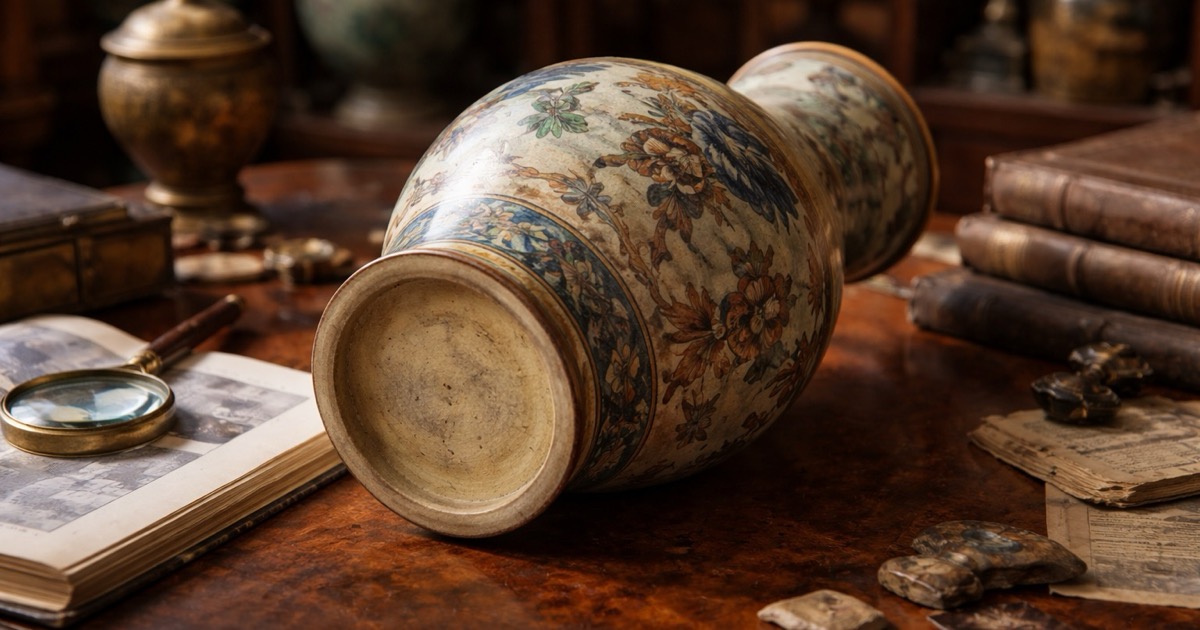
To identify a vase from its marks, turn it over and read the base first: an impressed or printed maker’s mark, a shape or pattern number, a country-of-origin line, and any painter’s initials together tell you far more than the decoration on the front. Record every character exactly as it appears, then match the mark’s style, wording, and method against a maker reference before you trust any single clue. A base with no mark at all is common and does not mean the vase is worthless; it just shifts the work onto material, construction, and wear.
The goal here is not to promise certainty from one photograph. It is to help you read the base like a cataloguer, ask sharper questions, and recognize which clues actually move an identification forward and which ones fool beginners.
Quick identification checklist
- Read the base: impressed, printed, or painted maker’s mark, plus any numbers, letters, or symbols.
- Note the mark method: impressed into the clay, ink-stamped, transfer-printed, or hand-painted.
- Check the clay body where it is exposed at the foot ring: porcelain, stoneware, or earthenware.
- Judge the glaze and any crazing, and whether the decoration is hand-painted or transfer-printed.
- Look for a country-of-origin line, which helps date a piece by import-marking laws.
- Inspect the foot ring, rim, and base for wear consistent with real age.
Read the base before anything else
The base of a vase carries the most diagnostic value, so start there and write down what you see before you touch a search engine. Small wording differences matter enormously: “England” and “Made in England” point to different date ranges, and a company name printed with “Ltd.” tells you the mark postdates incorporation. Note not just the words but the method. An impressed mark is pressed into the clay before firing; a printed or transfer mark sits on top of the glaze or under it; a painted mark shows brush strokes and slight irregularity. Reputable references catalog the specific marks each pottery used and roughly when, which is how a mark becomes a date rather than a guess (Kovels).
Country-of-origin wording is one of the most useful dating shortcuts. Broadly, unmarked country of origin suggests an earlier piece, a single country name (“Nippon,” “France,” “Germany”) points to the late nineteenth or early twentieth century, and “Made in [country]” wording generally reflects later twentieth-century import rules. Treat these as ranges, not exact dates, and confirm against the maker’s own mark history where you can.
Mark styles by era
Marks changed method and content over time, and knowing the rough pattern helps you place a vase before you ever find the maker. The table below is a general orientation, not a rule that holds for every pottery.
| Era (approx.) | Common mark method | Typical content | Notes |
|---|---|---|---|
| Pre-1850 | Impressed or hand-painted | Maker symbol, initials, often no country | Marks sparse; many quality pieces unmarked |
| 1850–1890 | Impressed, printed, painted | Maker name, pattern number, registry marks (UK) | British diamond registry mark used 1842–1883 |
| 1891–1920s | Printed and stamped | Country name added (“Nippon,” “France,” “England”) | Country-of-origin marking becomes widespread |
| 1920s–1950s | Printed, ink-stamped, foil labels | “Made in [country],” company logos, line names | Labels fall off; absence is common |
| Post-1950 | Printed, molded, backstamp logos | Full company branding, ™/® symbols, “dishwasher safe” | Modern wording and symbols date a piece late |
Use the era as a frame, then confirm with the specific maker’s documented marks. A mark that claims to be old but carries modern wording, a registration symbol, or a “microwave safe” note is telling you it is not.
Material and construction clues
When the mark is worn, missing, or ambiguous, the body and build carry the argument. Look at the foot ring where the clay is often unglazed: true porcelain is white, dense, and slightly translucent at thin edges; stoneware is heavier and more opaque; earthenware is coarser and more porous. The glaze tells its own story. Crazing, the fine network of surface cracks, develops with age and thermal cycling, but it can also be induced artificially, so crazing alone is not proof of age. Reign marks and dynasty marks on Chinese and Japanese vases are a special case: many were applied as marks of respect or reproduced later, so an apparently early reign mark frequently sits on a much later vase and should never be taken at face value (Gotheborg).
Construction details also date a piece. Hand-thrown vases usually show faint interior throwing rings and a base that was trimmed or wiped by hand; slip-cast and mold-made vases show seam lines and a more uniform interior. Museum ceramics collections are a good way to calibrate your eye on what genuine period bodies, glazes, and forms look like (Victoria and Albert Museum). If you are still narrowing the category, our guide to antique ceramic marks identification walks through porcelain, stoneware, and earthenware distinctions in more depth.
Reading maker’s marks and numbers
Once you have a mark, separate the parts. The maker’s name or symbol identifies who made it; a pattern or shape number identifies the design, not the age; and painter’s or decorator’s initials can sometimes be traced to a specific artist and working period. American art pottery is a clear example of how method and content combine. Roseville, for instance, used impressed and relief marks and paper labels across its run, and because so many Chinese reproductions carry Roseville-style marks, the mark alone is not enough; the quality of the molding and glaze has to agree with it (Kovels).
Resist the urge to force an attribution from a partial mark. An honest description like “European porcelain vase, hand-painted florals, painter’s initials ‘H.K.’, early 20th century” is stronger and more credible than a hopeful famous-maker name pinned to an ambiguous stamp. For the underlying skill of reading a backstamp line by line, our antique porcelain marks guide breaks down how to decode crowns, shields, and wording.
Watch-outs and common mistakes
- Dating a vase only by crazing; artificial crazing and thermal cycling both mimic age.
- Assuming all blue-and-white ware is old or Chinese; the pattern was copied worldwide for over a century.
- Taking a reign mark or dynasty mark at face value; many are reverential or reproduction marks on later pieces.
- Ignoring modern wording; “™,” “®,” “microwave safe,” or “Made in [country]” dates a piece to the modern era.
- Trusting a mark over the body; reproductions copy the mark first and the clay quality last.
Photo tips that improve identification
- Photograph the whole vase straight on so shape and proportions read clearly.
- Shoot the base square-on with even light, filling the frame with the mark and any numbers.
- Add a raking-light shot of the base so impressed marks catch shadow and become legible.
- Capture the unglazed foot ring to show clay color and body type.
- Take a close-up of the decoration to show hand-painted brushwork versus transfer-print dots.
Common questions
How do I identify an unmarked antique vase?
An unmarked vase is identified by material, construction, and decoration rather than a name. Look at the foot ring for clay body and color, check the glaze and any wear that matches genuine handling, and study whether the decoration is hand-painted or transfer-printed. Then compare shape, palette, and style against documented examples to narrow the region and rough period, and describe it honestly rather than forcing an attribution.
Do numbers on the bottom of a vase tell you its age?
Usually not directly. Numbers are most often shape or pattern codes that identify the design, not the year it was made. Some makers did encode dates in their numbering systems, but the meaning is maker-specific, so record the numbers exactly as they appear and let a reference for that particular pottery interpret them rather than assuming a number is a date.
Are reign marks on Chinese and Japanese vases reliable for dating?
No, not on their own. Reign marks and dynasty marks were frequently applied out of respect for an earlier emperor or reproduced on much later pieces, so an apparently early mark often sits on a far newer vase. Judge the body, glaze, potting, and painting alongside the mark, and treat the mark as one clue among several rather than a date stamp.
Related guides
- Antique Pottery Marks
- Antique Ceramic Marks Identification
- Antique Porcelain Marks: How to Read Backstamps
- Antique China Patterns Identification
- Roseville Pottery Marks Identification
When to use the Antique Identifier app
The app is most useful after you have taken one full photo of the vase and a few tight, well-lit shots of the base, the mark, and the foot ring. It can quickly narrow the likely type, era, and material, which makes your follow-up reference checking faster and more focused. If the result points to something unusually rare, signed, or high in value, treat that as a prompt for deeper verification with a maker reference or an appraiser rather than a final answer.
Topics