


Antique Ceramic Marks Identification
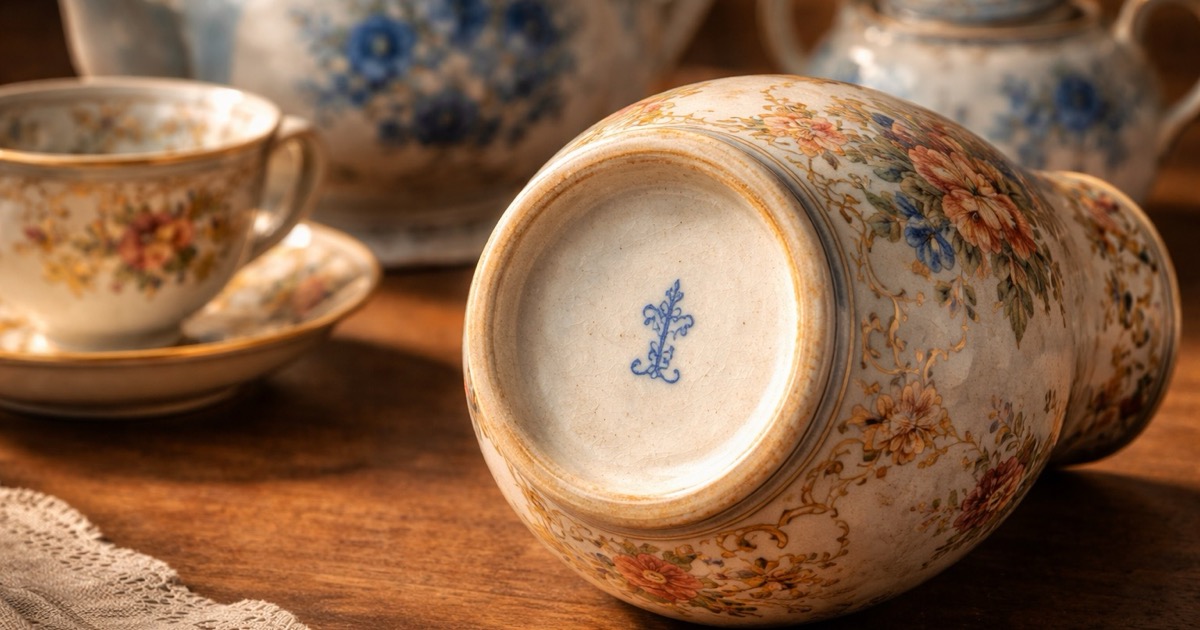
Antique ceramic marks identification starts by reading the mark on the base exactly as it appears — the maker’s name or symbol, the style of the mark (printed, impressed, or painted), and any country name, pattern number, or registration mark alongside it — then matching that combination against dated examples in a marks reference. The single most useful clue is the mark’s form, because printed transfer marks, impressed stamps, and hand-painted marks each cluster into different eras and price the object differently before you even read a word.
The goal is not to promise certainty from one photo. It is to help you record the right evidence, ask sharper questions, and recognize the clues most likely to move an identification forward — or to stop you paying for a modern reproduction stamped with an old-looking mark.
Quick identification checklist
- Read the mark literally: transcribe every word, letter, number, and symbol exactly, including anything that looks like a typo.
- Note the mark’s form: printed (transfer), impressed (pressed into the clay), painted (applied by hand over or under the glaze), or a combination.
- Look for a country of origin, which narrows the date range immediately.
- Record any pattern name, pattern number, or shape number separately from the maker’s mark.
- Check for a diamond-shaped or numbered registration mark, common on British ceramics.
- Examine the clay body, glaze, and foot ring for age evidence that either supports or contradicts the mark.
What the mark’s form tells you first
Before you read a single word, notice how the mark was made, because the technique alone brackets the era. An impressed mark — letters or a symbol pressed into the raw clay before firing — points to earlier or studio production and cannot be added after the fact. A printed mark, transferred like the decoration and sitting flat under or on the glaze, became the industrial standard through the nineteenth and twentieth centuries. A hand-painted mark, with visible brushwork and slight irregularity, is typical of both early porcelain and later studio and art pottery.
Combinations matter. A printed factory mark plus a separately painted pattern number and a painter’s initial is a normal, reassuring pattern for nineteenth-century porcelain. What should give you pause is a mark whose style does not match its object — a crisp modern-looking transfer mark on a piece claiming to be eighteenth-century, for instance. Museum ceramics guides organize their collections around exactly these material and manufacturing distinctions, which is why learning to see the technique pays off before you chase the name (Victoria and Albert Museum).
Mark styles by era
The form and content of ceramic marks shifted with manufacturing and trade law, so the mark itself is a rough dating tool. Treat this as a starting bracket to confirm against a specific reference, not a verdict on its own.
| Mark feature | Typical era | What it suggests |
|---|---|---|
| Impressed name or symbol only | 18th–early 19th c. and later studio ware | Hand or early factory production |
| Printed (transfer) maker’s mark | 19th–20th c. | Industrial factory output |
| Pattern name printed in the mark | Roughly post-1810 onward | Later factory production |
| Diamond registration mark (UK) | 1842–1883 | British registered design, dateable from the diamond |
| “Rd No” registration number (UK) | 1884 onward | British registered design, later than the diamond |
| Country of origin named | Generally 1891 onward | Made or imported after the McKinley Tariff era |
| “Made in [country]” phrasing | Generally 20th c. | Later still; often 1920s onward |
The country-of-origin line is one of the most reliable single clues. US import rules from 1891 required imported goods to be marked with the country of origin, so a named country generally signals that later era, and the fuller “Made in…” wording is later again — useful context confirmed by mark references and museum object records (The Potteries — pottery and porcelain marks). British registration marks are especially precise: the 1842–1883 diamond encodes the exact registration date, and it was replaced by a simple “Rd No” system from 1884, so which system appears already tells you which side of that line the design falls on.
How to actually read and match a mark
Transcribe first, search second. Write down every element separately — the maker’s mark, any pattern name, any number, and any extra symbols — because small wording differences distinguish genuine marks from reproductions and distinguish one factory’s decades apart. Many large makers changed their backstamp repeatedly, so the same name in two different mark styles can be fifty years apart in date. Marks databases exist precisely to sort these variants, and cross-checking the exact wording against one is the difference between a guess and an identification (Kovels pottery and porcelain marks).
For Asian export porcelain the logic is similar but the vocabulary differs: reign marks, workshop marks, and later export marks each carry their own conventions, and a reign mark is frequently a mark of respect or a later homage rather than a literal production date. Dedicated reference sites document these mark families in detail and are worth consulting before you attach a dynasty to a piece (Gotheborg antique Chinese and Japanese porcelain marks). When you are working through European factory backstamps specifically, our guide to antique porcelain marks and how to read backstamps walks through the same transcribe-then-match process with worked examples.
Let the object confirm the mark
A mark can be copied; a clay body and a lifetime of wear are harder to fake. Once you have a candidate identification from the mark, cross-check it against the object. Look at the clay body color where it is exposed at the foot ring, the glaze finish and any crazing, whether the decoration is hand-painted or transfer-printed, and how the rim, foot, and any handles were formed. Genuine age usually shows honest wear on the base and the touch points, glaze that has aged consistently, and foot rings finished the way that maker and era finished them.
Contradictions are the useful part. Crazing alone does not prove age, because it can be induced, and plenty of old ware never crazed — so dating on crackle glaze is a classic trap. Likewise, blue-and-white decoration is not a date; the blue willow pattern has been produced continuously by many makers for over two centuries, which is exactly why the mark and the body, not the pattern, have to carry the argument. Studio and art pottery adds another layer, where an impressed or incised personal mark matters more than any factory stamp — our studio pottery marks guide covers reading those hand marks.
Watch-outs and common mistakes
- Dating a piece by crazing or crackle glaze alone; crazing can be induced and many genuine pieces never craze.
- Assuming all blue-and-white ware is old; long-running patterns have been made continuously for generations.
- Ignoring modern reproduction stamps that copy famous marks; reproductions are common for the most collectible makers.
- Reading a reign mark as a literal production date on Asian porcelain; it is often homage or a mark of respect.
- Forcing a rare attribution from a partial or worn mark instead of recording exactly what survives.
Photo tips that improve identification
- Photograph the base and foot ring straight on, filling the frame, with even light and no glare on the mark.
- Take a second, raking-light shot of the base to reveal impressed or faint marks that flat light flattens out.
- Capture close-ups of the decoration so hand-painting versus transfer printing is clear.
- Show translucency only if the piece is porcelain and it is safe to backlight, since translucency helps separate porcelain from opaque earthenware and stoneware.
Common questions
How do I identify an unmarked piece of ceramic?
Work from the object instead of the mark: judge the clay body color at the foot, whether it is translucent porcelain or opaque earthenware or stoneware, the glaze and any crazing, the decoration technique, and the foot-ring and handle construction. These material and construction traits narrow the type, likely era, and sometimes the region. Many genuine pieces are unmarked, especially utilitarian ware and much studio and art pottery, so an unmarked piece is not automatically modern or worthless.
What does a country name on the bottom of a ceramic tell me?
A named country of origin generally signals a piece made or imported after US import rules required such marking from 1891, and the fuller “Made in…” wording is usually later still, often twentieth century. So a country name sets a rough earliest date rather than a precise one. Combine it with the maker’s mark style and any pattern or registration number to tighten the range.
Are crazing and crackle proof that a ceramic is old?
No. Crazing is a network of fine glaze cracks that can develop with age but can also be induced deliberately or appear on relatively new pieces, and many genuinely old pieces never craze at all. Treat crazing as one weak clue among several rather than a dating method. Weigh it alongside the mark, the clay body, the wear pattern, and the construction before drawing any conclusion.
Related guides
- Antique Pottery Marks
- Antique Porcelain Marks: How to Read Backstamps
- China Makers Marks Identification: How to Read Old China Marks
- Studio Pottery Marks Identification
- Antique Stoneware Crock Identification Marks
When to use the Antique Identifier app
The app is most useful after you have taken one full photo and a few tight, well-lit shots of the base, the mark, and the decoration. It can help narrow the likely type, era, and maker, which makes your follow-up research faster and points you at the right marks reference to confirm against. If the result points to something unusually rare, signed, or high value, treat that as a prompt for deeper verification rather than a final answer.
Topics