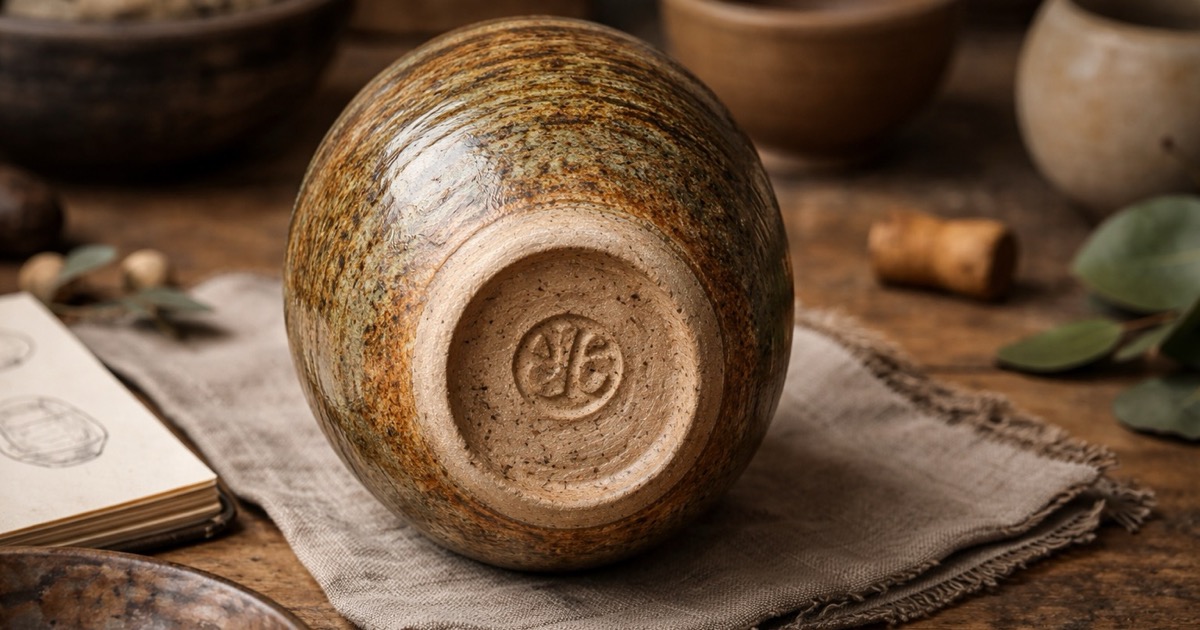
Studio pottery marks are identified by the potter’s personal seal or impressed cipher, an incised or painted signature or initials, and often a second mark for the workshop where the piece was made. Unlike factory backstamps, these marks are usually small, hand-cut or hand-painted, and personal, so the fastest route to a name is to read the mark exactly, match the clay body and glaze, and then check it against a potter’s-marks reference. Start by photographing the mark straight on and recording every stroke before you begin searching.
Studio pottery is the tradition of individual artist-potters throwing, glazing, and firing by hand, as opposed to industrial factory production. It runs from the early twentieth century, shaped in Britain by Bernard Leach and the workshop he founded at St Ives in 1920 (Leach Pottery), through a large postwar community of studio and craft potters worldwide. Because these marks are personal rather than corporate, identification leans as much on the pot’s material and making as on the stamp itself.
Quick identification checklist
- Look for two marks, not one: many studio potters used a personal seal plus a separate pottery or workshop seal on the same piece.
- Read the mark exactly, letter by letter, before searching. Initials, a monogram, or a device tell you more than a full name (which is rare).
- Feel the mark: impressed seals leave a crisp recessed stamp, incised marks are scratched into leather-hard clay, and painted marks sit under or over the glaze.
- Check the clay body at the unglazed foot: stoneware, porcelain, and earthenware each narrow the field.
- Judge the making: throwing rings, a trimmed foot ring, and glaze pooling point to hand work, not slip-cast production.
- Record any incised or painted numbers separately; they may be a date, an edition, or a shape code.
What a studio pottery mark actually is
Factory china carries a printed backstamp designed to be uniform across thousands of pieces. A studio potter’s mark is the opposite: a personal signature pressed, scratched, or brushed into a one-off or small-batch pot. The three forms you will meet most often are the impressed seal (a carved stamp pushed into soft clay, leaving a small recessed device or set of initials), the incised mark (letters or a monogram scratched in with a tool before firing), and the painted mark (a signature or cipher brushed on in slip, oxide, or overglaze enamel).
The single most useful habit is to look for a pair of marks. In the Leach tradition and the many workshops it influenced, a piece often carries the individual potter’s personal seal alongside a separate seal for the pottery where it was thrown. Two ciphers together are far more identifiable than either alone, and mistaking a workshop seal for the maker’s own is one of the most common attribution errors. Museum records make the distinction explicit; the Victoria and Albert Museum, for instance, catalogues Bernard Leach’s own vases with his personal seal noted separately from the St Ives Pottery mark (V&A Collections).
Reading the mark: seal, incised, or painted
How a mark was made is a dating and identification clue in itself, because it tells you the point in production when the potter added it and what tools were in the studio.
| Mark type | How it was made | What it looks like | Typical clue value |
|---|---|---|---|
| Impressed seal | Carved stamp pressed into soft, leather-hard clay | Small recessed device, monogram, or initials with crisp raised edges | Strongest for named potters and workshops; consistent shape across a maker’s output |
| Incised mark | Scratched in with a point before firing | Thin, slightly ragged lines; letters or a monogram, sometimes a date | Personal and variable; good for matching a hand, weaker for a clean database match |
| Painted mark | Brushed in slip, oxide, or overglaze enamel | Softer strokes, sits visibly under or over the glaze | Common on decorative and later studio ware; colour and placement help |
| Paper or foil label | Applied after firing, often a gallery or exhibition tag | Printed adhesive label, frequently lost | Supporting evidence only; easily faked or transferred |
Whatever the type, transcribe it precisely. A monogram read as “DL” when it is actually “LD”, or a device you record as a bird when it is a fish, sends the search in the wrong direction. If letters are ambiguous, photograph the mark and note the alternatives rather than committing to one reading.
Let the clay and glaze corroborate the mark
A mark on its own can be copied; the pot around it is much harder to fake convincingly. Turn the piece over and look at the unglazed foot ring, where the raw clay shows. Stoneware fires to a dense grey, buff, or toasted brown; porcelain is white and often faintly translucent at thin edges; earthenware is softer, more porous, and usually a warmer terracotta or cream. This is the same read you would do on any hand-thrown stoneware, and it is worth practising on pieces where the maker is known, such as marked antique stoneware crocks, before you trust it on an unknown studio pot.
Glaze tells you about the studio’s technique and era. Studio potters favoured expressive glazes: ash and celadon greens, iron-rich tenmoku browns and blacks, tin-glazed whites, and deliberate effects like hare’s-fur streaking or reduction-fired blushes. These are made choices, not factory uniformity, so a glaze that pools in the throwing rings, breaks over a carved edge, or varies pot to pot is consistent with genuine studio work. Crazing (the fine crackle in a glaze) can happen naturally over time but is also engineered deliberately, so do not treat crazing alone as proof of age. For the broader vocabulary of hand-decorated versus printed surfaces, our guide to antique pottery marks covers how decoration method interacts with dating.
Distinguish studio pottery from factory art ware
The trickiest attribution problem is telling a genuine artist-potter’s piece from factory-made “art pottery” designed to look handmade, and from modern reproductions of famous studio styles. A few tells help:
- Slip-cast seams, a perfectly smooth interior, and identical repeated shapes point to factory production, even when the glaze looks arty. Genuine studio throwing leaves interior spiral rings and slight asymmetry.
- A printed backstamp with a company name, a country of origin, and a pattern number is a factory mark, not a studio potter’s seal. If the mark reads like a brand rather than a person or small workshop, treat it as factory art ware and identify it the way you would any antique porcelain backstamp.
- Reproductions of celebrated studio styles (Leach-tradition tenmoku bowls, for example) often copy the look but not the seal, or apply a plausible-looking seal to a body and glaze that do not match documented work. When the mark says one thing and the clay says another, believe the clay.
Comprehensive potter’s-marks references are the backstop here. General mark databases such as Kovels catalogue thousands of pottery and porcelain marks and are a reasonable first cross-check (Kovels), while specialist studio-pottery references and museum collection records are stronger for confirming a specific artist-potter’s seal.
Watch-outs and common mistakes
- Reading a workshop seal as the maker’s personal mark, or vice versa, when both appear on the pot.
- Dating a piece from crazing alone, when crazing can be either age-related or deliberately induced.
- Assuming every hand-thrown look is studio pottery; factory art ware imitates the aesthetic on slip-cast bodies.
- Trusting an adhesive gallery label as proof of maker; labels are easily moved between pots.
- Forcing a famous attribution (Leach, Hamada, and similar names) onto an unmarked or ambiguously marked piece.
Photo tips that improve identification
- Photograph the mark straight on, filling the frame, with soft raking light so an impressed seal casts a slight shadow and reads clearly.
- Take one wider shot showing where the mark sits (foot, side, or base) and its size relative to the pot.
- Shoot the unglazed foot ring to record the raw clay colour and texture.
- Capture a close-up of the glaze where it pools or breaks over an edge, plus a full profile so the thrown shape reads.
Common questions
What is the difference between a studio pottery mark and a factory backstamp?
A studio pottery mark is a personal seal, incised signature, or painted cipher added by an individual artist-potter, and it is usually small, hand-made, and variable. A factory backstamp is a printed, uniform brand mark carrying a company name, often a country of origin and a pattern number. If the mark reads like a person or small workshop, it is a studio mark; if it reads like a brand, it is a factory piece.
Why do some studio pots have two different marks?
Many studio potters, especially in the Leach tradition, stamped a piece with their own personal seal and also a separate seal for the pottery or workshop where it was thrown. The two together identify both the maker and the studio, which is far more useful than either alone. Recording both marks, and not confusing one for the other, is key to a correct attribution.
Can I identify studio pottery with no visible mark?
Sometimes, but with lower confidence. Unmarked studio pots are common, and identification then rests on the clay body, glaze style, throwing and trimming characteristics, and comparison with documented work by potters who used those techniques. An honest description such as “hand-thrown stoneware, tenmoku glaze, mid-twentieth century, unmarked” is stronger and more credible than a hopeful attribution to a famous name.
Related guides
- Antique Pottery Marks
- Antique Porcelain Marks: How to Read Backstamps
- China Makers Marks Identification: How to Read Old China Marks
- Antique Stoneware Crock Identification Marks
- Roseville Pottery Marks Identification
When to use the Antique Identifier app
The app is most useful after you have taken one full profile photo and a few tight shots of the mark and the unglazed foot. It can help narrow the likely type, glaze family, and era, which makes your follow-up research in a potter’s-marks reference faster. If the result points to a recognized artist-potter or an unusually rare piece, treat that as a prompt for deeper verification against museum records and specialist references rather than a final answer.