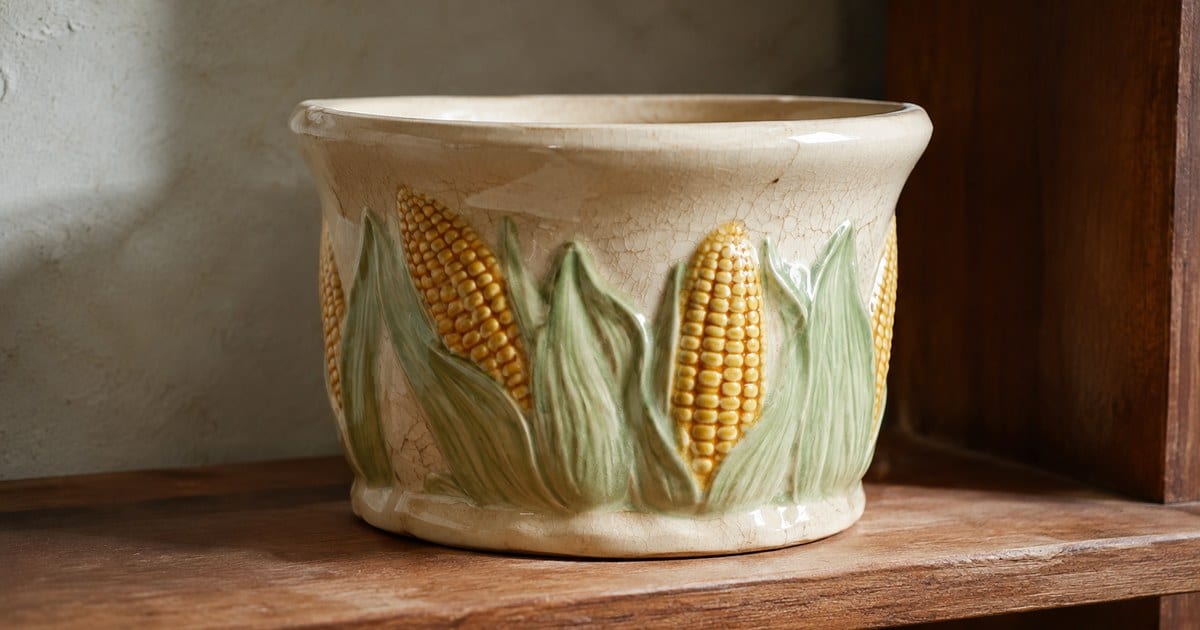
The usual way people try to identify Shawnee is to turn a planter over, look for the word Shawnee, fail to find it, and conclude the piece is something else. That single move is responsible for most of the misattributed Shawnee sitting in booths and online listings right now, because Shawnee pottery marks very often do not include the company name at all. The factory relied heavily on paper labels that came off in the first wash, and what stayed behind on the base was frequently nothing more than an impressed country name and a number.
Shawnee pottery marks are usually just “USA” impressed into the base, often with a mold number, and frequently nothing else. The company relied on paper labels for branding, so an absent Shawnee name is normal rather than disqualifying. Marks reading “Shawnee U.S.A.” with a mold number appear on later production, and division names such as Kenwood also identify Shawnee ware.
Quick identification checklist
- Read the base exactly as written, in the order it appears. Record whether it says only USA, USA with a number, Shawnee USA, or a line name plus USA.
- Write down the mold number. It is the single most searchable thing on the piece, more useful than the company name.
- Look for label residue. A ring of dried adhesive or a slightly cleaner patch on the base indicates a paper label that has been removed.
- Check the impression, not the print. Shawnee base marks are typically pressed into the clay before glazing rather than printed on the surface.
- Assess the glaze. Soft high-gloss glazes, pastel bodies, and cold-painted decorative accents are characteristic of the mid-century Ohio pottery this company belongs to.
- Identify the line before the mark. Corn ware, cookie jars, figural planters, and shakers each have documented Shawnee forms that can carry the identification on their own.
- Compare against McCoy and Hull deliberately. Three Ohio potteries working in the same decades produced similar shapes and glazes, and this is where most confusion starts.
What Shawnee pottery marks actually say
The Shawnee Pottery Company operated in Zanesville, Ohio, from 1937 until it closed in 1961, taking over a large former tile works plant. It produced dinnerware, kitchenware, figural planters, cookie jars, salt and pepper shakers, and the corn-shaped ware it is best remembered for.
For much of that history, the branding on a finished piece lived on a paper or foil label rather than in the clay. Labels wash off, so surviving examples routinely show a base that has been wiped completely clean of any company identification. What tends to remain is an impressed “USA,” sometimes on its own and sometimes paired with a number. Some pieces carry the number with no country wording at all.
This is the fact that changes how you should search. If you have a base reading “USA 71” or similar, you do not have an unidentifiable piece. You have a mold number, which is the primary key collectors and reference guides use for this factory. Searching the exact number alongside the shape you are holding is far more productive than searching for the company name that was never impressed in the first place.
The Shawnee U.S.A. mark and later production
The company name does appear impressed on some ware, generally reading “Shawnee U.S.A.” together with a mold number. Collectors associate that combination with later production rather than with the factory’s earliest years, so its presence is a mild indicator of a piece from the 1950s onward rather than the late 1930s or the war years.
Treat that as a general tendency rather than a precise dating test. Ohio potteries of this period were not consistent about marking, and mold reuse across years is normal, so the mark form narrows a range rather than fixing a date. The most reliable dating handles for Shawnee are the line and the glaze treatment, not the wording on the base.
Kenwood and other line names on the base
A base that carries a name you do not recognize is another common source of misidentification.
Kenwood is the clearest example. It was a division created within Shawnee in the 1950s, under a management change late in the company’s life, to market kitchenware. Pieces from it are commonly marked “Kenwood USA” with a mold number, and readers regularly assume Kenwood was a separate company. It was not. Kenwood ware is Shawnee ware.
Collectors also encounter other line and house-brand names on Shawnee bases, including Great Northern on certain corn-form pieces produced for particular buyers. The general principle matters more than any individual name: a mid-century Ohio piece marked with an unfamiliar line name plus USA is worth checking against Shawnee’s known lines before you conclude it came from an unknown factory. Retailer-specific and division-specific branding was ordinary practice.
Corn King, Corn Queen, and the line that dates itself
Corn ware is Shawnee’s signature and the one line where the piece dates itself without any reference to the base mark.
Corn King was produced from 1946 to 1954. Corn Queen followed and ran from 1954 until the factory closed in 1961. The two are told apart by color rather than by form. Corn King has darker, deeper yellow kernels with lighter green leaves, while Corn Queen shifted to darker green leaves against paler, more cream-toned kernels. Once you have compared a confirmed example of each side by side, the difference is obvious, and it gives you a genuine production window without needing the mark at all.
The line ran to a full table service, including plates, mugs, teapots, casseroles, cookie jars, pitchers, and salt and pepper shakers, so the range of forms is wide. Shawnee’s earlier Valencia dinnerware, a brightly colored solid-glaze line, belongs to a different part of the company’s output and is worth knowing about because it looks nothing like the corn ware people expect from this maker.
Telling Shawnee from McCoy and Hull
Three Ohio potteries dominate this confusion, and there is a reason: they worked in the same decades, in the same region, in the same commercial categories, with overlapping glaze palettes.
McCoy generally marked its ware more consistently and more visibly than Shawnee did, and the McCoy name appears impressed on a large share of its output, which by itself makes a bare “USA” base less likely to be McCoy. Hull is known for matte pastel art pottery with a distinctive body and typically carries impressed marks combining a letter, a number, and a size. Shawnee sits between them: strong figural and kitchenware output, high-gloss glazes, and the lightest marking habits of the three.
The practical method is to work from form first. Each of these factories produced documented shapes, and matching the exact silhouette of a planter or cookie jar against reference photographs settles more attributions than any base reading will. Use the dedicated McCoy and Hull guides below when a piece could plausibly belong to either.
Watch-outs and common mistakes
- Concluding it is not Shawnee because the base lacks the name. This is the single most common error in the category, and the paper-label practice is the reason.
- Treating the mold number as a date. It identifies the mold, not the year. Numbers were assigned by form.
- Assuming Kenwood or another line name means a different company. Division and retailer branding was normal.
- Overvaluing cold paint. Decoration applied over the glaze rather than fired under it wears off with handling and washing. Original cold paint in good condition matters, and repainted cold paint is a real problem in this category.
- Ignoring reproduction pressure on the popular forms. Well known Shawnee cookie jars and shakers have attracted copies. Compare glaze quality, weight, mold sharpness, and base finish against documented examples rather than relying on shape alone.
- Mistaking crazing for damage or for age. Fine glaze crazing is common on mid-century American pottery and does not by itself prove or disprove anything about the maker.
Photo tips
- Photograph the base filling the frame, with strong light coming in from a low angle so the impressed lettering and number cast shadows and become readable.
- Shoot the whole piece square-on against a plain background, since form matching is how most attributions in this category are actually made.
- Take a close photograph of the glaze surface, which records color, gloss level, and any crazing pattern.
- Photograph any cold-painted detail separately so wear and possible repainting are visible.
- Include a scale reference in one frame. Size separates several similar mold variants across these Ohio factories.
Common questions
My pottery is marked only “USA” with a number. Is it Shawnee?
It might be. A bare “USA” impressed mark with a mold number is entirely typical of Shawnee, because the company branded most of its output with paper labels that did not survive. It is not conclusive on its own, since other American potteries also used minimal marks. Match the form against documented Shawnee shapes and search the exact mold number alongside a description of the piece.
How do I tell Corn King from Corn Queen?
Compare the colors rather than the shape. Corn King, made from 1946 to 1954, has darker, deeper yellow kernels with lighter green leaves. Corn Queen, made from 1954 until the factory closed in 1961, has noticeably darker green leaves and paler, creamier kernels. The forms overlap substantially between the two lines, so color is the working test.
Is Kenwood pottery the same as Shawnee?
Yes. Kenwood was a division established within Shawnee in the 1950s to market kitchenware, and pieces are typically marked “Kenwood USA” with a mold number. Finding that mark on a base is confirmation of Shawnee manufacture rather than evidence of a different maker, which is the opposite of what most people assume when they first read it.
Related guides
- McCoy Pottery Marks Identification
- Hull Pottery Marks Identification
- Red Wing Stoneware Identification
- Antique Pottery Marks
When to use the Antique Identifier app
Shawnee is the category where a photo-based first pass earns its keep, because the base often gives you nothing to search. Photograph the whole piece square-on and the base in raking light, and let the app suggest a maker, a line, and a likely period from the form and glaze rather than from a name that was never impressed. That gives you a starting hypothesis and, more importantly, the vocabulary to check it against the McCoy and Hull guides above and against documented mold numbers before you decide what you have.