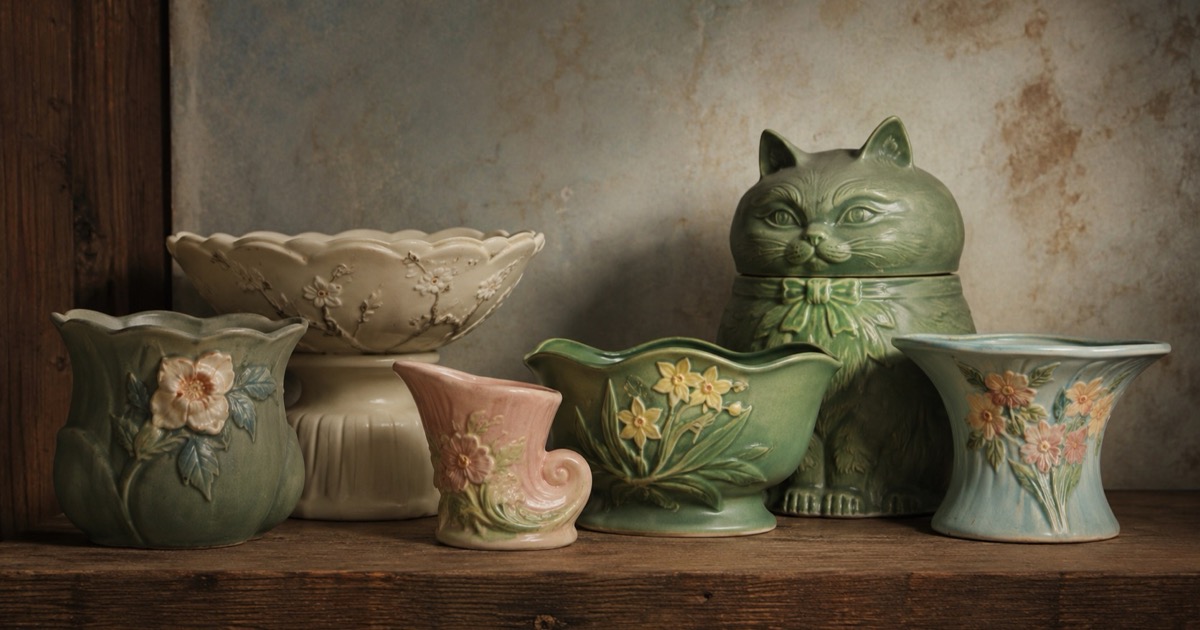
McCoy pottery marks look deceptively simple, often nothing more than the company name molded into the base, but the style of the mark, where it sits, and whether it exists at all carry real dating information. Nelson McCoy production ran from 1910 into the 1980s, and the marks changed enough across those decades that you can usually place a piece within a broad era from the base alone. By the end of this guide you will know the major mark families, the lines collectors hunt, and the telltales of the fake cookie jars that flooded the market in the 1990s.
McCoy pottery marks are usually the company name molded or incised into the base, often with “USA” and a shape number, on buff to cream Ohio clay. Early stoneware carried shield-style stamps, and 1930s pieces an “NM” mark. Start by flipping the piece and reading the base under angled light.
Two cautions up front. McCoy left a great deal of its production unmarked, so a missing mark proves nothing by itself. And because the McCoy name went unprotected for a period, a McCoy mark alone does not prove McCoy made the piece. Marks are evidence to stack, not verdicts.
Quick identification checklist
- Look on the base for “McCoy,” “McCoy USA,” “NM,” or an early shield-style stamp.
- Note whether the mark stands up in relief (molded in the mold) or is cut down into the clay (incised).
- Check exposed clay on the foot: Nelson McCoy typically fired to a buff, cream, or light tan body.
- Treat unmarked pieces as normal; much early production and florist ware carries no mark at all.
- Be suspicious of any McCoy-marked cookie jar in a design you cannot find in McCoy references.
- Look for honest glaze wear and shelf scuffs; raw, glassy-new glaze on a “vintage” jar is a warning sign.
How McCoy pottery marks evolved
The Nelson McCoy Sanitary Stoneware Company was founded in Roseville, Ohio, in 1910, producing utilitarian stoneware such as crocks, jugs, and jardinieres. Early pieces, when marked at all, tend to carry stamped devices, including a shield-style mark, sometimes with a size or shape number. Collector references generally place these stoneware-era marks in the 1910s and 1920s.
Through the 1930s and into the early 1940s, many pieces carry an “NM” mark for Nelson McCoy, incised or impressed into the clay. Around 1940 the McCoy name itself begins to appear, molded or incised, and from the mid-1940s onward variants adding “USA” or “Made in USA” become common. Later ownership eras, after the company changed hands from the late 1960s onward, sometimes added extra letters or numbers near the name. Treat every bracket below as approximate; McCoy ran molds for years at a time, and transitional pieces exist.
| Mark style | Rough era per collector references |
|---|---|
| Shield-style stamps on stoneware | 1910s to 1920s |
| ”NM” incised or impressed | 1930s to early 1940s |
| Molded or incised “McCoy” name | around 1940 onward |
| ”McCoy USA” and “Made in USA” variants | mid-1940s onward |
| Name with added letters or numbers | later corporate eras |
Molded versus incised marks, and where they sit
Most McCoy marks were part of the mold itself, so the name stands up from the base in low relief. Because glaze often pooled over these molded marks, a soft, partly filled-in mark is completely normal and reads best under angled light. Incised marks, cut down into the clay, appear on some earlier and hand-finished pieces and feel like a groove under a fingernail.
Marks usually sit near the center of the base, frequently on an unglazed or partially glazed foot area, and are often accompanied by a molded shape number. Floraline, the company’s florist line, is typically marked with the Floraline name and a number rather than the McCoy name. What you should not see is a sharp, scratchy signature cut through the glaze after firing; that is a sign someone added a name to an unmarked pot.
The lines collectors hunt first
Cookie jars are the headline category. McCoy produced figural jars across several decades in a long list of documented designs, and condition-sensitive details like lid fit and paint survival drive prices. Planters are the volume category, from simple bulb bowls to elaborate figural planters, and jardinieres with matching pedestals connect back to the company’s earliest production.
Vases in both matte and gloss glazes turn up constantly at estate sales, and Floraline supplied florists with plain, modern shapes that are now an affordable entry point. Across all lines, the pattern is the same: the form and glaze identify the design, and the mark then supports or undermines that identification.
The fake McCoy cookie jar problem
McCoy has one of the best-known reproduction problems in American pottery. Starting in the early 1990s, reproduction workshops began marking newly made cookie jars with a McCoy mark, including designs the original company never produced, taking advantage of the then-unprotected name. These jars have circulated for decades and regularly surface at sales priced as originals.
The telltales are consistent. First, check whether McCoy ever made the design at all; a McCoy-marked jar in a pattern missing from standard references is the loudest alarm available. Second, copies cast from original jars shrink in firing, so reproductions often run slightly smaller and lighter than documented originals. Third, the clay and surface differ: whiter or grayer body where buff is expected, wet-looking new glaze, slightly off colors, and crisp marks in the wrong style or position. No single telltale is conclusive, but two together should stop a purchase.
Clay body and glaze clues
Nelson McCoy fired a buff to cream Ohio clay for most of its history, visible on dry feet and unglazed base areas. A bright white body on a piece sold as mid-century McCoy deserves skepticism. Weight should feel substantial but not crude; McCoy was mass-produced ware with even walls and clean mold lines.
Glaze tells the rest of the story. The company is known for both rustic matte glazes, especially greens and browns, and cheerful gloss pastels. Decades of real life leave fine utensil scratches, shelf wear on high points and foot rims, and sometimes light crazing. Uniform, untouched gloss over every surface of a supposedly old piece should send you back to the mark and the design for a harder look.
Watch-outs and common mistakes
- Assuming unmarked means not McCoy, or that a McCoy mark guarantees authenticity; both fail regularly.
- Confusing Nelson McCoy with Brush-McCoy, a separate company tied to J.W. McCoy; references treat them differently.
- Paying original prices for 1990s reproduction cookie jars, especially in designs McCoy never made.
- Treating mark-era date ranges as precise years; molds stayed in service for long runs.
Photo tips that improve identification
- Shoot the base straight on so the full mark, shape number, and foot are in one frame.
- Add a raking-light shot across the mark; low-relief molded names nearly disappear under flat light.
- Capture the exposed clay color on the foot in daylight, since body color is a key authenticity clue.
- Photograph the whole piece with its lid or pedestal so the design can be matched to references.
Common questions
Is unmarked McCoy pottery worth anything?
Yes. McCoy left a great deal of its production unmarked, especially early pieces and florist ware, so the absence of a mark does not lower a piece to worthless. Value rests on the form, glaze, and condition matching a documented McCoy line; an unmarked planter in a recognized design and glaze trades on those merits.
What does the NM mark on pottery mean?
“NM” stands for Nelson McCoy and appears incised or impressed on pieces generally dated from the 1930s into the early 1940s, before the full McCoy name became standard. It is one of the more useful McCoy marks because it points to a relatively narrow era, though molds stayed in service long enough that the bracket is approximate.
How can you tell a fake McCoy cookie jar?
Check three things together. First, confirm McCoy actually made the design; reproduction workshops marked jars in patterns the company never produced. Second, compare size and weight, since copies cast from originals shrink in firing and run slightly smaller and lighter. Third, look at the clay and glaze: a whiter body, wet-looking new gloss, and a crisp mark in the wrong style or position all point to a 1990s reproduction.
Related guides
- Antique Pottery Marks
- Studio Pottery Marks Identification
- Antique Vase Identification Marks
- Antique Ceramic Marks Identification
When to use the Antique Identifier app
Photograph the whole piece first, then take tight shots of the base mark, shape number, and exposed clay. The app can quickly narrow whether a form and glaze match known McCoy lines and which mark era fits, which turns an hour of catalog flipping into a short verification job. If it flags a rare jar or an unusually valuable design, treat that as a reason to check serious references, not as a final answer.