Hull pottery marks are the most direct route to placing a piece in the right period and identifying which of the company’s many lines you are looking at. The A.E. Hull Pottery Company operated out of Crooksville, Ohio for most of the twentieth century, and its marks changed enough across two distinct eras — divided by a 1950 plant disaster — that reading the base carefully tells you more than the glaze color alone.
To identify Hull pottery marks, turn the piece over and read the lettering incised in the clay: “Hull Art U.S.A.” in block letters points to the prized pre-1950 matte art lines, while a lowercase script “hull” signals post-fire production. Note the shape number and size fraction beside the mark, then check them against a documented line listing.
By the end of this guide you will know how to read Hull’s incised marks, what shape numbers and size fractions mean, which famous lines to look for, why Little Red Riding Hood requires extra caution, and what condition issues to expect on older pieces.
Quick identification checklist
- Examine the base for an incised or mold-pressed mark; most Hull production lines carry a mark directly in the clay, not as a fired-on decal.
- Read the mark carefully: early pre-fire pieces often read “Hull Art U.S.A.” while post-fire production uses “hull” in a lowercase script form.
- Note the shape number and size fraction that appear alongside the mark; these identify the specific mold and size within a line.
- Match the glaze finish to the era: matte pastel glazes are characteristic of the pre-fire art lines, while glossier finishes are more common after 1950.
- Check for foil stickers on later production pieces; these sometimes substitute for or supplement a base mark.
- Look at crazing, glaze texture, and any drip lines at the foot for signs of age and period-appropriate production quality.
The 1950 fire: the dividing line in Hull production
In 1950, the Hull plant was destroyed by a flood and fire. When the company rebuilt and resumed production, the character of the ware changed noticeably. The pre-fire period is most prized by collectors because it produced the matte pastel art pottery lines that Hull is best known for. Post-fire production shifted toward glossier glazes and a broader range of household and decorative items, and the company operated until 1986.
This dividing line matters for identification because the marks, the glaze character, and the line names all shift across it. A piece described simply as “Hull pottery” could belong to either era, and the distinction affects collector interest significantly for certain lines.
Incised marks and what they mean
Hull used incised marks — letters and numbers cut into wet clay before firing — as its primary identification system. The pre-fire mark most commonly seen on art pottery lines reads “Hull Art U.S.A.” in block letters; the post-fire mark shifts to “hull” in lowercase script or “HULL” in all capitals.
Alongside the brand mark, Hull incised a shape number and a size indicator (written as a fraction or number). The shape number identifies the mold form within a line; the size tells you which variant it is. Hull made many forms in multiple sizes, and collector references list shape-and-size combinations for every documented line, making it possible to confirm that a mark matches the piece it is on. A mismatch between the stated size and the actual dimensions is a flag worth investigating.
Famous pre-fire lines
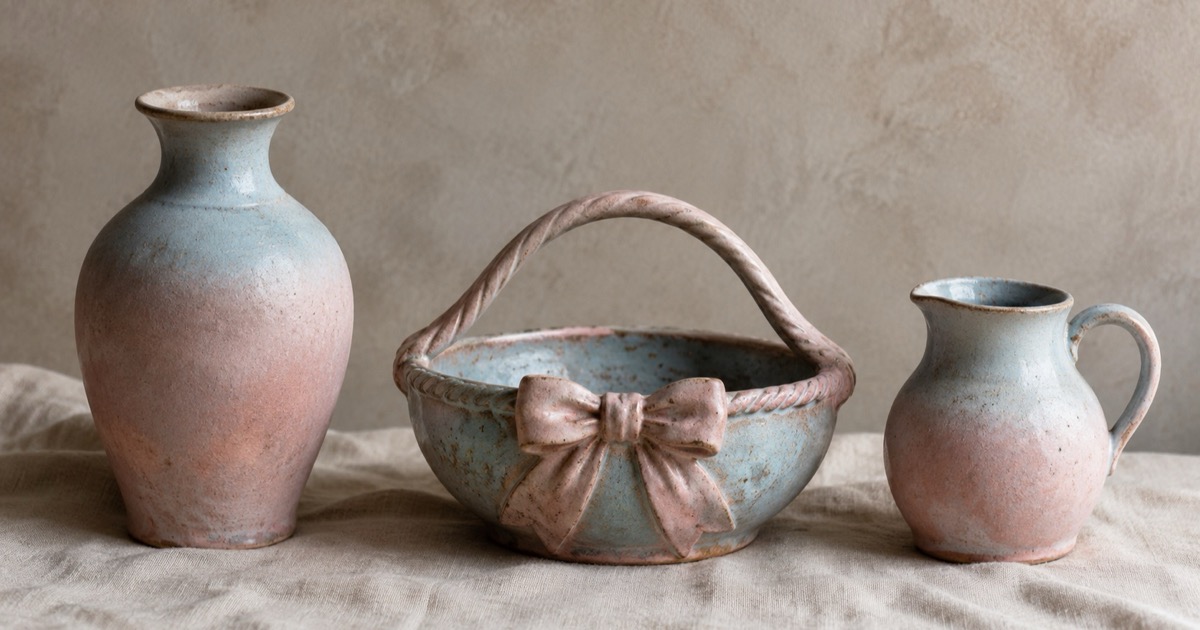
Bow-Knot, produced in the late 1940s, features applied floral and bow decorations in matte pastel relief, typically in blue-pink or turquoise-pink combinations. Wildflower is another pre-fire matte line with stylized floral relief against soft pastel backgrounds. Both are identified through their incised shape numbers and the characteristic glaze palette.
Little Red Riding Hood is a Hull line featuring the storybook character on cookie jars, canisters, pitchers, and related pieces, produced from the mid-1940s. It has been heavily reproduced, making careful mark examination essential. Genuine pieces carry appropriate incised base marks; reproductions often show marks that differ in letter spacing, depth, or style from documented originals, and the slip-cast detail is typically coarser. For any Little Red Riding Hood purchase based on value, compare the mark against a specialized reference rather than relying on visual impression alone.
Foil labels on later production
Hull used paper foil labels on some of its post-fire production lines, particularly on pieces where a base mark was less practical or where the form was being sold into gift markets. These labels are easily lost, which means unmarked Hull pieces from the post-fire period are common. An unmarked glossy piece with Hull-style forms and glaze is not necessarily a fake; it may simply have lost its foil label. Context — the form, the glaze, comparison to marked examples — is what allows a reasonable attribution in these cases.
Condition notes
Crazing — the network of fine lines that develops in a glaze as it ages and contracts differently from the clay body beneath it — is normal and expected on older Hull art pottery. Light crazing does not significantly affect value. Heavy crazing that has allowed dirt or staining into the craze lines can reduce desirability, and severe crazing sometimes signals that a piece was exposed to rapid temperature changes at some point.
Glaze flakes at the base edge or around relief details are common on pieces that have been used or handled over decades. Chips and flakes on the main decorative surface, particularly on Bow-Knot or Wildflower pieces where the relief work is the primary feature, reduce value more substantially.
Hairline cracks — thin cracks in the clay body that may not be immediately visible — are worth checking for by holding the piece up to a strong light and looking at the silhouette, or by tapping gently and listening for a dead sound rather than a clear ring.
| Era | Mark style | Glaze character |
|---|---|---|
| Pre-fire (before 1950) | “Hull Art U.S.A.” block letters incised | Matte pastels, soft surface |
| Post-fire (1950–1986) | “hull” lowercase script, or “HULL” all caps | Glossier finishes common |
| Later lines / gifts | Foil label only, base mark absent | Variable |
Watch-outs and common mistakes
- Little Red Riding Hood has a significant reproduction problem; compare base marks against documented originals before paying collector prices.
- Not all Hull marks are perfectly formed; slight variations in depth and spacing occur on genuine pieces due to mold wear.
- The absence of a base mark does not automatically mean a piece is not Hull; foil-label pieces are common in post-fire production.
- Post-fire glossy Hull is genuinely collectible but commands different prices than the matte art lines; know which era you are buying.
- Restored or re-glazed pieces do exist; fresh glaze over old clay is occasionally detectable by differences in sheen, crazing pattern, or edge texture.
Photo tips that improve identification
- Photograph the base straight-on under raking light to make incised marks and size numbers legible, including the shape number and size fraction.
- Capture the relief decoration with directional light that lets the raised details cast small shadows, showing the crisp or worn state of the molded work.
- Photograph any crazing by holding the piece at an angle to the light so the craze pattern shows clearly.
- Document chips and glaze flakes with tight close-up shots before any sale or appraisal.
Common questions
What do the numbers on the bottom of Hull pottery mean?
The number incised beside the Hull mark is a shape number identifying the specific mold form within a line, and the fraction or additional number next to it indicates the size variant. Hull made many forms in several sizes, and collector references list the documented shape-and-size combinations for each line. If the stated size does not match the piece’s actual dimensions, that mismatch is worth investigating.
Is unmarked Hull pottery worth anything?
It can be. Hull used paper foil labels instead of base marks on some post-fire production, and those labels are easily lost, so unmarked glossy pieces with Hull-style forms and glazes are common and not automatically suspect. Attribution then rests on comparing the form and glaze against marked examples. Confidently attributed unmarked pieces sell, though the matte pre-fire art lines remain the stronger collector market.
How can you tell if Little Red Riding Hood pottery is a reproduction?
Compare the base mark against a specialized reference, because reproductions often differ from documented originals in letter spacing, depth, or style. The molded detail is another tell: reproduction slip-casting is typically coarser than the original work. Because this line has been heavily reproduced, any purchase at collector prices should rest on a mark-by-mark comparison rather than overall visual impression.
Related guides
- McCoy Pottery Marks Identification
- Roseville Pottery Marks Identification
- Antique Pottery Marks
- Van Briggle Pottery Marks: How to Identify and Date Van Briggle
When to use the Antique Identifier app
Photograph the whole piece and a close-up of the base mark, including the shape number and any size designation. The app can help narrow the line and era quickly. If the result suggests a pre-fire art line or a Little Red Riding Hood piece with collector value, use that as a starting point for comparison against documented reference marks rather than treating it as a final identification.