Most guides to Lefton china marks hand you a picture of the crown backstamp and stop there, which leaves you exactly where you started: holding a figurine with a crown on the base and no idea whether it left the factory in 1950 or 1985. The crown is genuinely the maker’s mark, so it answers the question of who. It is close to useless for the question of when, because the fired mark changed remarkably little across decades of production. The dating evidence on a Lefton piece is usually somewhere else entirely, on a small paper or foil sticker that most sellers peel off before the piece reaches you.
Lefton china marks come in two layers. The fired backstamp, typically a crown with “Lefton China” or “Lefton’s” wording, identifies the brand but stayed broadly similar for a very long stretch, so it brackets a piece only loosely. The paper or foil label is the better dating tool, because its color and wording changed several times between the late 1940s and the 1990s.
Quick identification checklist
- Look for a surviving label before you do anything else. A crimson, red, or gold foil sticker on the base is worth more identification information than the fired mark under it.
- Read the label wording exactly. “Exclusive Japan,” “Reg. U.S. Pat. Off.,” “Trademark,” “Taiwan,” and “China” each point to a different production window.
- Check for “Occupied Japan” wording, which belongs to a short and well documented postwar export period.
- Record the fired mark separately. Note whether it reads “Lefton China,” “Lefton’s,” and whether a crown is present.
- Copy the number, including any letters in front of it. Letters preceding the number are usually factory codes, not dates.
- Note any copyright line. A ”© 19xx Geo. Z. Lefton” line refers to the mold, not necessarily the year the piece was made.
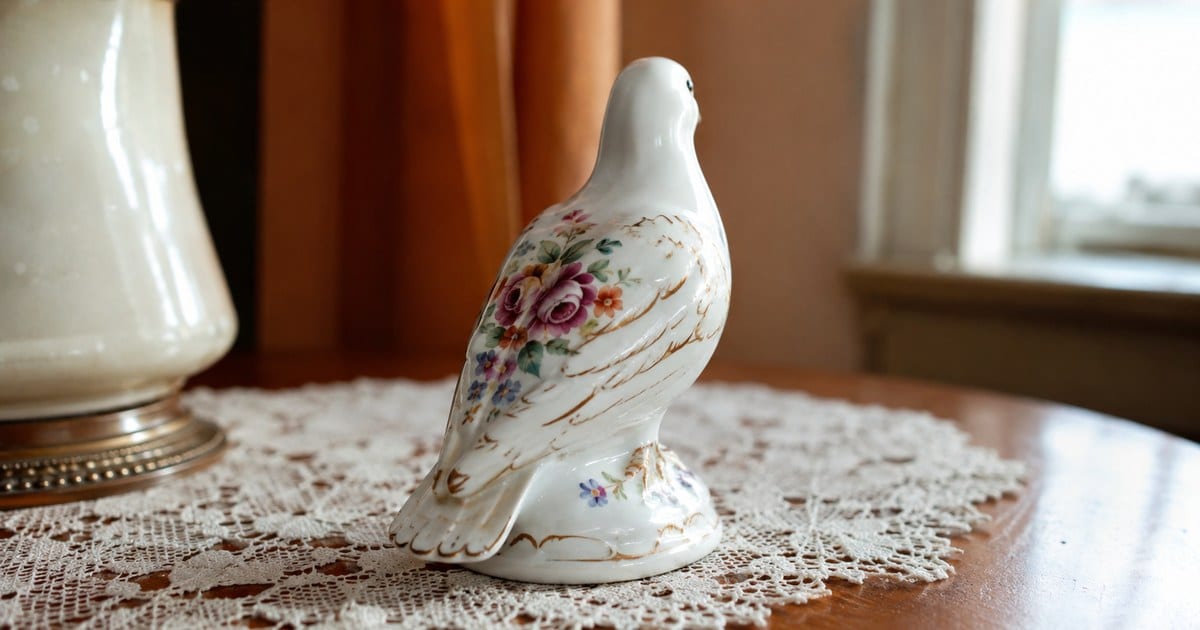
- Judge the piece itself. Hand-painted detail, applied flowers, gold trim quality, and the crispness of the molding all separate the better pieces from the ordinary ones.
Why the fired Lefton china marks date a piece only loosely
Lefton was not a pottery. George Zoltan Lefton, a Hungarian immigrant who arrived in the United States at the end of the 1930s, founded the company in Chicago around 1940 as an importer and wholesaler of ceramic giftware. The pieces were made under contract by Japanese factories and later by other overseas producers, then marked and distributed under the Lefton name.
That business model explains the mark problem. Because the branding was applied on behalf of an importer rather than evolving inside a single factory, the fired crown backstamp had no reason to change every few years the way a manufacturer’s own mark usually does. Similar crown marks, in gold or in a colored stamp, appear across a wide span of production. Two pieces with nearly identical fired marks can easily be separated by twenty or more years.
So treat the fired mark as confirmation of brand, not as a clock. If someone tells you a particular crown variant pins your figurine to a single decade, ask what documentation that rests on, because the general pattern in this category does not support that kind of precision.
The paper and foil label is the actual dating tool
Collector references for Lefton are built around the labels, and this is the part most short guides skip. The broad sequence, which should be read as approximate brackets rather than hard cutoffs, runs like this.
A large crimson label with gold or silver trim reading “Lefton’s Exclusive Japan” is associated with the earliest years of the line, roughly from 1946 into the early 1950s. A red label reading “Lefton’s Reg. U.S. Pat. Off. Exclu. Japan” is associated with the following stretch, roughly from the early 1950s into the early 1970s. Labels using “Trademark” wording with Japan appear across an overlapping later window. From around the mid-1980s, labels naming Taiwan reflect the shift of production away from Japan, and by the late 1990s the wording moves again toward China.
Two honest cautions. First, published label sequences overlap at the edges, because label stocks were used up over time and more than one style could be in circulation at once. Use the label to place a piece in a band of years, not on a single year. Second, labels fall off, get washed off, and get deliberately removed. An absent label is normal and tells you nothing at all.
If your piece still has its sticker, do not soak it, scrape it, or “tidy” it. An intact original label is part of the evidence, and pieces that keep both the fired mark and the label generally attract more interest than the same piece stripped clean.
Occupied Japan wording and the earliest imports
The single highest-signal mark you can find on an early Lefton piece is “Made in Occupied Japan” or simply “Occupied Japan.” After the war, goods exported from Japan under the Allied occupation were required to carry that wording, and the practice covers a narrow window from the second half of the 1940s to the spring of 1952, when the occupation formally ended. Lefton’s first imported Japanese ceramics reached the United States in 1946, right at the start of that window.
That gives you an unusually tight bracket for a giftware item, which is why Occupied Japan pieces are collected as a category in their own right rather than only as examples of a particular brand. It cuts both ways, though. The wording is common enough across the whole export trade that it identifies a period, not a maker, so you still need the crown or the label to attach the piece to Lefton specifically.
Numbers, letter codes, and copyright dates
Three things on a Lefton base look like dates to a first-time reader and are not.
The number. A bare number on the base is an item or mold identification number. It tells you which model the piece is, which is genuinely useful when you are matching against a reference or searching sold listings, but it carries no year information.
A letter prefix in front of the number. Combinations such as two letters followed by digits are generally understood as factory codes identifying which contracted producer made the piece. They are not date codes and they are not size codes, and reading them as either is a common mistake.
A copyright line. Some pieces carry ”© 19xx Geo. Z. Lefton” impressed or printed on the base. That year refers to when the design or mold was registered, not necessarily when your example was produced. Molds stayed in service, so the copyright year sets an earliest plausible date and nothing more. In practice it is still one of the more useful marks on a labelless piece, precisely because it puts a floor under the estimate.
Reading a piece with no label at all
Most Lefton on the secondhand market has lost its sticker, so here is the sequence that still works.
Start with the country wording in the fired mark or any surviving printed text, since Japan, Taiwan, and China wording separate the broad production eras on their own. Then take the copyright year, if present, as the earliest possible date. Then look at the object. Heavily hand-painted work with applied porcelain flowers, fine gold banding, and delicate molded detail is characteristic of the earlier Japanese production, while later pieces tend toward simpler decoration and more uniform finishing. None of these is a verdict by itself. Stacked together, three agreeing observations put a piece in a decade band, which is as much precision as this category honestly supports.
Watch-outs and common mistakes
- Treating the crown as a date stamp. It is a brand mark that persisted across eras.
- Removing the label to see the mark underneath. The label is usually the more informative of the two. Photograph around it instead.
- Reading a copyright year as the manufacturing year. It dates the mold registration and sets a floor, not the production run.
- Reading letter prefixes as dates or sizes. They point to a factory.
- Assuming unmarked means not Lefton. Plenty of pieces left the factory carrying only a label, so a base with nothing fired into it is unremarkable.
- Confusing Lefton with the wider Japanese giftware trade. Many companies imported similar figurines from the same region in the same years, and the styling alone does not distinguish them.
Photo tips
- Photograph the base square-on and close, filling the frame, so every word of both the fired mark and the label is readable rather than merely visible.
- Add a second base shot at a low raking angle. Impressed marks and copyright lines only show properly when light throws a shadow into the lettering.
- Shoot any surviving label straight on and undisturbed, including its color and edge shape, since color is part of the dating evidence.
- Capture the whole piece against a plain background for form and proportion.
- Photograph the decoration close up: applied flowers, hand-painted faces, and gold trim all carry era information.
Common questions
Do all Lefton pieces have a fired mark?
No. A significant share of Lefton left the factory with only a paper or foil label and no fired backstamp, so an unmarked base is common rather than suspicious. On those pieces, identification runs through the surviving label if there is one, the item number, the modeling and decoration style, and comparison with documented examples of the same shape.
What does the number on the bottom of a Lefton piece mean?
It identifies the model rather than the year. Use it as a search key when you look for the same item in reference material or in sold listings. If letters appear in front of the digits, treat them as a factory code identifying the contracted producer, not as a date or size indicator.
How can I tell early Lefton from later production?
Work from country wording first, since Japan, Taiwan, and China wording separate the broad eras. Then use a copyright year, if present, as an earliest plausible date. Then read the piece itself, since heavier hand painting, applied flowers, and finer gold work generally point earlier. Three agreeing signals give you a decade band, which is the realistic level of precision here.
Related guides
- Noritake China Marks Identification
- Occupied Japan Marks: What They Mean and How to Date Them
- Nippon Porcelain Marks Identification
- China Makers Marks Identification: How to Read Old China Marks
When to use the Antique Identifier app
A shelf of Japanese giftware figurines is exactly the situation where a photo-based first pass saves an evening. Shoot each base, each label, and the whole piece, and the app suggests the likely brand family and production era so you know which two pieces deserve real research and which ten are ordinary. Confirm the promising ones against label references and sold listings before you price anything, and keep the app’s read as a starting point rather than a conclusion.