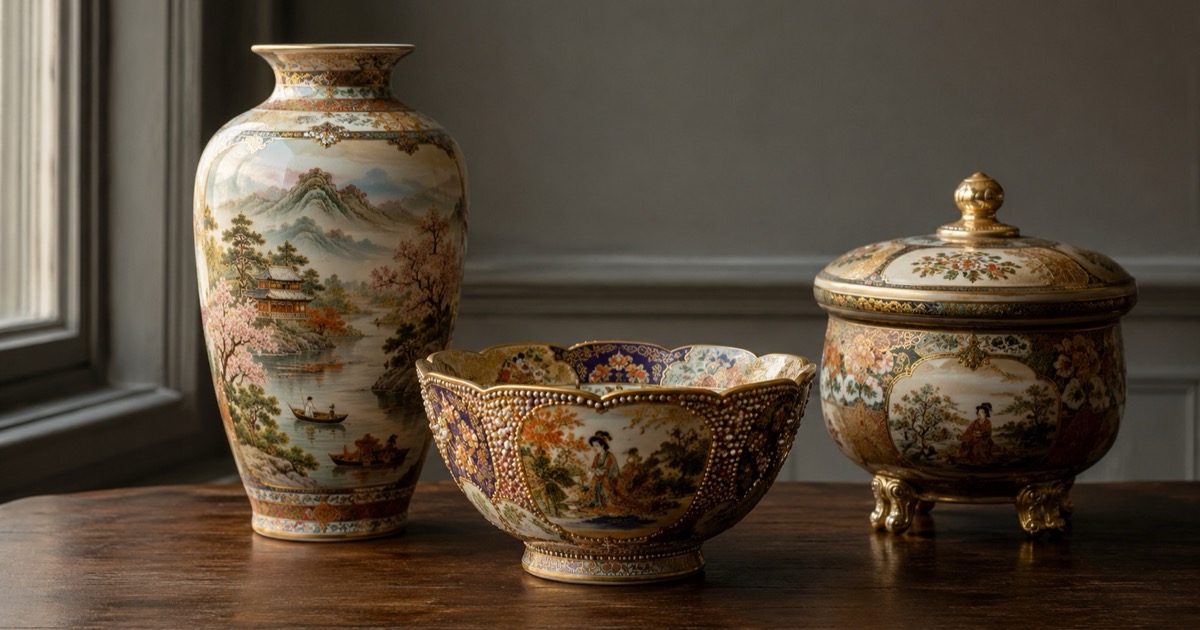
Reading nippon porcelain marks is one of the most reliable ways to date Japanese export porcelain, because the word “Nippon” on a piece is directly tied to US customs law. For roughly three decades, that single word serves as a built-in date bracket collectors depend on. By the end of this guide you will be able to place a Nippon-marked piece in its correct era, recognize the most common mark families, assess decoration quality, and flag modern fakes.
Nippon porcelain marks are backstamps on Japanese export porcelain bearing the word “Nippon,” which dates a piece to roughly 1891–1921 under US tariff law. The most diagnostic tells are the word itself and a stamp fired into the glaze, typically green, blue, or red. Start by photographing the backstamp and comparing it to documented mark families such as the M-in-wreath.
The bracket comes from two legal events. A US tariff act effective in 1891 required imported goods to be marked with the country of origin, and Japanese exporters used “Nippon,” the Japanese word for Japan, to satisfy it. US customs then ruled in 1921 that “Nippon” was not a proper English-language country name and mandated “Japan” instead — so any piece marked “Nippon” was almost certainly made and exported between those dates.
Quick identification checklist
- Look for “Nippon” in the backstamp — its presence alone places the piece in the 1891–1921 export window.
- Check the mark’s color: green, blue, and red are all period-correct; marks that look printed by laser or inkjet are modern red flags.
- Examine decoration edges under good light — period hand-painting shows minor brushstroke variation; uniform flat color suggests decal work, which became standard later.
- Feel for moriage (raised, textured slip decoration) or heavy enamel beading — these are typical period techniques.
- Look at the gilding: original gold on Nippon pieces often shows gentle wear at contact points; new gold is uniformly bright with no honest patina.
- Compare the mark font to known reference marks — excessively ornate or inconsistent lettering can indicate a reproduction stamp.
The Nippon dating ladder
The progression of Japanese export marks follows US customs law changes closely, giving you a four-step dating framework.
| Era | Mark wording | Approximate dates |
|---|---|---|
| US tariff era | ”Nippon” | c. 1891–1921 |
| Post-ruling era | ”Japan” | 1921–1941 and post-1952 |
| Occupation era | ”Made in Occupied Japan” | 1945–1952 |
| Modern era | ”Japan” or full company names | 1952–present |
A piece marked only “Made in Occupied Japan” falls squarely in the post-WWII occupation window and is a collectible category of its own. The “Nippon” to “Japan” shift in 1921 and the Occupied Japan window are the two most useful hard brackets for dating by backstamp alone.
Common Nippon-era mark families
Nippon-era porcelain was produced by many different decorating firms and export houses, so marks are numerous. A few families appear most often in collector references.
The M-in-wreath mark — the letter M surrounded by a laurel or maple-leaf wreath — is closely associated with the Morimura Brothers export firm, which was the main US distributor for what later became Noritake. Different versions of the wreath design were used across different periods, and color variations (green, blue, red) appear throughout the era. A green M-in-wreath is among the most frequently encountered marks on quality Nippon tableware and decorative pieces.
The maple-leaf mark appears on a range of quality levels and was used by multiple decorating firms. It is distinct from the wreath marks and often appears alone or with “Nippon” beneath it.
The rising sun mark takes various forms, generally showing a stylized sun motif. It appears on both finer and more commercial pieces and is one of the more widely varied mark families.
Because many Nippon pieces were decorated by independent studios rather than the original factory, marks may reflect the decorator rather than the manufacturer. This layering is normal and expected.
Decoration quality as a dating and grading tool
Nippon-era production ranged from simple, inexpensive tableware to elaborate hand-painted cabinet pieces. Learning to read decoration quality helps you distinguish grades within the era.
Hand-painted scenic pieces — landscapes, portraits, floral vignettes painted with visible brushwork — represent the upper tier of Nippon output. Look for slightly uneven background washes, subtle color variation in shaded areas, and fine detail work that holds up under magnification. These are the pieces most heavily faked.
Moriage decoration involves thick slip (liquid clay) applied in raised lines and dots to create a textured, three-dimensional effect. Genuine period moriage feels firm and well-adhered; it may show minor crazing consistent with the glaze age. Applied beading of enamel is related but distinct — look for small raised enamel dots, often in gold or jewel colors, around borders and handles.
Heavy gilding in cartouche borders, handles, and rims is common on better Nippon. Period gold gilding develops a slight warmth or unevenness with age. Uniformly bright, mirror-finish gold on a piece otherwise showing wear is a mismatch worth investigating.
Transfer-printed or decal decoration also exists from this period but generally indicates the lower commercial end of production. The tell is perfect, uniform color with no brushstroke variation under magnification.
The fake-Nippon problem
The popularity of Nippon-era porcelain has generated a significant reproduction and fraud market. The most common approach involves applying “Nippon”-style backstamps to new, inexpensive porcelain made in China or elsewhere.
Several clues help flag modern fakes. The mark itself may look too crisp and evenly printed compared to the imperfect, slightly uneven stamps of the period. Font styles may not match documented Nippon-era marks in collector references. Decoration on fakes is typically decal-printed, with completely uniform color and pattern repetition that genuine hand-painted work does not show. The clay body on authentic pieces shows a particular translucency and weight — lightweight, chalky porcelain is a caution sign. Edge finishing and foot rim grinding on period pieces differ from modern mass production standards.
Some sellers also label pieces “Nippon style” or add hand-written “Nippon” to unmarked pieces. Treat any unusual or non-fired mark with extra skepticism.
Watch-outs and common mistakes
- Confusing “Made in Nippon” with “Nippon” alone — both appear in the era, but the phrasing varies by exporter; neither is more or less authentic than the other.
- Over-attributing all M-in-wreath marks to Noritake — the mark family is associated with Morimura Brothers/Noritake but was used across a period, and not all examples are Noritake studio production.
- Assuming any wear proves age — artificial distressing on fakes is common; look for consistent aging across the entire piece, including inside unglazed foot rims, not just on the mark.
- Ignoring the clay body — the porcelain itself, not just the mark, carries dating information; period Nippon generally has a specific translucency and whiteness distinct from modern off-white or gray-toned bodies.
- Missing decorator-added marks — some pieces carry both a factory mark and a separate decorator’s mark; the presence of two marks is normal, not suspicious.
Photo tips that improve identification
- Photograph the entire backstamp in raking light at a low angle — this reveals whether the mark is fired into the glaze (period-correct) or printed on top of it.
- Capture moriage and enamel beading from a side angle to show the raised texture clearly against a contrasting background.
- Photograph the foot rim’s unglazed band — clay color, texture, and grinding marks all help date and authenticate.
- Take a close shot of the decoration transition zone where painted colors meet — brushstroke edges show in period hand-painting and are absent in decal work.
Common questions
What does Nippon on the bottom of porcelain mean?
“Nippon” is the Japanese word for Japan, and it appears on porcelain because a US tariff act effective in 1891 required imports to be marked with their country of origin. When US customs ruled in 1921 that the English word “Japan” was required instead, the marking changed. A genuine Nippon backstamp therefore places a piece in the roughly 1891–1921 export window.
How can you tell fake Nippon marks from real ones?
Period Nippon marks were fired into or under the glaze and show slight unevenness, while many fakes look too crisp, sit on top of the glaze, or use fonts that do not match documented mark families. Fakes also tend to pair the mark with decal-printed decoration that shows perfectly uniform color under magnification. A lightweight, chalky porcelain body is another caution sign, since period Nippon has a distinct translucency and whiteness.
Is Nippon porcelain the same as Noritake?
Not exactly. The M-in-wreath mark common on Nippon-era pieces is associated with the Morimura Brothers export firm, which later became Noritake, but many other decorating firms and export houses also marked porcelain “Nippon.” A Nippon backstamp identifies the era and country, not a single maker, so the specific mark family must be checked to suggest a producer.
Related guides
- Antique Porcelain Marks: How to Read Backstamps
- China Makers Marks Identification: How to Read Old China Marks
- Old China Marks Identification: What Backstamps Really Tell You
When to use the Antique Identifier app
Photograph the full piece plus a tight, well-lit shot of the backstamp. The app can help narrow the mark family and era quickly, cross-referencing against documented Nippon-era mark types. Use that result as a starting point — if it points toward a rare decorator mark or a high-value hand-painted piece, treat the identification as a prompt to consult a specialist or printed Nippon reference before buying or selling.