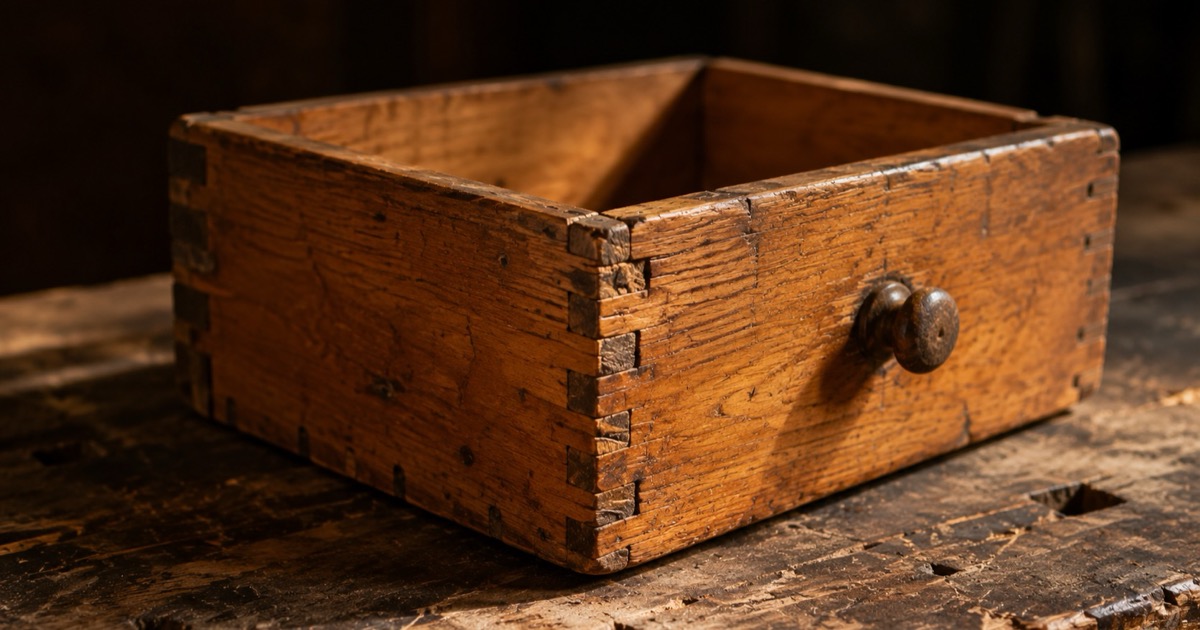
Dovetail joints dating furniture is one of the most reliable hands-on methods available to anyone who can open a drawer. The joint where two boards meet at the corner of a case piece or drawer box carries a record of the tools, machinery, and shop practices of the era when it was made — and once you know what to look for, you can often narrow a piece’s age to within a few decades without needing any marks at all.
To date furniture by its dovetail joints, pull a drawer and study the pins: irregular spacing, fewer wide pins, and faint scribe lines indicate hand-cut work, common before the late 1800s, while perfectly uniform narrow pins indicate machine cutting from roughly the 1860s onward. Round, lollipop-shaped Knapp joints place a piece in about 1870 to 1900.
This guide covers the key visual differences between hand-cut and machine-cut dovetails, the specialized Knapp joint that pins a piece tightly to the late 19th century, what it means when dovetails are absent entirely, and how to corroborate your reading with secondary wood, saw marks, and drawer bottoms.
Quick identification checklist
- Pull a drawer all the way out and examine the rear corners as well as the front
- Look at the spacing of the pins: irregular and wider suggests hand work; perfectly even and narrow suggests machine cutting
- Check for faint scribe lines or gauge lines on the tails — a handmade sign
- Look for rounded or scalloped pin shapes (Knapp joint) rather than straight-sided tails
- Examine the drawer bottom grain direction and how it is secured
- Check the back panel’s saw surface under raking light for pit-saw or circular-saw marks
Hand-cut dovetails: what they look like
Hand-cut dovetails were the standard until the second half of the 19th century, and skilled makers continued to use them well into the 20th. The visual tells are:
Irregular spacing and fewer, wider pins. A craftsman laid out the joint by eye or with dividers, so the pin spacing is rarely mathematically even. There may be three to five pins on a typical drawer side where a machine might cut seven or more. The angles can vary slightly from joint to joint on the same drawer.
Scribe lines. The maker scored a baseline across the end grain with a marking gauge before cutting. On unpainted or unfinished interior surfaces, these faint parallel scratches are often still visible. A machine had no reason to scribe.
Slight fitting irregularities. Look at the glue lines and shoulder fits. Hand-cut joints may show very minor gaps or file marks where the maker fit the joint to close tightly. Machine-cut joints are engineered to be interchangeable.
Asymmetry between corners. Front and back corners of the same drawer may differ slightly in layout if two workers cut them, or if the maker adjusted the rear joint to clear a knot.
Machine-cut dovetails: the post-1860s shift
Factory machinery capable of cutting multiple uniform dovetails simultaneously came into commercial use broadly in the 1860s to 1890s, depending on the manufacturer and region. The result is instantly recognizable:
Uniform, closely spaced pins. The spacing is mathematically consistent around the entire joint. Pins are typically narrow with a sharp, thin profile compared to hand-cut work.
No scribe lines. Machine setups were calibrated at the start of a production run; no individual scoring was needed.
Identical corners. Both rear corners of a drawer, and often all drawers in a case piece, will show the same spacing and pin count.
Finding machine-cut dovetails does not mean a piece is not antique — it may simply be a well-made factory piece from the late Victorian era or early 20th century. It does help set a terminus post quem: the piece cannot predate the machinery.
The Knapp joint: a precise date window
| Feature | Detail |
|---|---|
| Also called | Pin-and-cove joint, scallop joint |
| Shape | Round-ended, lollipop-shaped pins with matching concave sockets |
| Patented | 1867 (Charles Knapp) |
| Commercial use window | Roughly 1870s to about 1900 |
| Found on | Factory-made American case furniture, dressers, chests |
The Knapp joint is the single most precisely datable machine joint in American furniture. It was cut by a specialized router-like machine that produced rounded pin ends rather than the straight-sided tails of a conventional dovetail. If you pull a drawer and see what looks like a row of mushroom caps or lollipops fitting into matching curved sockets, you are almost certainly looking at a Knapp joint, and the piece almost certainly dates from the last three decades of the 19th century.
The Knapp machine’s patents expired and competitors emerged, but the joint fell out of common use by around 1900 as other machine joinery became standard. Its window is tight enough that a confirmed Knapp joint is one of the more useful dating landmarks in American Victorian furniture.
No dovetails at all: reading modern construction
The absence of any dovetail joint is itself information. Case furniture and drawer boxes made before the era of staple guns and cam locks were almost always joined with some form of wood-to-wood interlocking joint. Finding:
- Metal staples at drawer corners points to furniture made from the mid-20th century onward, increasingly common from the 1960s and ubiquitous in flat-pack and budget furniture after that
- Wooden dowels replacing dovetails became popular in mid-century factory production, roughly 1940s–1970s, as doweling machines became economical
- Cam locks, plastic brackets, and MDF-and-staple construction are hallmarks of post-1980s and especially post-2000 flat-pack production
A drawer with no interlocking joint at all should reset your expectations about age well before you start looking at style.
Corroborating the joint evidence
Dovetail type tells you about the drawer box, not necessarily the whole piece. Corroborate with:
Drawer bottom grain. A drawer bottom running side-to-side (grain perpendicular to the drawer front) is a pre-20th-century technique that accommodated seasonal wood movement; it is often held in a groove with no glue and chamfered at the back to slide under a strip. Plywood drawer bottoms are a 20th-century indicator. Stapled hardboard is modern.
Secondary wood. Open the drawer and look at the wood used for the box sides and back. Period American furniture used regional secondaries: tulip poplar, white pine, cedar, and chestnut appear frequently before 1900. Luan, particleboard, and machined poplar with no figure are modern shop choices.
Saw marks on the back panel. Under raking light, look at any exposed back boards. Straight, parallel pit-saw or up-and-down mill saw marks suggest pre-mid-19th century; the arc-shaped marks of a circular saw are post-1840s to 1850s in American work; the very fine, closely spaced marks of a band saw are late 19th century onward.
Marriages and replaced drawers
The most important caveat: one drawer’s joint dates that drawer, not necessarily the case it lives in. Period case pieces commonly received replacement drawers decades or even a century after original manufacture. A hand-cut drawer in a case with a machine-cut frame may mean the frame was updated, or vice versa. Similarly, “married” pieces combine a top from one case and a base from another.
Always examine multiple elements and look for consistency — matching secondary woods, consistent saw marks across all back boards, matching patina on interior surfaces. A single anomalous joint should raise the question of replacement rather than anchor the entire dating of the piece.
Watch-outs and common mistakes
- Assuming a hand-cut dovetail means pre-1860: skilled craftsmen and small shops used hand-cut joinery well into the 20th century, especially in custom and high-end work
- Overlooking the rear drawer corners, which are often more revealing than the front because they were less likely to be refinished or repaired
- Confusing a reproduced hand-cut dovetail on a revival-style piece: some 20th-century makers deliberately hand-cut dovetails in Arts and Crafts and Colonial Revival furniture
- Treating the joint type as definitive in isolation: always read it alongside secondary wood, hardware, and surface aging
Photo tips that improve identification
- Pull the drawer fully out and photograph all four corners: front left, front right, back left, back right
- Use a strong raking sidelight across the joint face to reveal scribe lines, tool marks, and irregularities
- Photograph the drawer bottom edge-on to show its thickness, material, and how it is seated in its groove
- Photograph exposed back-panel surfaces under raking light to capture saw-mark patterns
Common questions
Do machine-cut dovetails mean a piece is not antique?
No. Machine-cut dovetails became common in factory furniture from roughly the 1860s onward, so a piece with uniform machine joints can still be a genuine late Victorian or early 20th-century antique. What the joint does establish is an earliest possible date: the piece cannot predate the machinery that cut it.
What is a Knapp joint and what years does it date to?
A Knapp joint, also called a pin-and-cove or scallop joint, has round, lollipop-shaped pins fitting into matching curved sockets instead of straight-sided tails. It was patented in 1867 and used commercially on American factory case furniture from roughly the 1870s to about 1900, which makes it one of the most precisely datable joints in American furniture.
Are hand-cut dovetails always older than machine-cut ones?
Not necessarily. Skilled craftsmen and small shops continued cutting dovetails by hand well into the 20th century, particularly in custom, Arts and Crafts, and Colonial Revival work. Read the joint alongside secondary wood, saw marks, hardware, and surface aging before settling on a date, since a hand-cut joint alone only suggests hand methods, not a specific era.
Related guides
- How to Tell If Furniture Is Antique
- Antique Furniture Identification Marks
- Where to Find Markings On Antique Furniture
When to use the Antique Identifier app
Photograph the full piece, then add tight shots of each drawer corner joint, the drawer bottom, and any exposed back-panel boards. The app can narrow the furniture style, likely era, and construction type quickly, giving you a working hypothesis to test against the physical evidence. For any piece where the combination of style and construction suggests significant age or value, treat the app’s output as a starting point and pursue specialist verification.