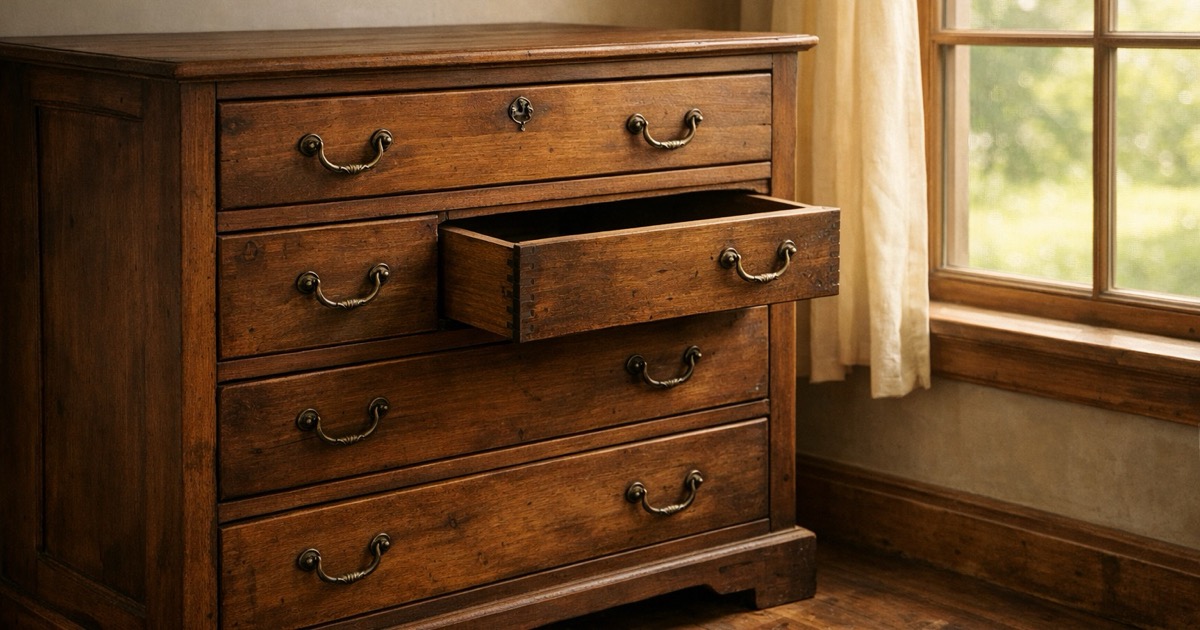
Antique furniture identification marks are the stamps, labels, brands, and stenciled numbers that a maker, retailer, or workshop left on a piece, and the fastest way to find them is to turn the piece over and open every drawer. Look on the underside of the top, the back of the case, the insides and bottoms of drawers, and the underside of seats and tabletops. Marks take the form of paper or foil labels, burned-in brands, ink or metal stamps, and hand-written chalk or pencil numbers, and each type points you toward a different era and a different kind of research.
The hard truth is that most antique furniture was never marked at all, and a great deal of what was marked has since lost its label to a century of dust, moving, and refinishing. So this guide does two things: it shows you where the marks hide and how to read the ones you find, and it shows you how to build a case from construction and materials when the mark is gone. That combination is what separates a confident identification from a hopeful guess.
Quick identification checklist
- Turn the piece upside down and check the underside, back panel, and case bottom before anything else.
- Pull every drawer and inspect the sides, bottoms, and backs, inside and out.
- Look under seats, tabletops, and leaves, where labels and stamps survive out of the light.
- Record marks exactly as written, including partial words, numbers, and patent lines.
- Note the mark type: paper label, foil sticker, branded stamp, metal tag, ink stamp, or chalk number.
- Cross-check the mark against construction and wood so the date the mark implies matches the piece.
Where the marks hide on antique furniture
Makers marked their work in predictable but out-of-sight places, because the mark was for their records and their retailers, not for display. On case pieces, check the underside of the top, the back of the carcass, the top edge and bottom of the case, and the inside back wall. On chairs and settees, look under the seat rail and on the inside of the back splat. On tables, flip the top or open the frame and check the underside and the leaf ledges. Drawers are the richest hunting ground: examine the drawer sides, the drawer bottom, the drawer back, and the runner the drawer slides on.
A missing mark is normal, not disqualifying. Paper and foil labels fall off, and stripping or refinishing removes surface stamps and stencils. Great national collections are full of superb pieces that carry no maker’s mark and are attributed on style and construction alone, which is why museums document form and joinery so carefully alongside any signature (Victoria and Albert Museum). If you find nothing, that is a reason to lean harder on the physical evidence, not a reason to stop.
Types of antique furniture marks and what they tell you
Different mark types belong to different periods and carry different weight. A paper retailer’s label can name the shop that sold the piece without naming the shop that built it. A branded iron stamp burned into the wood is harder to fake and usually belongs to the actual maker. A metal manufacturer’s tag with a model number ties the piece to a catalog and often to a date range.
| Mark type | Typical era | What it usually tells you | Reliability |
|---|---|---|---|
| Branded / burned-in stamp | 18th–early 20th c. | Maker or workshop identity | High, hard to fake |
| Ink or die stamp | 19th–20th c. | Maker, model, or inspector number | Medium–high |
| Paper label | 19th–20th c. | Maker or retailer; sometimes address | Medium; often lost |
| Foil / metallic sticker | Mid–late 20th c. | Manufacturer or importer | Medium; falls off |
| Metal / brass tag | 20th c. | Manufacturer and model line | High when present |
| Chalk or pencil number | 18th–20th c. | Assembly, order, or cabinetmaker mark | Low alone; useful with context |
Numbers stamped or written inside drawers are usually assembly, model, or order codes, and a few makers encoded dates in them, so record them exactly rather than guessing at a meaning. When you do find a name or logo, a marks reference such as a printed or online dictionary of marks is the right next step, because the same maker often used several different marks across the decades (Kovels Dictionary of Marks). Small differences in wording, spelling, and layout are frequently the detail that pins a mark to a specific span of years.
Reading maker and retailer marks
Once you have a legible mark, separate what it proves from what it merely suggests. A maker’s brand or stamp is direct evidence of who built the piece. A retailer’s label is evidence of who sold it, which is useful but not the same claim, since large stores commissioned furniture from many workshops. Patent numbers and “patent applied for” lines are gifts, because a patent can often be traced to a filing date that sets a firm earliest-possible age for the piece.
Arts and Crafts furniture is a good example of how a mark and a philosophy travel together. Gustav Stickley built his reputation on visible, honest construction and marked much of his work, and the firm still frames its identity around the Flemish motto “Als ik kan,” meaning “to the best of my ability” (Stickley). Knowing that a maker used a recognizable shopmark tells you both where to look and roughly what era you are in, which is exactly the kind of context that turns a bare logo into a dated attribution. For a deeper walk through one such maker’s marks and forms, see our Stickley and Mission furniture identification guide.
When the mark is missing: build the case from the piece
Most of the time the mark will be gone or was never there, and the identification has to rest on the object itself. Construction is the strongest evidence. Hand-cut dovetails with slightly uneven spacing point to earlier, pre-machine work, while perfectly uniform machine-cut dovetails indicate later production; the joint style is one of the most reliable dating clues you have, and our guide to dating furniture by dovetail joints walks through the progression. Circular saw marks, wire nails, and Phillips screws all carry rough date ranges of their own.
Wood and secondary materials tell the rest. Solid wood throughout, hand-planed surfaces with subtle irregularities, and shrinkage that has pulled round tops slightly oval all speak to age and hand work. Wood species, the choice of secondary woods on drawer sides and backs, and the finish era combine with the silhouette to place a piece even without a signature. If you are new to reading form and feet, start with identifying antique furniture styles, then use marks and construction to confirm the period the style suggests.
Watch-outs and common mistakes
- Treating a retailer’s label as proof of the maker; the store that sold it may not have built it.
- Assuming any mark makes a piece old; reproductions and revivals were stamped, labeled, and antiqued too.
- Reading a partial or worn mark hopefully; record only the letters you can actually see.
- Letting a mark’s implied date override the construction; if the joinery is machine-made, the piece is not 1780.
- Stripping or refinishing before you have searched for and photographed every mark and label.
Photo tips that improve identification
- Photograph the whole piece front-on and at a three-quarter angle so form and proportion read clearly.
- Shoot every mark straight on and in focus, with one wider shot showing exactly where it sits.
- Open a drawer and capture the dovetails, drawer-side wood, and interior surfaces.
- Use raking window light across stamps and brands so shallow impressions become readable.
- Record chalk and pencil numbers before handling, since they smudge and disappear easily.
Common questions
Where do you find identification marks on antique furniture?
Turn the piece over and look where the light rarely reaches. On case pieces, check the underside of the top, the back of the carcass, and the case bottom. On chairs and tables, look under the seat rail and the tabletop. Then open every drawer and inspect the sides, bottom, back, and runners, inside and out.
What if my antique furniture has no marks at all?
That is normal, because most antique furniture was never marked and many labels have since fallen off or been stripped away. In that case the identification rests on construction and materials: dovetail style, saw and tool marks, fasteners, wood species, and the overall silhouette. A confident, well-supported “unmarked, hand-built, mid-19th century” description is stronger than a forced maker attribution.
Do the numbers stamped inside furniture drawers mean anything?
Often yes, but usually as assembly, model, or order codes rather than dates, and a few makers encoded production dates in them. Record the numbers exactly as they appear, along with any name, label, or patent line nearby. Then let a maker-specific reference interpret the system rather than guessing at what the digits mean.
Related guides
- Where to Find Markings On Antique Furniture
- How to Photograph Makers Marks for Identification
- Identifying Antique Furniture Styles: Shape, Feet, and Joinery
- How to Date Furniture by Dovetail Joints
- Stickley and Mission Furniture Identification
When to use the Antique Identifier app
The app is most useful after you have taken one full photo and a few tight shots of any marks, labels, drawer joinery, and the underside. It can quickly narrow the likely type, era, style family, and sometimes the maker, which tells you whether the piece in front of you deserves deeper reference checking. If the result points to something unusually rare, signed, or high value, treat that as a prompt for verification against stronger references rather than a final answer.
Sources
- Furniture (Winterthur Museum, Garden & Library)
- Furniture -- Explore the Collections (Victoria and Albert Museum)