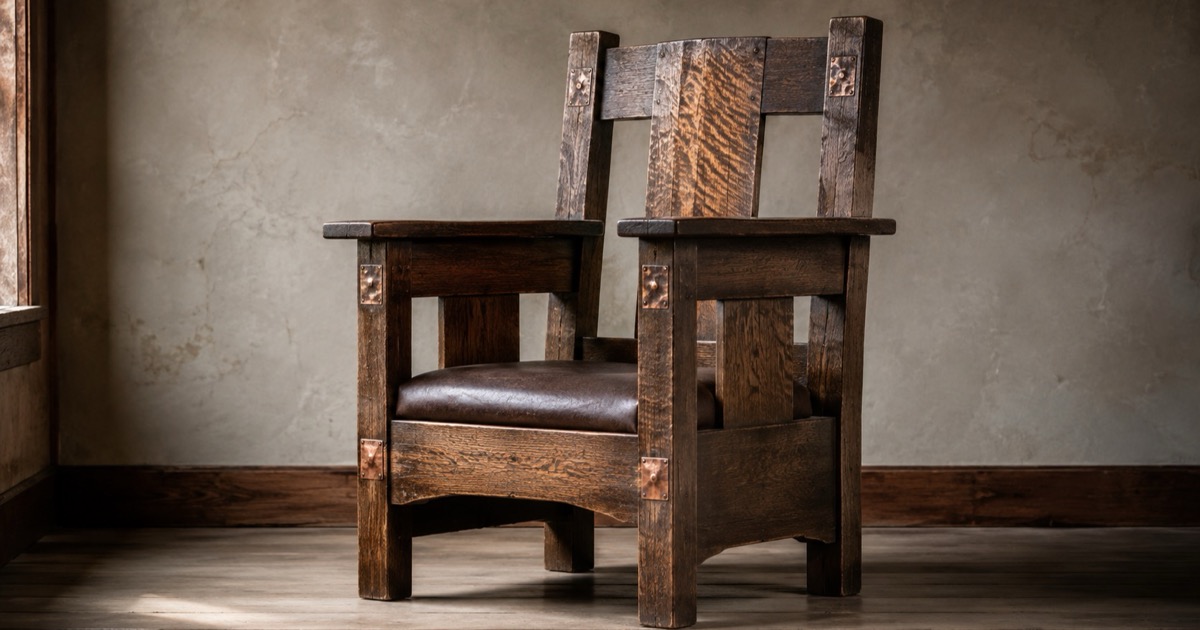
Stickley furniture identification begins with understanding the Arts & Crafts movement’s visual vocabulary, because without knowing what genuine quartersawn oak joinery looks like, no amount of mark-hunting will reliably distinguish a Gustav Stickley Morris chair from a factory Mission reproduction. The Stickley name covers several separate companies, only some of which made the pieces collectors prize, and the marks evolved substantially over the production period. By the end of this guide you will be able to recognize Arts & Crafts construction quality, read the major Stickley mark families, understand the company landscape, and know why original finish can make or break a piece’s value.
To identify Stickley furniture, look for quartersawn oak with silvery ray fleck figure, exposed through-tenon joinery, and a period mark — most famously Gustav Stickley’s joiner’s-compass decal with the motto “Als Ik Kan.” Start by photographing the wood figure, one joint, and any decal, label, or brand on the back or underside.
Mission furniture was the American Arts & Crafts style that dominated the market from roughly 1900 to 1920. It rejected Victorian ornament in favor of exposed structure — visible joints, honest wood grain, flat planes, and hardware that looked functional rather than decorative. Within that broad category, the quality range was enormous, from Gustav Stickley’s workshop production to cheap factory imitations sold through mail-order catalogs. The marks and construction clues described here help you find your place in that range.
Quick identification checklist
- Examine the wood surface for ray fleck figure — quartersawn oak shows distinctive silvery medullary ray patterns across the face; flat-sawn oak does not.
- Look for through-tenons: joints where the tenon visibly passes through the leg or post and is often secured with a wooden peg or key are a hallmark of quality Arts & Crafts construction.
- Check drawer construction: hand-cut dovetails and fitted drawer runners differ from machine-cut dovetails and commercial drawer hardware.
- Look on the back, underside, and inside drawer faces for paper labels, decals, or branded marks.
- Assess the finish: dark fumed or waxed original finishes have a specific warm depth; refinished pieces often look brighter or more uniform.
- Examine the hardware: original Arts & Crafts hardware is typically hand-hammered or lightly textured copper or iron with simple forms.
Arts & Crafts construction vocabulary
Several construction details appear consistently on quality Mission furniture and are largely absent from factory imitations.
Quartersawn oak is the wood signature of the movement. When oak is quartersawn (cut radially from the log rather than tangentially), the medullary rays that run from bark to center are exposed on the face. These rays create a distinctive silvery, flecked, or ribbon-like figure across the surface. This figure is not merely decorative — quartersawn oak is more dimensionally stable than flat-sawn oak. Recognizing it is the first step in distinguishing quality from imitation, since factory mission furniture often used flat-sawn oak or oak veneer over other wood.
Exposed through-tenons are the most photographically distinctive joinery feature: the end of a tenon (the projecting tongue of the joint) passes entirely through the receiving piece and is visible on the far side. On arm chairs, the side stretcher tenons often pass through the front and rear legs visibly. This construction is stronger than blind mortise-and-tenon and was celebrated as an honest display of craft.
Pegged joints — wooden pegs driven through a mortise-and-tenon joint after assembly — appear on quality pieces. Genuine period pegs are often slightly proud of the surface and may show slight shrinkage gaps; reproduction pegs tend to look freshly fitted.
Square spindles in backs and sides have specific profiles and spacing on Stickley production. The spindles themselves are generally rectangular in cross-section rather than turned round.
Stickley marks: the major families
The Stickley name across multiple companies used different marks, and knowing the major families prevents misattribution.
Gustav Stickley used several marks across his production period. The most celebrated is the red joiner’s-compass decal (sometimes described as a red or brown decal) incorporating the Flemish phrase “Als Ik Kan” (“as best I can”), adapted from the motto of Jan van Eyck. This decal appears in varying forms across the production years; collectors track the specific compass-and-phrase layout as a dating aid. Gustav also used paper labels and branded/burned marks at different periods. The compass-with-motto mark is closely associated with the peak Arts & Crafts period of his production.
L. & J.G. Stickley (Leopold and John George Stickley, two of Gustav’s brothers) marked their furniture with “Onondaga Shops” labels and later “Handcraft” labels, among other mark variations. Their production overlapped with Gustav’s in time and style but was separate.
Later Stickley production used brass tag marks and other metal hardware with the name. The modern Stickley company, which continues to this day, uses its own contemporary marks.
The five Stickley brothers — Gustav, Charles, Albert, Leopold, and John George — were involved in several separate businesses across different cities. Albert (initially with John George) ran “Stickley Brothers” in Grand Rapids, Michigan. Charles ran Stickley & Brandt in Binghamton, New York. Gustav ran “Craftsman Workshops” in Syracuse, New York, and Leopold and John George ran their own operation nearby. The shared surname across competing companies is a perennial source of confusion; identifying which company made a specific piece requires looking at the specific mark type, not just the name “Stickley.”
Quality lookalikes vs factory mission
Within Arts & Crafts furniture, several makers produced work comparable in quality to Stickley, while a much larger universe of factory producers made lower-grade imitations.
Limbert (Grand Rapids, Michigan) produced Arts & Crafts furniture with distinctive cut-outs and slightly heavier proportions. Limbert marks are documented and the company’s work is collectable in its own right. Limbert pieces are not Stickley, but they are genuine Arts & Crafts quality.
Roycroft furniture, made at Elbert Hubbard’s Roycroft community near Buffalo, New York, is marked with the Roycroft orb-and-cross mark. Roycroft is a distinct and significant Arts & Crafts maker with its own collector market.
Factory mission — the broad category of mass-produced Mission-style furniture made for catalog sales — typically uses flat-sawn oak, machine-cut and nailed joints, and lacks through-tenons and exposed pegging. Hardware is often stamped rather than hand-worked. Construction quality is noticeably lower even without knowing the maker.
The modern Stickley company and reissues
The Stickley company has continued operating through various ownership structures and today produces reproduction and continuation pieces based on historical Stickley designs. These pieces are made with quality materials and craftsmanship, but they are modern production and should be represented and priced accordingly.
Modern Stickley reissues use contemporary marks that differ from period decals and labels. The materials and joinery quality can be excellent, but the wood patina, finish character, and hardware aging on modern pieces differ from a century-old original. On any piece represented as period production, look for honest age in the finish, wood shrinkage at joints, and wear consistent with actual use.
Why original finish matters enormously
The dark, fumed or stained and waxed finish on period Arts & Crafts furniture is integral to its character and value. Fuming — exposing oak to ammonia vapor — reacts with the tannins in the wood to create a warm, even dark tone that penetrates the wood rather than sitting on its surface. Wax-finished pieces develop a depth and patina through use.
Refinishing removes this history. A refinished Arts & Crafts piece in otherwise good structural condition may lose a very large portion of its market value compared to an equivalent piece in unrestored original finish. Collectors specifically seek original surfaces, and the difference between an untouched original and a cleanly refinished piece can be stark in dollar terms. Assess finish by looking at unworked areas — the inside of aprons, the back of doors, the undersides of shelves — where original finish is most likely to survive intact.
Watch-outs and common mistakes
- Assuming all “Stickley” marks are Gustav Stickley — the surname appears across at least three separate companies; read the full mark, not just the name.
- Mistaking flat-sawn oak for quartersawn — looking for the medullary ray figure is the reliable check; its absence on a claimed Arts & Crafts piece is significant.
- Overlooking finish condition as a value factor — structural integrity and joinery quality matter, but original finish is often the dominant value driver.
- Treating Limbert or Roycroft as lesser Stickley — these are distinct, respected makers, not impostors; misidentification in either direction affects value and attribution.
- Ignoring the modern company’s reissues — a piece with excellent construction and a Stickley mark may be contemporary production; check the mark type and finish age carefully.
Photo tips that improve identification
- Photograph the wood surface in raking light from the side — this emphasizes the medullary ray figure in quartersawn oak and shows it clearly against flat-sawn wood.
- Capture through-tenons and pegs from a close angle showing both the tenon end and the surrounding surface — the relationship between joint and wood surface is diagnostic.
- Photograph any paper label or decal under even, slightly raking light to capture full text and any compass or motto imagery.
- Shoot the underside of seat rails and the back of the piece where original finish survives — the color and texture of unrestored original finish is distinctive.
Common questions
How can you tell real Stickley from a reproduction?
Period Stickley shows quartersawn oak with pronounced ray fleck, through-tenons and pegged joints, and honest age — wood shrinkage at joints, wear at contact points, and a fumed or waxed finish with real depth. Reproductions and modern reissues can be well made, but their marks differ from period decals and labels, and the finish and hardware lack a century of patina. Always read the specific mark type rather than relying on the Stickley name alone.
Is unmarked mission furniture worth anything?
It can be, if the construction quality is there. Marks were applied as decals and paper labels that frequently wore off or were removed during refinishing, so quality unmarked Arts & Crafts pieces do circulate. Quartersawn oak, through-tenons, pegged joints, and hand-worked hardware support a quality attribution, while flat-sawn oak and nailed machine joints indicate factory mission regardless of styling.
What is the difference between Gustav Stickley and L. & J.G. Stickley?
They were separate companies run by different brothers in the same family. Gustav Stickley ran the Craftsman Workshops in Syracuse, New York, and used the joiner’s-compass decal with the motto “Als Ik Kan,” while his brothers Leopold and John George operated their own nearby firm using “Onondaga Shops” and later “Handcraft” labels. Both made quality Arts & Crafts furniture, but collectors value and track them as distinct makers.
Related guides
- Identifying Antique Furniture Styles: Shape, Feet, and Joinery
- Mid-Century Modern Furniture Identification
- Victorian Furniture Identification
- Antique Furniture Identification Marks
When to use the Antique Identifier app
Photograph the full piece from the front and side, a close shot of the wood surface showing any ray fleck figure, the joinery details at one corner, and any marks or labels. The app can help narrow the Arts & Crafts maker and approximate era from these combined cues. If the result points toward Gustav Stickley with the compass-and-motto mark, treat that identification as a prompt for specialist verification — original Gustav Stickley production in good original finish represents significant value.