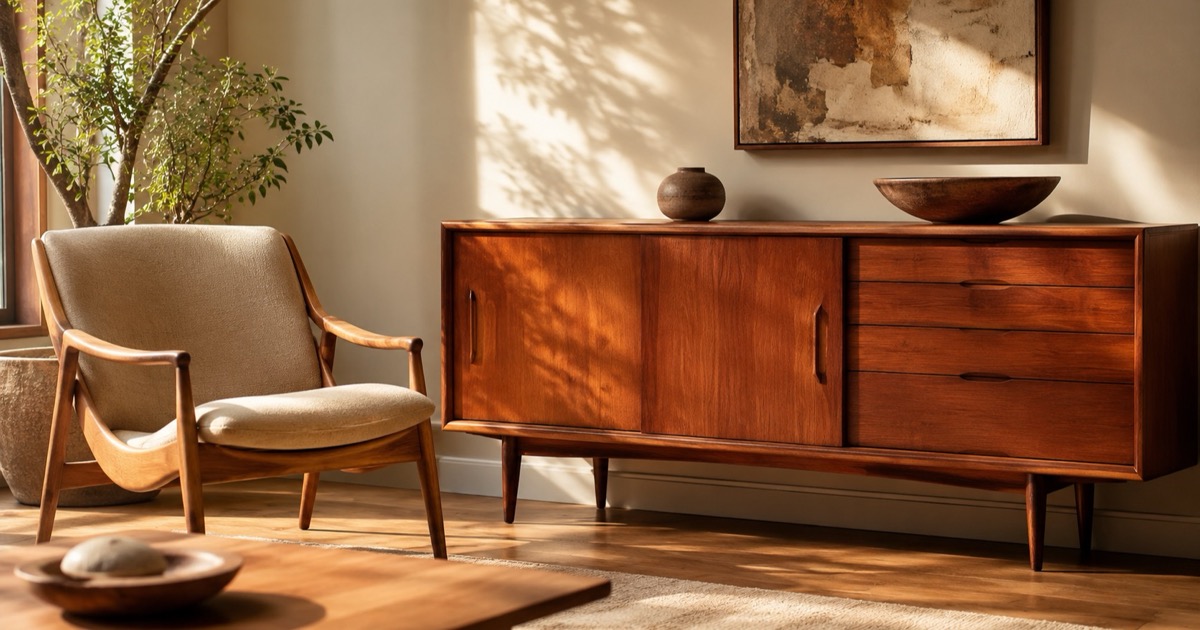
Mid-century modern furniture identification starts with a silhouette you can learn in an afternoon and ends with details that take a flashlight and a pulled-out drawer. The period runs roughly from 1945 to 1969, and because the style has been copied continuously ever since, the real skill is separating period production from decades of imitations. By the end of this guide you will know the design vocabulary, the materials, where the labels hide, and the construction tells that expose modern fast-furniture lookalikes.
Mid-century modern furniture, made roughly 1945 to 1969, is identified by tapered or splayed legs, low clean-lined silhouettes, and teak, walnut, or rosewood veneers with oiled finishes. The most diagnostic evidence is a maker’s label or stamp. Start by pulling every drawer and checking sides, bottoms, and the underside for marks.
The good news is that mid-century makers labeled, stamped, and branded their work more often than most earlier furniture manufacturers. If a piece is genuine, there is a fair chance it will tell you so, provided you look in the right places.
Quick identification checklist
- Check the silhouette: tapered or splayed legs, low profiles, clean lines, and organic curves with minimal ornament.
- Identify the wood: teak, walnut, and rosewood veneers dominate, usually with an oil or thin lacquer finish.
- Pull every drawer and look at sides, bottoms, and the case interior for stamps, foil labels, and paper tags.
- Flip chairs and tables; undersides and dust panels are the most common label locations.
- Look for “Made in Denmark” or other country-of-origin marks, common on imported pieces of the era.
- Judge construction: dovetailed drawers and real wood veneer point to period work; cam locks point away.
Mid-century modern furniture identification by silhouette
The design vocabulary is consistent enough to spot from across a room. Legs are tapered, often splayed at a slight angle, and usually round or gently faceted rather than turned or carved. Case pieces sit low and long, with flat fronts, recessed or sculpted pulls, and almost no applied ornament. Where earlier styles decorated surfaces, mid-century design shaped them: boomerang and kidney forms, gentle organic curves, and sculpted edges that invite a hand.
Seating shows the same thinking. Frames are exposed and slender, arms are shaped rather than upholstered boxes, and backs float on visible supports. If a piece is heavy, ornate, claw-footed, or loaded with molding, it belongs to a different conversation entirely, no matter what the listing says.
Materials that place a piece in the period
Wood choice is a strong period signal. Teak dominates Danish and Danish-style production, walnut dominates American work, and rosewood appears on higher-end pieces, almost always as a veneer over a stable core. Oak and beech turn up as secondary woods in frames and drawer sides. Finishes are typically oiled or thinly lacquered, leaving grain you can feel, rather than buried under thick glossy polyurethane.
The era also embraced new materials, and those experiments are identification gold. Bent and molded plywood, fiberglass shells, early molded plastics, hairpin and sculpted metal legs, and woven cane or cord seats all anchor a piece to the period’s design culture. A veneer-over-particleboard core, on its own, does not disqualify a piece; quality makers used engineered cores under real wood veneer, especially later in the era. What matters is the quality of the veneer and the joinery around it.
Where the labels and stamps hide
Mid-century manufacturers marked their work in predictable but hidden spots. Open every drawer and check the sides and bottom, inside and out. Look at the back panel, the underside of tabletops and seats, and the dust panels between drawers. Marks take several forms: foil or paper labels, burned-in or ink stamps, embossed metal tags, and molded marks on plastic and fiberglass components.
Imported pieces frequently carry origin marks, with “Made in Denmark” the one you will see most, and Danish production sometimes carries quality-control marks documented in collector references. Numbers stamped inside drawers or on the underside are usually model or production codes; references for specific makers explain how to read them, so record them exactly rather than guessing at meanings. A missing label is common, since paper and foil fall off, which is why construction evidence has to carry the argument when the label is gone.
Maker names worth recognizing
A handful of names anchor the market and serve as useful reference points. Herman Miller and Knoll produced the famous American designer pieces, and both used labels and tags that changed over the years, which collector references document in detail. Lane made widely available American casegoods, including the popular Acclaim line with its distinctive dovetail-motif tops, and stamped numbers inside its drawers. Broyhill’s Brasilia line, with its sculpted arches inspired by the architecture of Brasília, is one of the most recognized mass-market lines of the era.
Danish production ranges from celebrated designers to excellent anonymous workshops, and much of it reached the US through importers, so a Danish piece may carry an importer tag, a control mark, or nothing at all. Resist the urge to force an attribution. An honest “Danish, teak, 1960s, unmarked” is a stronger description than a hopeful designer name, and the market treats it with more respect.
Period piece or modern lookalike
Construction settles most arguments. Pull a drawer: period casegoods usually show dovetailed corners, solid wood drawer sides, and smooth-running wood or simple metal glides. Flat-pack hardware, cam locks, visible staples, and drawer boxes of raw particleboard mark recent manufacture. Lift one end; period pieces built with real veneer over solid or quality cores have a substance that fast furniture lacks.
Veneer quality is the second test. Period veneer is real wood with grain variation, book-matched faces, and edges finished in wood. Modern lookalikes often wear photo-printed foil or paper “veneer” with repeating grain patterns and plastic edge banding. Hardware and wear finish the picture: period pulls are usually wood, brass, or aluminum with honest wear at the touch points, and undersides show oxidation and dust shadow. A piece that looks sixty years old on top and brand new underneath was built recently.
Watch-outs and common mistakes
- Treating “mid-century style” or “MCM-inspired” listings as period pieces; style words are not dates.
- Assuming teak means Danish or valuable; teak lookalike finishes and modern teak imports are everywhere.
- Over-restoring before identifying; stripping an original oil finish can hurt value on collectible pieces.
- Forcing designer attributions onto unmarked pieces; unsupported names damage trust and resale.
- Dismissing a piece for an engineered-wood core; period makers used them under genuine veneer.
Photo tips that improve identification
- Photograph every label, stamp, and number straight on, with one wider shot showing where it sits.
- Shoot a full front view and a three-quarter view so leg shape and proportions read clearly.
- Capture an open drawer showing the joinery, drawer-side wood, and interior finish.
- Add a close-up of veneer grain and an edge or corner, where real wood and foil diverge.
Common questions
How can you tell real mid-century furniture from a reproduction?
Construction settles it. Pull a drawer: period casegoods usually show dovetailed corners and solid wood drawer sides, while cam locks, staples, and raw particleboard drawer boxes mark recent manufacture. Then check the veneer: period veneer is real wood with grain variation and wood-finished edges, where modern lookalikes often wear photo-printed foil with repeating grain and plastic edge banding.
Is mid-century furniture without a label worth anything?
Yes. Paper and foil labels fall off constantly, so unmarked period pieces are normal, and much excellent Danish production was anonymous to begin with. Value then rests on construction quality, materials, and design, and an honest description like “Danish, teak, 1960s, unmarked” is respected by the market. Just avoid forcing a designer attribution onto an unmarked piece.
What do the numbers stamped inside mid-century furniture drawers mean?
They are often model or production codes, but some makers’ numbers encode dates — Lane’s stamped serial numbers, for example, read backwards as the production date (month, day, year). References for specific manufacturers explain how to read their systems. Record the numbers exactly as stamped, along with any label or origin mark nearby, and let a maker-specific reference interpret them rather than guessing.
Related guides
- Identifying Antique Furniture Styles: Shape, Feet, and Joinery
- Vintage vs Antique Furniture
- Antique Furniture Identification Marks
- Art Deco Furniture Identification
When to use the Antique Identifier app
Photograph the whole piece from the front and at an angle, then take tight shots of any labels, stamps, drawer joinery, and the underside. The app can quickly narrow the likely era, style family, and sometimes the maker or line, which tells you whether the credenza in front of you deserves serious reference checking. If it points to a notable designer or a valuable line, treat that as the start of verification, not the end of it.