


Vintage vs Antique Furniture
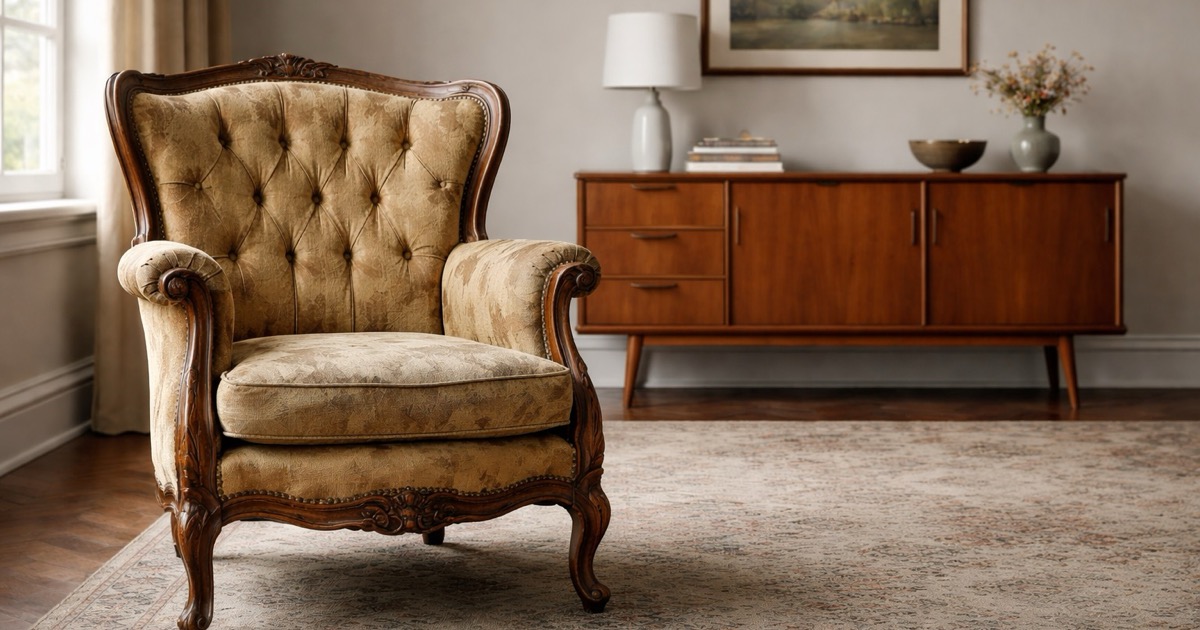
Antique furniture is generally defined as at least 100 years old, while vintage furniture is younger than that but old enough to be out of current production, with dealers usually applying the label to pieces roughly 20 to 100 years old. So the difference between vintage and antique furniture is mostly a matter of age: measured from today, an antique was made before the mid-1920s, and a vintage piece was made after it. The problem is that furniture rarely comes with a birth certificate, so the real work is dating the piece from its construction, materials, and hardware rather than from the word on a price tag.
This guide gives you a practical first-pass workflow. The goal is not to promise certainty from one photo, but to help you place a piece on the right side of that hundred-year line, spot the clues most likely to move the dating forward, and know when a piece is worth serious verification.
Quick identification checklist
- Apply the age rule: antique is 100+ years old, vintage is younger but out of production, retro is a later revival of an older style.
- Check the joinery first: hand-cut dovetails and irregular saw marks point to earlier work; perfectly uniform machine dovetails and cam locks point later.
- Read the hardware: hand-forged and cast fittings, slotted screws, and square nails suggest age; Phillips screws and modern glides do not.
- Look for country-of-origin marks: a stamped or labeled country name generally signals post-1891 manufacture.
- Judge the material: solid wood with visible plane marks reads older than plywood, particleboard, or printed foil “veneer.”
- Separate the style from the date: a Queen Anne leg or a Chippendale back can be original, a Victorian revival, or a 1990s reproduction.
Vintage, antique, or retro: getting the words right
The three terms are used loosely in listings, and the looseness costs buyers money. Antique has the firmest definition: broadly, an object at least 100 years old, a threshold long tied to the age at which older US customs law treated certain goods as duty-free antiques. Vintage is softer. It signals a piece that is genuinely old and out of production but short of the century mark, and most dealers stretch it to cover the 1920s through the early 2000s. Retro is different again: it describes new or newer furniture made to look like an older style, so a “retro” diner chair may be five years old.
Because these words are marketing as much as fact, treat them as claims to verify, not conclusions. “Antique-style,” “vintage-inspired,” and “in the manner of” all describe appearance, not age. The date lives in the wood and the joinery, and that is where the rest of this guide looks. For a deeper walk through the shapes and feet that name a style, see Identifying Antique Furniture Styles.
What to inspect first
Begin with the parts of the piece that carry the most diagnostic value, and for furniture that means the drawers, the underside, and the back. Pull every drawer all the way out and turn it over. Look at how the sides join the front, at the wood of the drawer bottom, and at any tool marks left in the raw, unfinished surfaces. Unfinished interiors and backs are where age shows honestly, because no one bothered to disguise them.
Write down exactly what you see before you start searching, including any stamps, labels, chalk marks, or numbers, copied precisely. Then note the damage and repairs: a replaced foot, a new back panel, modern screws sunk beside old ones, or a drawer that clearly came from another piece. Mixed parts and later repairs change both the dating and your confidence in it, so they belong in the record from the start.
Construction clues that actually date furniture
Joinery is the single most reliable evidence, because construction methods changed with technology in ways that are hard to fake convincingly. Hand-cut dovetails are few, wide, and slightly uneven, with the faint scribe line the maker cut to guide the saw. Machine-cut dovetails, common from the late 1800s onward, are numerous, narrow, and identical. Circular-saw marks (curved arcs) indicate work after the saw came into wide furniture use in the mid-1800s, while straight, irregular pit-saw or plane marks point earlier. Our dovetail-joint dating guide breaks the drawer test down step by step.
Fasteners tell the same story. Hand-forged nails, then square-cut nails, give way to round wire nails around the late 19th century; slotted screws predate the Phillips head, which is a 20th-century arrival. Materials date a piece too: solid wood throughout is older than early plywood, which is older than particleboard and MDF, and printed foil “woodgrain” over an engineered core is a modern-manufacture tell. None of these is decisive alone, but together they build a range you can trust more than any label.
| Feature | Antique (pre-1920s) | Vintage (roughly 1920s–2000s) |
|---|---|---|
| Drawer dovetails | Hand-cut: few, wide, slightly uneven | Machine-cut: many, narrow, uniform |
| Saw marks | Straight/irregular (pit saw, plane) or early circular | Uniform circular or band-saw, or none visible |
| Fasteners | Square-cut nails, slotted screws, forged hardware | Wire nails, Phillips screws, modern glides |
| Primary material | Solid wood throughout | Solid wood, plywood, or engineered core with veneer |
| Country-of-origin mark | Often absent (pre-1891) | Frequently present (“Made in…”) |
Reading marks, labels, and country of origin
Furniture is marked less consistently than pottery or silver, but when a mark exists it can settle the date fast. Manufacturer labels, stamps, and metal tags most often hide on drawer interiors, back panels, and the underside of tops and seats. Numbers stamped inside a drawer are usually model or production codes, and some makers encode a date within them, so record them exactly and let a maker-specific reference interpret them (Kovels furniture marks).
Country-of-origin marks are one of the most useful dating shortcuts. A stamped or labeled country name generally indicates manufacture after 1891, when US law began requiring imported goods to be marked with their country of origin, and phrasing such as “Made in” points still later. That single clue often pushes a piece firmly into the vintage rather than antique bracket. When a piece carries no mark at all, which is common, construction and material evidence has to carry the argument. For a room-by-room map of where to look, see Where to Find Markings on Antique Furniture.
Style is not a date
The most expensive mistake in this whole exercise is dating a piece by its style. Furniture styles are revived constantly: Victorian makers reproduced Queen Anne and Chippendale forms, the Colonial Revival flooded the early 20th century with “antique-look” pieces, and modern factories still turn out cabriole legs and ball-and-claw feet by the container-load. A silhouette tells you which design vocabulary a piece speaks, not when it was built, and museum style guides make clear how long each vocabulary stayed in circulation (Victoria and Albert Museum).
So use style as a starting hypothesis and let construction confirm or reject it. A genuine period Arts and Crafts piece, for instance, shows the honest joinery and quarter-sawn oak the movement prized (Victoria and Albert Museum, Arts and Crafts), whereas a 1990s “mission-style” lookalike often hides its construction behind veneer and modern fasteners. When style and construction disagree, the construction wins. If you suspect a genuine period example, Stickley mission furniture identification covers what authentic examples show.
Watch-outs and common mistakes
- Using “vintage” and “antique” interchangeably, or trusting the word on a listing instead of checking the piece.
- Dating by style alone, when revivals and reproductions copy old forms in every later decade.
- Ignoring later repairs, replaced parts, or two pieces married into one, all of which scramble the evidence.
- Assuming any old-looking piece is valuable; condition, maker, and demand matter as much as age (Kovels furniture price guide).
- Over-restoring before you identify, since stripping an original finish can erase both dating clues and value.
Photo tips that improve identification
- Shoot a full front view and a three-quarter view so the overall shape and leg profile read clearly.
- Photograph an open, pulled-out drawer showing the dovetail joinery and the drawer-bottom wood.
- Capture any label, stamp, or stamped number straight on, plus a wider shot showing where it sits.
- Add a close-up of a fastener, an unfinished back, and any tool or saw marks in raw surfaces.
Common questions
What is the difference between vintage and antique furniture?
Antique furniture is generally defined as at least 100 years old, while vintage furniture is younger than that but old enough to be out of current production, typically 20 to 100 years old. Retro is a separate term for newer furniture made to imitate an older style. Because the labels are used loosely in listings, the reliable answer comes from dating the piece by its construction and materials, not from the word on the tag.
How can you tell how old a piece of furniture is?
Start with the drawers and the underside, where construction shows honestly. Hand-cut dovetails, square-cut nails, slotted screws, and irregular saw marks point to older work, while uniform machine dovetails, wire nails, Phillips screws, and engineered wood point later. A stamped country-of-origin name usually means manufacture after 1891, which places a piece in the vintage rather than antique range.
Is antique furniture always worth more than vintage furniture?
No. Age is only one factor in value, alongside maker, rarity, condition, quality of construction, and current demand. A well-made, sought-after vintage piece in good original condition can easily outsell a worn or common antique, and heavily reproduced antique styles are often worth less than buyers expect. Confirm the date first, then research comparable sales before assuming what a piece is worth.
Related guides
- Identifying Antique Furniture Styles
- How to Date Furniture by Dovetail Joints
- Antique Furniture Identification Marks
- Where to Find Markings on Antique Furniture
- Where to Sell Antiques
When to use the Antique Identifier app
The app is most useful after you have taken one full photo and a few tight detail shots of the drawers, joinery, hardware, and any marks. It can quickly narrow the likely style family, era, and sometimes the maker, which tells you whether the piece in front of you sits near that hundred-year line and deserves closer reference checking. If the result points to something unusually rare, signed, or high value, treat that as a prompt for deeper verification rather than a final answer.
Topics