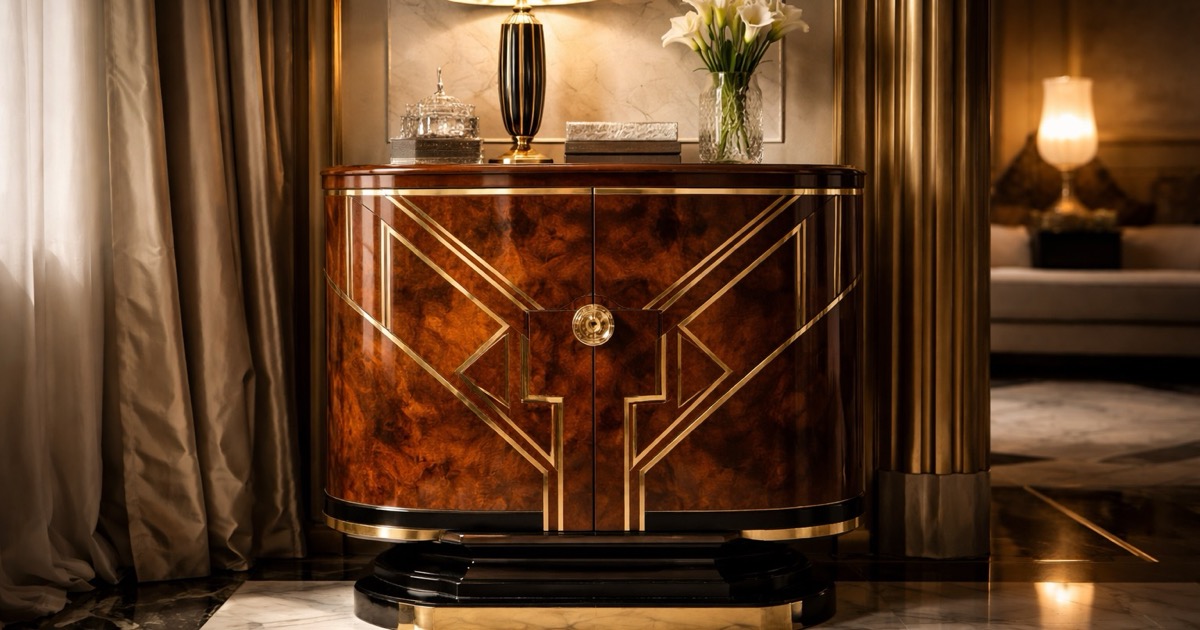
Art deco furniture is identified by bold geometric forms, luxurious materials like exotic-wood veneers, lacquer, chrome, and mirror, and a machine-age sense of streamlined symmetry. The style peaked between roughly 1925 and 1940, taking its name from the 1925 Paris Exposition Internationale des Arts Décoratifs et Industriels Modernes (Sotheby’s). The most diagnostic evidence is the combination of that geometry with the material palette, backed by any maker’s mark, stamp, or retailer label you can find on the underside or back.
The hard part is that art deco has been revived and reproduced almost continuously since the 1970s, so a piece that reads as deco at a glance may be a later homage. This guide gives you the design vocabulary, the materials, where the marks hide, and the construction tells that separate period production from decades of revival furniture. The goal is not certainty from one photo, but better questions, better photos, and a shorter list of likely answers.
Quick identification checklist
- Read the silhouette: stepped, tiered, or ziggurat forms, sweeping curves, sunbursts, and strong bilateral symmetry.
- Identify the surface: high-figure exotic veneers, glossy lacquer, burl, or mirror and chrome accents rather than carved ornament.
- Check the materials mix: wood cases often paired with chrome or nickel tube, glass, Bakelite, or shagreen detailing.
- Pull drawers and look at backs, undersides, and case interiors for stamps, paper labels, and retailer tags.
- Judge construction: solid or quality veneered cores and traditional joinery point to period work; particleboard and cam locks point away.
- Weigh proportion: period deco casegoods tend to be substantial and front-heavy, with the drama concentrated on the facade.
Art deco furniture identification by silhouette
The design vocabulary is architectural, borrowing directly from the skyscrapers and ocean liners of the interwar years. Look for stepped and tiered profiles, ziggurat and pyramid forms, and the sunburst or fan motif that recurs across the period. Curves are deliberate and sweeping rather than delicate: waterfall edges that roll a veneer over a rounded corner in a single unbroken sheet, U-shaped and semicircular cabinet fronts, and drum-shaped bases. Symmetry is strong; a deco piece is usually organized around a central axis with mirrored detailing on either side.
Where earlier styles decorated with carving and molding, art deco concentrated its drama in the material itself and in bold geometric shape. Ornament, when present, is applied hardware or inlay in a repeating geometric rhythm, not naturalistic carving. If a piece is loaded with claw feet, cabriole legs, or floral relief, it belongs to a different conversation no matter what the listing says. The two most common American mass-market expressions are “waterfall” bedroom and dining suites, built with dramatic rounded veneered edges, and heavier “streamline moderne” pieces with rounded corners and horizontal banding.
Materials that place a piece in the period
Material is the strongest period signal, and art deco makers prized dramatic surfaces (V&A). High-figure veneers dominate: burl walnut, book-matched to make mirrored flame and cathedral patterns, along with exotic woods like Macassar ebony, rosewood, zebrawood, and amboyna on higher-end work. Faces are frequently book-matched or quarter-matched so the grain forms a symmetrical pattern, and edges may be banded in a contrasting wood. Finishes range from a deep hand-rubbed sheen on fine cabinetmaker pieces to sprayed lacquer on mass-market suites.
The machine age also brought new materials that anchor a piece firmly to the period. Tubular chrome and nickel-plated steel, mirror and black glass panels, Bakelite and early plastics, shagreen (sharkskin), parchment, and etched or frosted glass all belong to the deco material culture. On fine European pieces you may also find ivory or bone stringing and silvered-bronze mounts. A veneer-over-engineered-core does not automatically disqualify a piece; even period makers used stable cores under genuine veneer, especially on large curved surfaces. What matters is that the veneer is real sliced wood with grain variation, not a printed photo-foil.
Art deco versus its neighbors and revivals
The eras on either side of art deco produce the most common misidentifications, and a compact comparison sorts most pieces quickly. Match the silhouette and materials against the columns below before you commit to a period.
| Feature | Art Deco (c.1925–1940) | Art Nouveau (c.1890–1910) | Mid-Century Modern (c.1945–1969) | Later Deco Revival (1970s–now) |
|---|---|---|---|---|
| Line quality | Geometric, stepped, streamlined | Flowing organic whiplash curves | Clean, low, tapered | Deco motifs, often exaggerated |
| Ornament | Sunbursts, chevrons, ziggurats | Vines, florals, flowing figures | Minimal, shape-driven | Geometric, sometimes overscaled |
| Signature woods | Burl walnut, Macassar ebony, rosewood | Mahogany, fruitwoods, carved oak | Teak, walnut, rosewood veneers | Mixed, often thin foil “veneer” |
| Metal | Chrome, nickel tube, silvered bronze | Wrought iron, bronze naturalism | Hairpin and sculpted steel | Bright modern chrome or brass tone |
| Construction | Traditional joinery, quality cores | Traditional joinery, carving | Dovetails, wood glides | Cam locks, staples, particleboard |
Where the marks and labels hide
Art deco furniture is marked less consistently than mid-century production, but the evidence is still worth hunting. Pull every drawer and check the sides, bottoms, and backs, inside and out. Look at the case back panel, the underside of tabletops and seats, and the interior of cabinet carcasses. Marks take several forms: burned-in or ink stamps, paper or foil labels, stenciled model numbers, and retailer or department-store tags, since much American deco was sold branded by the store rather than the factory. Fine European work from named ateliers may carry a stamped or branded signature, though many quality pieces went out anonymously.
Record any mark exactly as it reads, including partial or worn text, and photograph it straight on with one wider shot showing where it sits. Numbers stamped inside drawers are usually model or pattern codes rather than dates, so note them but do not over-interpret them. A missing label is normal on furniture nearly a century old, which is why the material palette and construction have to carry the argument when the mark is gone. When you have logged what you can see, our guide to antique furniture identification marks explains how to work a mark toward a maker.
Period piece or revival reproduction
Construction settles most arguments. Pull a drawer: period deco casegoods usually show dovetailed corners, solid-wood drawer sides, and wood or simple metal runners, while cam locks, staples, and raw particleboard drawer boxes mark recent manufacture. Weigh the piece in your hands; period deco built with real veneer over solid or quality cores has a substance that flat-pack furniture lacks. Dating construction details is a skill in itself, and dovetail joints are among the most reliable tells for separating older casework from modern production.
Veneer and hardware finish the picture. Period veneer is real sliced wood with genuine grain variation and book-matched faces; revival pieces often wear photo-printed foil with a repeating grain pattern and plastic edge banding. Check the metal and any early plastics: original Bakelite has a warmth and, when gently rubbed, sometimes a faint formaldehyde smell, whereas modern acrylic and injection plastics feel colder and more uniform. Chrome and nickel on period pieces usually show honest wear at touch points and some pitting, not the flawless bright plating of a new reproduction. A piece that looks ninety years old on the facade and brand new underneath was built recently.
Watch-outs and common mistakes
- Treating “deco style” or “deco-inspired” listings as period pieces; style words are not dates.
- Assuming all art deco is the rare cabinetmaker tier; most surviving deco is mass-market American waterfall furniture, which is common and modestly valued.
- Forcing a famous atelier attribution onto an unmarked piece; unsupported names damage trust and resale.
- Confusing streamline moderne and mid-century modern; deco predates and out-decorates the cleaner postwar style.
- Over-restoring before identifying; stripping original lacquer or refinishing burl veneer can hurt value on collectible pieces.
Photo tips that improve identification
- Photograph the full piece straight on and at a three-quarter angle so the silhouette, symmetry, and any waterfall edges read clearly.
- Shoot a close-up of the veneer grain, where real book-matched wood and printed foil diverge.
- Capture an open drawer showing the joinery, drawer-side wood, and interior finish.
- Photograph every label, stamp, or number straight on, with one wider shot showing its location on the piece.
Common questions
How can you tell art deco furniture from a modern reproduction?
Construction and materials settle it. Pull a drawer: period deco usually shows dovetailed corners and solid-wood sides, while cam locks, staples, and raw particleboard boxes mark recent manufacture. Then check the veneer and metal: period pieces have real book-matched wood grain with honest wear at touch points, where reproductions often wear photo-printed foil, plastic edge banding, and flawless bright chrome. A piece that looks aged on top and brand new underneath was built recently.
Is art deco furniture valuable?
It varies enormously by tier. Signed work by celebrated French cabinetmakers can be extremely valuable, but the vast majority of surviving art deco is mass-market American “waterfall” bedroom and dining furniture, which is common and usually modestly priced. Value rests on maker, materials, condition, and design quality, so an honest description of an unmarked mass-market suite is more useful than a hopeful attribution.
When was art deco furniture made?
The style is generally dated from about 1925 to 1940, taking its name from the 1925 Paris exposition of decorative arts and reaching its peak in the late 1920s and 1930s. Production tapered off with the Second World War, and the style was later revived from the 1970s onward, so a deco-looking piece is not automatically from the interwar period. Construction and materials, not silhouette alone, place a piece in the original era.
Related guides
- Antique Furniture Identification Marks
- Victorian Furniture Identification
- Mid-Century Modern Furniture Identification
- How to Date Furniture by Dovetail Joints
- How to Identify Bakelite
When to use the Antique Identifier app
Photograph the whole piece from the front and at an angle, then take tight shots of any labels, stamps, veneer grain, and drawer joinery. The app can quickly narrow the likely era, style family, and sometimes the maker or line, which tells you whether the sideboard or vanity in front of you deserves serious reference checking. If it points to a named atelier or a valuable line, treat that as the start of verification, not the end of it.
Sources
- Art Deco in the home (Victoria and Albert Museum)
- An introduction to Art Deco (Victoria and Albert Museum)