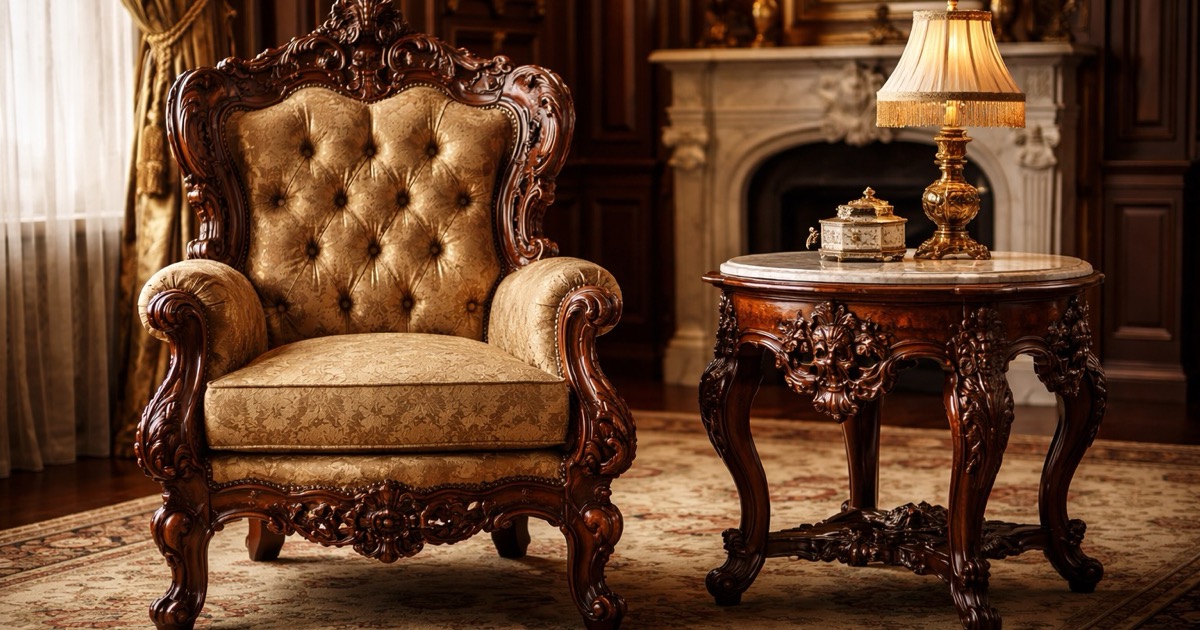
Victorian furniture, made roughly 1837 to 1901 during the reign of Queen Victoria, is identified by heavy dark woods like walnut, mahogany, and rosewood, ornate carved or applied decoration, and machine-cut construction that grew more mechanical as the century went on. The single most useful step is not looking for a maker’s mark, because most Victorian furniture carries none. Instead you date the piece by matching its sub-style, its construction, and its hardware to the decade, then confirm with any label, stamp, or patent date you can find underneath.
“Victorian” is a span of more than sixty years, not a single look. The era ran through a rapid sequence of revival styles, borrowed old motifs and rebuilt them with new factory methods, and left behind millions of pieces plus a century of reproductions. The real skill is placing a piece within the period and separating genuine Victorian work from the Colonial Revival and reproduction furniture that copied it later. By the end of this guide you will know the sub-styles, the woods, the construction tells, and where the rare marks hide.
Quick identification checklist
- Identify the sub-style: Gothic Revival, Rococo Revival, Renaissance Revival, Eastlake, or Aesthetic Movement each point to a rough date range.
- Check the wood: walnut dominates mid-century Victorian, with mahogany, rosewood veneer, and later oak also common, usually under a dark finish.
- Judge the construction: look for machine-cut, uniform dovetails, circular-saw marks, and machine-turned parts rather than hand-tool irregularity.
- Look underneath and behind for stamps, paper labels, patent dates, and stenciled numbers, which are uncommon but decisive when present.
- Note marble tops, casters, and applied carvings, which are era hallmarks but were also reproduced later.
- Weigh the piece and check secondary woods; genuine period cases are heavy and use pine, poplar, or chestnut for drawer sides and backs.
Victorian furniture identification by sub-style
The fastest way to place a piece is to name its revival style, because Victorian design moved through them in a rough sequence. Gothic Revival, popular early in the period, borrows cathedral shapes: pointed arches, trefoils, quatrefoils, and crockets, often on oak. Rococo Revival, associated with the 1840s through 1860s, brings curved cabriole legs, C- and S-scrolls, and naturalistic carved fruit, flowers, and grapes, most famously in the work attributed to John Henry Belter and his laminated, pierced rosewood.
Renaissance Revival, strongest in the 1860s and 1870s, turns heavier and more architectural: tall crested pediments, burl walnut panels, applied roundels, and incised gilt lines. Then the reaction arrives. Eastlake furniture, named for the reformer Charles Eastlake and popular in the 1870s and 1880s, rejects the curves for straight lines, shallow incised geometric and floral decoration, and rectilinear forms. The overlapping Aesthetic Movement adds ebonized surfaces, Japanese-inspired motifs, and spindled galleries. A piece rarely wears one style purely, but the dominant vocabulary usually names the decade.
| Sub-style | Rough peak | Signature cues | Typical wood |
|---|---|---|---|
| Gothic Revival | 1840s–1860s | Pointed arches, trefoils, quatrefoils, crockets | Oak, walnut |
| Rococo Revival | 1840s–1860s | Cabriole legs, C/S-scrolls, carved fruit and flowers | Rosewood, walnut |
| Renaissance Revival | 1860s–1870s | Crested pediments, burl panels, applied roundels | Walnut, burl walnut |
| Eastlake | 1870s–1880s | Straight lines, incised geometric ornament, spindles | Walnut, cherry, oak |
| Aesthetic Movement | 1870s–1890s | Ebonized finish, Japanese motifs, gilt incising | Various, often ebonized |
Materials that place a piece in the period
Wood choice tracks the decades. Walnut is the defining wood of mid-Victorian America, often as solid walnut with burl-walnut veneer panels on the finest pieces. Mahogany carries over from earlier styles, rosewood appears as a prized veneer on high-end Rococo Revival work, and oak surges late in the period alongside the Eastlake and early Arts and Crafts taste. Finishes are generally dark: shellac and varnish over stained wood, sometimes ebonized to a near-black.
Marble tops are a genuine Victorian signature, especially white or gray marble on dressers, washstands, and parlor tables, though marble was widely reproduced afterward, so a marble top proves nothing on its own. The era also industrialized decoration: applied carvings glued or screwed onto flat surfaces, pressed and molded ornament, and cast-iron or brass hardware produced in factories. The V&A notes how nineteenth-century manufacturers embraced machinery and new materials to produce ornament at scale, which is exactly what you are reading when you see uniform, repeated decoration (Victoria and Albert Museum). Underneath, look at the secondary woods: pine, poplar, and chestnut on drawer sides, backs, and dust panels are consistent with period American work.
Reading the construction
Construction is where Victorian furniture confesses its date, because the period sits right on the shift from hand tools to machines. Early in the era you still find hand-cut dovetails with slight irregularity, but as factory production took over, dovetails become uniform and evenly spaced, saw marks turn from the straight lines of a pit or sash saw to the arced marks of a circular saw, and turned parts show the clean repetition of a machine lathe. Fully identical, perfectly spaced machine dovetails point to the later part of the century or beyond. Our guide on dating furniture by dovetail joints walks through how to read those corners in detail.
Hardware and fasteners add a second clock. Wood screws with off-center, hand-filed slots and blunt tips suggest earlier work; fully uniform machine-made screws with sharp gimlet points became standard as the century progressed. Casters on legs, wooden or brass, are common on Victorian case pieces and seating. As with any furniture, judge the whole piece rather than a single clue, the same way you would when identifying antique furniture styles across periods: a genuine period case is heavy, shows consistent oxidation and dust shadow underneath, and carries wear at the points a hand actually touches.
Where the rare marks hide
Most Victorian furniture is unmarked, so a mark is a bonus rather than the plan. When makers did label their work, they favored the same hidden spots you would check on any casegood: the back panel, the underside of tops and seats, inside and under drawers, and the dust panels between drawers. Marks take the form of paper labels, ink or burned-in stamps, stenciled numbers, and, valuably, patent dates cast into metal mechanisms or stamped on parts.
Patent dates are especially useful because a patent date establishes an “not before” boundary: the piece cannot predate the patent it cites, though it may be later. Stenciled or stamped retailer and manufacturer names, when legible, can be matched against directories and collector references. The kind of construction details, marks, and labels worth photographing on Victorian casegoods overlap heavily with the broader field of antique furniture identification marks, so record everything exactly as it appears rather than paraphrasing it.
Period piece or later revival
The biggest trap is the Colonial Revival and reproduction furniture of the late 19th and 20th centuries, which copied Victorian and earlier forms using increasingly modern methods. Tells of later manufacture include plywood panels, particleboard cores, Phillips-head screws (a 20th-century fastener), staples, perfectly uniform machine dovetails, and photo-printed or plastic-edged veneer instead of real wood. A “Victorian” piece with a plywood back or staples in the upholstery frame is a later revival, not period work.
Weight and secondary materials settle many arguments. Genuine period cases are heavy, built of solid hardwood and dense secondary woods, and show honest wear and oxidation in hidden areas. Because condition and originality drive value so heavily, a documented, honestly described period piece outperforms an optimistic attribution; browsing a reference like the Kovels furniture price guide shows how sharply value tracks maker, style, and condition rather than age alone (Kovels). Reproductions and revivals have their own collectors, so an accurate “Renaissance Revival style, later reproduction” is worth more trust than a hopeful period claim.
Watch-outs and common mistakes
- Treating “Victorian” as one look; the sub-style, not the word, dates the piece.
- Reading a marble top or applied carving as proof of period; both were reproduced for decades afterward.
- Missing later fasteners: Phillips screws, staples, and plywood mark 20th-century manufacture.
- Over-restoring before identifying; stripping an original dark finish can hurt value on collectible pieces.
- Forcing a maker name like Belter onto any pierced rosewood; most period furniture was made by anonymous factories.
Photo tips that improve identification
- Shoot a full front view and a three-quarter view so silhouette, carving, and proportions read clearly.
- Photograph every label, stamp, stencil, and patent date straight on, with one wider shot showing where it sits.
- Capture an open drawer showing the dovetails, drawer-side wood, and interior secondary wood.
- Add close-ups of hardware, casters, and any join where applied carving meets the surface.
Common questions
How can you tell if furniture is genuinely Victorian?
Match the sub-style, construction, and materials to the 1837 to 1901 window rather than relying on a mark, since most Victorian furniture is unmarked. Look for heavy dark hardwoods, revival-style ornament, dense secondary woods like pine and poplar underneath, and period-appropriate machine construction. Later fasteners such as Phillips screws or staples, plywood, and particleboard indicate a 20th-century reproduction instead.
What wood is most Victorian furniture made from?
Walnut is the signature wood of mid-Victorian furniture, often solid walnut with burl-walnut veneer panels on finer pieces. Mahogany and rosewood veneer appear on higher-end and earlier work, and oak becomes common late in the period with the Eastlake and Arts and Crafts taste. Finishes are typically dark stained shellac or varnish, sometimes ebonized to near-black.
How do you date Victorian furniture without a maker’s mark?
Read the revival sub-style to get a rough decade, then confirm with construction: hand-cut versus uniform machine dovetails, straight versus circular-saw marks, and early versus fully machine-made screws. A patent date cast or stamped into hardware sets a “not before” boundary. Combine those signals rather than trusting any single clue, and record everything you see before comparing it to references.
Related guides
- Identifying Antique Furniture Styles: Shape, Feet, and Joinery
- Antique Furniture Identification Marks
- How to Date Furniture by Dovetail Joints
- Art Deco Furniture Identification
- Stickley Mission Furniture Identification
When to use the Antique Identifier app
Photograph the whole piece from the front and at an angle, then take tight shots of any carving, hardware, drawer joinery, and the underside. The app can quickly narrow the likely sub-style, era, and sometimes the type of piece, which tells you whether the parlor cabinet in front of you deserves serious reference checking. If it points to a notable maker or a valuable revival line, treat that as the start of verification, not the end of it.