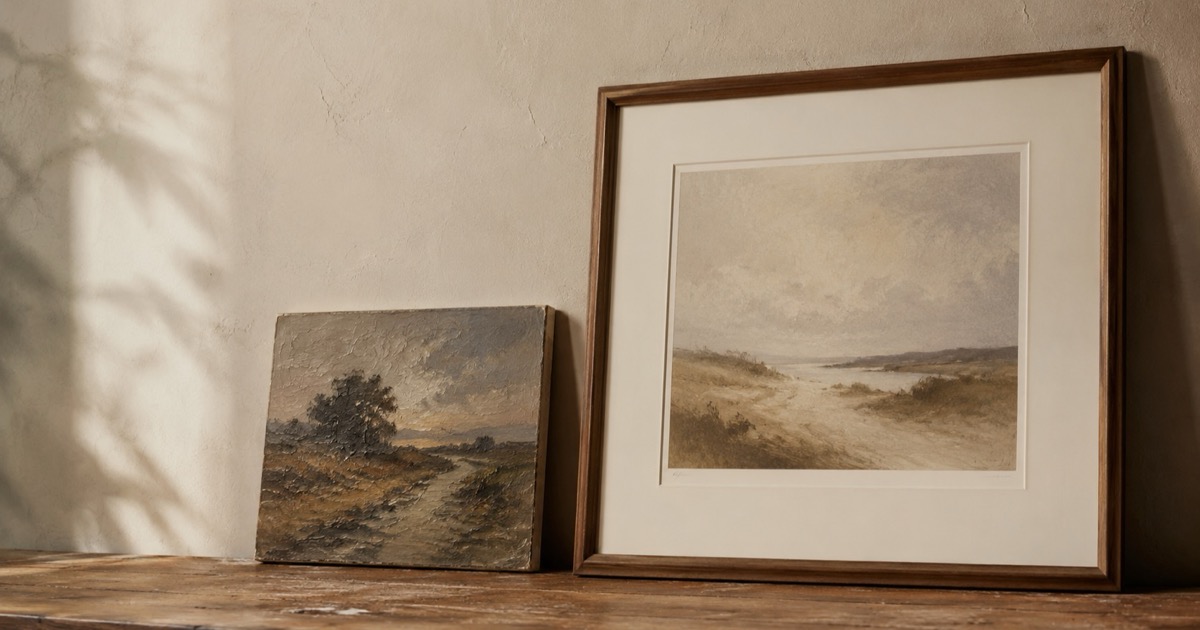
Knowing how to tell if a painting is a print is one of the most practical skills for anyone browsing estate sales, thrift stores, or antique shops. The framing can be beautiful and the price significant — but without a closer look you may be paying original-painting prices for a mass-produced reproduction. The differences are physical and observable with nothing more than a loupe or a bright light.
To tell if a painting is a print, examine the surface under a 10x loupe: a regular grid of tiny cyan, magenta, yellow, and black dots means mechanical printing. Then hold the piece at a low angle to a lamp — original oil or acrylic shows irregular raised brushwork, while prints are flat or uniformly textured.
By the end of this guide you will know the key inspection tests, understand why some prints are legitimately valuable in their own right, and recognize the “hand-embellished” prints that deliberately blur the line.
Quick identification checklist
- Under a 10x loupe or phone macro mode, look for a regular grid of tiny colored dots — that pattern means mechanical (CMYK) printing, not a hand-applied medium.
- Hold the piece at a low angle to a raking light source and observe the surface: original oil or acrylic builds up in ridges (impasto); prints are flat or carry a uniform mechanical texture.
- Check the support: canvas, paper, or board each carry different clues about era and process.
- Examine the signature — is it part of the printed image, or does it sit on top of the image surface in a slightly different plane?
- Turn the piece over and look for labels, stamps, edition numbers, and stretcher construction.
- On framed works on paper, look for a plate mark (a slight embossed rectangle) around the image, which indicates an intaglio fine-art print — a legitimate print category with its own market.
The loupe test: CMYK dot rosettes
The single most reliable test for photomechanical printing is the dot pattern. Every offset-printed or digitally printed reproduction — cheap poster or high-quality giclée alike — reproduces color by layering tiny dots of cyan, magenta, yellow, and black ink. Under a 10x loupe (or a macro camera lens held close), these dots resolve into a visible grid or rosette pattern.
On a hand-painted work, no such grid exists. You see irregular brushstrokes, transparent glazes over opaque passages, and color shifts no mechanical pattern mimics. If you find a dot rosette, the piece is printed, regardless of how it looks at normal viewing distance.
Giclée printing — high-resolution inkjet on canvas or fine-art paper — produces smaller, less regular dots than offset printing, which can make them harder to spot at lower magnification. Use the highest magnification available. The dots are still there.
Surface relief under raking light
Light from a sharp angle — a windowsill or a desk lamp held to the side — reveals surface topography that flat overhead lighting hides. Original paintings in oil or thick acrylic show impasto: ridges and peaks where the artist worked paint with a brush or palette knife. These variations are irregular and three-dimensional.
A print surface under raking light shows essentially nothing, or reveals a uniform mechanical embossed texture — a canvas-weave pattern pressed into the print at the factory. That texture is perfectly even and repeating in a way real paint application never is.
Absence of surface relief is strong evidence of a print. Its presence suggests original work — but read on, because giclée prints can have real paint added on top.
Support clues: canvas, paper, and board
The material provides context, not proof. Stretched canvas is associated with paintings, which is why manufacturers print high-end giclées on canvas. Genuine old canvases show linen or cotton weave with aging in the paint layer, craquelure (age cracking) that crosses from support to paint, and grime in the weave valleys. Works on paper may be original drawings, watercolors, lithographs, or etchings. Board-mounted images are common for both photomechanical prints and legitimate oil-on-board paintings.
Giclée prints and hand-embellished prints
The giclée category sits in honest gray territory. A fine-art photographer or digital artist may produce a limited edition giclée on archival paper or canvas as the intended finished work, with legitimate collector value.
More problematic for buyers is the “hand-embellished” print: a mass-produced giclée or lithograph with real paint applied over the highest-contrast areas to add texture and pass casual inspection. The tell is inconsistency: under raking light some areas show genuine impasto while others are flat, and under magnification areas with paint dabs show brushwork while adjacent areas reveal the underlying dot pattern. A piece that passes the raking-light test in one spot but fails the dot test in another is almost certainly hand-embellished.
Intaglio plate marks and edition numbers
Etchings and other intaglio prints are pressed from a metal plate into damp paper, leaving a characteristic plate mark: a slightly raised or indented rectangular impression around the image area — reliable evidence of a legitimate printmaking process.
Fine-art prints — intaglio, lithograph, or screenprint — are commonly numbered and signed in pencil in the lower margin. The fraction notation (e.g., 14/50) indicates this impression out of a total edition. A hand-penciled number, a plate mark, and a signature below the image all point toward a legitimate limited-edition print, which can be quite valuable in its own right.
Signature location: in the image vs. signed in the margin
Where the signature falls is a useful clue. On original paintings, signatures are painted in the same medium as the rest of the work and show brushwork under magnification. On prints, a signature that is part of the image appears at the same surface level as everything else and shows the same dot pattern or flat quality. A hand-signed print carries a real signature in pencil or pen on the paper surface, usually in the lower margin — that signature does not change whether the image is a print, but it distinguishes a signed impression from an unsigned one for collector purposes.
Back-of-work clues
The reverse of a framed or stretched piece often provides the clearest evidence. Paper labels from galleries or auction houses confirm provenance and sometimes include lot numbers or dates. On stretched canvas, examine the stretcher bars: handmade irregular joinery with cut nails indicates significant age; uniform machine-cut joints and staples suggest modern production. Edition prints on paper are often matted with an acid-free backing board and may carry a certificate behind the mat.
Watch-outs and common mistakes
- Assuming canvas means painting — high-quality giclée prints on canvas are widely sold as both decorative reproductions and artist editions.
- Relying on frame quality as a proxy for image quality — expensive frames routinely accompany mass-produced prints.
- Mistaking a hand-embellished print for an original because some areas feel textured.
- Ignoring the back of the work — labels, edition stickers, and origin stamps are often hidden by backing paper.
- Assuming a hand-signed print is a hand-painted original — a genuine signature does not make the image an original.
Photo tips that improve identification
- For the dot test, hold the phone camera as close as macro mode allows in strong even light — the dot grid becomes visible in the digital photo even if hard to see live.
- For the raking-light test, place the piece at a right angle to a lamp and photograph along the surface; impasto shows as shadow-casting ridges.
- Photograph the lower margin fully to capture any penciled numbers, edition notations, or signatures on paper.
- Photograph the entire back of the stretcher or board, then close-up any labels or stamps.
Common questions
Does a signature mean a painting is original?
No. On prints, a signature that is part of the image shows the same dot pattern or flat quality as everything around it. A genuine pencil or pen signature on the paper surface makes the piece a hand-signed print, which matters to collectors, but it does not make the image a hand-painted original.
How can you tell a giclee print from an oil painting?
Use magnification and raking light together. A giclee is inkjet-printed, so under strong magnification it still shows tiny ink dots, even though they are smaller and less regular than offset-printing dots. Under a lamp held at a low angle, an oil painting shows irregular raised brushwork, while a giclee is flat or carries a perfectly even factory-embossed canvas texture.
Are prints of paintings worth anything?
Some are. Limited-edition fine-art prints — etchings, lithographs, and screenprints with a penciled edition number and signature in the lower margin — have their own collector market and can be valuable in their own right. Open-edition decorative reproductions, by contrast, carry little resale value no matter how good the frame is.
Related guides
- How to Identify Antique Oil Paintings
- How to Identify Antique Picture Frames
- Common Signs of Antique Reproductions and Fake Antiques
When to use the Antique Identifier app
Photograph the full front, then take a tight macro shot of the surface texture and a close-up of the signature. The app can flag whether visible features are consistent with known reproduction types or original media, and suggest further inspection steps for ambiguous cases. For pieces where originality significantly affects value, treat the app’s findings as a starting point for professional appraisal.