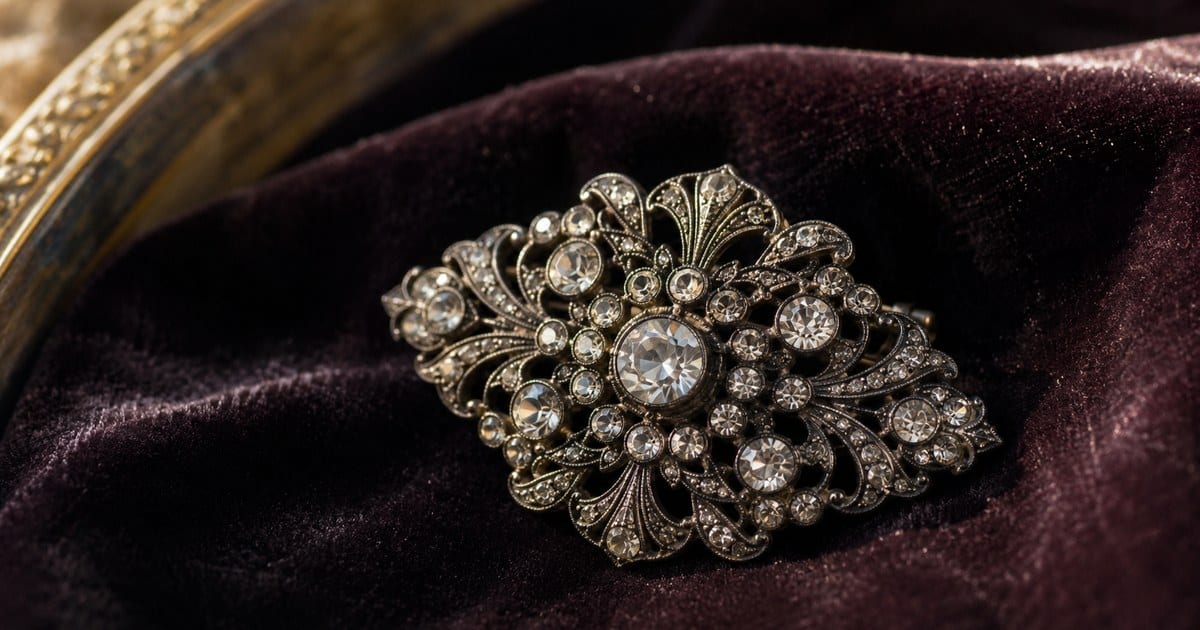
A box of inherited jewelry is the hardest thing on this site to sort, because it looks the least like what it is. Solid gold and gold-filled brass look identical across a table. A brilliant rhinestone brooch by a collected maker and a five-dollar department store pin from the same year are the same size, the same color, and roughly the same weight. The pieces that turn out to be vintage jewelry worth money are almost never the ones that catch the eye first, and the sorting has to be done with marks and construction rather than with sparkle.
Vintage jewelry worth money is identified in three steps: establish the metal and the maker from the marks, date the piece from its findings and the form of the mark rather than from any number stamped into it, then check completed sold listings for the same maker, form, and comparable condition. Signature, materials, and condition drive value far more than age.
Quick identification checklist
- Turn every piece over first. Marks live on the back plate near a brooch’s pin mechanism, on a clasp tongue, on a small tag by the clasp, on the inside of a ring shank, and on earring backs.
- Separate metal marks from maker marks. “14K,” “925,” “STERLING,” and “PLAT” describe material. A name, a logo, or a monogram describes a maker. Both matter, and they answer different questions.
- Watch for the letters after a karat number. “G.F.” and “R.G.P.” change what the piece is entirely.
- Look at the findings, not just the front. Clasps, catches, hinges, pin stems, and earring backs changed over time and are among the better dating handles available.
- Note any copyright symbol next to a signature. It sets an earliest plausible date on costume pieces.
- Judge the construction. Prong-set stones, finished and tidy backs, solid weight, and even plating separate quality work from throwaway production regardless of signature.
- Assess condition honestly. Missing stones, worn plating, repairs, and replaced clasps all move a piece down a bracket.
- Then, and only then, look at prices. Identification first, valuation second.
Step one: identify what it actually is
Start with metal, because it decides which market the piece belongs to. Fine jewelry, meaning solid precious metal, is valued on materials plus workmanship plus maker. Costume jewelry, meaning base metal with plating or gilding, is valued almost entirely on maker, design, and condition. Those are two different research paths and mixing them up wastes hours.
American purity marks are straightforward once you know the convention. Karat marks such as 10K, 14K, and 18K state the gold content, with 14K being the most common in American work. Metric fineness marks say the same thing in parts per thousand, so 585 corresponds to 14K and 750 to 18K. “Sterling” or “925” indicates the standard silver alloy. Platinum is typically marked with “PLAT” or a fineness number.
Then read what follows the karat number, because this is where most home valuations go wrong. “14K G.F.” means gold filled, a substantial layer of gold bonded to a base metal core. “14K R.G.P.” means rolled gold plate, a related and generally thinner treatment. Both are real gold on the surface and neither is solid gold, so a gold-filled locket should not be priced as though it were solid karat gold. Gold filled work can still be collectible on its own merits, particularly Victorian and Edwardian pieces, but it belongs in the costume and antique market rather than the bullion one.
For maker marks, the important thing to know about American jewelry is that a missing mark proves very little. Jewelry made in the United States before roughly 1900 frequently carries no mark at all, and in costume jewelry many good pieces left the factory with a paper hang tag that has long since gone. Unsigned is not the same as worthless.
Step two: date it, and avoid the two classic traps
Two errors account for most of the misdating in this category, and both come from reading a stamped character as a year.
Trap one: treating a purity mark as an age indicator. “925” and “14K” tell you what the metal is and nothing whatever about when the piece was made. Both markings have been in continuous use for a very long time and are still stamped on jewelry produced today. In the other direction, the absence of a purity stamp does not make a piece modern, since large amounts of genuinely old American work is unmarked. A metal mark is a material fact, not a date.
Trap two: reading a copyright symbol or a patent number as the year of manufacture. In costume jewelry, a small copyright symbol beside a maker’s signature became widespread after a mid-1950s legal fight established that jewelry designs could be protected. That makes it a useful floor: a copyright symbol argues for production from roughly the mid-1950s onward. It is not a manufacturing date, and its absence proves nothing, because marks wear and adoption was uneven. Design patent numbers work the same way, marking when a design was registered rather than when your example was produced.
What does date a piece is the hardware. On brooches, a simple C-shaped catch with no safety mechanism, often paired with a long pin stem extending past the body of the brooch, is generally associated with earlier work. Tube-style catches, sometimes called trombone clasps, cluster in a middle period. Rolling safety catches became the later standard. On earrings, screw backs are generally earlier than clip backs, and pierced posts largely disappeared from mainstream American production in the middle of the century before returning in the later 1960s. Treat all of these as tendencies rather than rules, since findings were replaced during repairs and cheap production lagged behind fashion.
The same logic covers stones and metals. Old mine and old European cut diamonds, with their chunkier facet patterns and small flat culets, precede the modern brilliant. White gold rose to prominence in the 1920s and 1930s as an alternative to platinum. Stack three agreeing observations and you have a decade band, which is the realistic level of precision.
Step three: check sold listings, not asking prices
Once the piece has a metal, a maker where one exists, and a rough period, valuation becomes research rather than guessing.
Filter to completed and sold results only. Active listings show what sellers hope to get, which is a systematically higher and less useful number. Then match on four things: the same maker signature, the same form (brooch, bracelet, necklace, earrings), the same materials, and comparable condition. A signature match with a condition mismatch is not a comparable, and in jewelry condition swings hard, because missing stones and worn plating are visible in every photograph.
Read the middle of the range rather than the top of it. If eight examples sold, the cluster is the market and the single highest sale usually reflects something the listing does not spell out: an original box, a rare colorway, a documented line, or two determined collectors in the same auction. Sample six to ten sales before you decide anything.
For solid precious metal, there is a floor underneath all of this. Any piece of real gold or silver is worth at least its metal content, so the collector value is only relevant when it exceeds that floor. For a plain worn chain it often does not. For a signed period piece it usually does, by a wide margin.
Two worked examples
A rhinestone brooch from the bottom of the box. It is heavy for its size, the stones are held in metal prongs rather than glue, and the back is smoothly finished rather than raw. Those three construction signals already say quality production. Turn it over and look near the pin mechanism, where a small stamped signature sits. Say it reads as a known American house, with a small copyright symbol beside it. Now you have two facts: a collected maker, and a floor of roughly the mid-1950s onward from that symbol. Check the catch, which corroborates the era. At that point the search is specific, “maker name plus brooch plus the design motif,” filtered to sold, and the comparables mean something. Notice that the sparkle contributed nothing to the identification. The prongs, the finished back, and a signature smaller than a grain of rice did all the work. Signed pieces from the recognized houses consistently outperform visually identical unsigned pieces, which is exactly why turning things over pays.
A gold-colored locket assumed to be solid gold. It has weight, a warm color, and a family story attached. Inside the bail, in worn lettering, it reads “14K G.F.” That is gold filled, not solid gold, and the distinction changes the whole plan. It is not worth sending to a scrap buyer on its own, because refiners pay a low percentage on gold-filled material and most will not take a single small piece, so pricing it as bullion would produce a number far below what the piece is actually worth. What it might have instead is collector value, decided by period, style, condition of the gold layer, and whether the original chain and any photographs or hair work inside survive. So the research goes to sold listings for gold filled lockets of the same style and condition rather than to a metal calculator. This is the single most common disappointment in an inherited jewelry box, and it is also the most avoidable, because the answer is stamped on the piece.
What separates vintage jewelry worth money from the common pieces
Signature. In costume jewelry this is the largest single variable. A clear mark from a recognized house moves a piece into a collector market that an identical unsigned piece never enters.
Materials, honestly assessed. Solid precious metal sets a price floor. Gold filled, rolled gold plate, and base metal do not. Natural stones, well cut and in good condition, carry value that glass and later synthetics do not.
Design and desirability. Collectors chase particular lines, motifs, and periods. A famous maker’s ordinary production is still ordinary production, and a strong design from a lesser name can outperform it.
Condition and completeness. Every missing stone, worn patch of plating, replaced clasp, and amateur solder repair costs. Matching sets, original boxes, and original tags all raise a piece’s standing.
Construction quality. Prong setting rather than glue, tidy finished backs, articulated components that still move freely, and even plating all indicate work that was expensive to make and tends to hold interest.
Watch-outs and common mistakes
- Assuming gold color means gold. Check for the karat mark and read the letters after it before you plan anything.
- Scrapping jewelry without identifying it. A signed period piece can be worth considerably more intact than melted, and melting is irreversible.
- Cleaning aggressively. Polishing strips plating and gilding, ultrasonic cleaners can loosen stones and damage soft or porous materials, and over-cleaning silver removes the darkened detail in a design.
- Replacing a period clasp before selling. The original findings are dating evidence and buyers look for them.
- Reading a purity stamp as an age. It is a material mark.
- Pricing from the highest listing you can find. Outliers exist in every category and rarely repeat.
- Dismissing unsigned pieces. Early American work is often unmarked, and construction quality can carry a piece on its own.
Photo tips
- Photograph every mark close and filling the frame, on the back plate, the clasp tongue, the inside of a ring shank, and the earring backs. A phone macro shot beats a distant shot every time.
- Use raking side light for stamped marks. Light from a low angle throws a shadow into the impression and makes worn lettering readable; flat overhead light erases it.
- Shoot the findings on their own. The catch, hinge, pin stem, and earring back are dating evidence and deserve their own frame.
- Photograph the back of the piece as a whole, since the finish quality of the reverse is one of the best quality signals in costume jewelry.
- Document damage deliberately. Missing stones, worn plating, and repairs each get their own photo. This keeps you honest about which sold comparables actually apply.
- Include a scale reference and record the weight, because size and heft are hard to judge from photographs and both affect comparables.
Common questions
How can I tell if my old jewelry is real gold or just gold plated?
Look for a karat mark and read what follows it. A bare “14K” indicates solid gold at that fineness. “14K G.F.” indicates gold filled and “14K R.G.P.” indicates rolled gold plate, both of which are a gold layer over a base metal core rather than solid gold. Unmarked pieces need professional testing rather than a home guess, and worn areas showing a different metal underneath are a strong plated signal.
Is unsigned vintage jewelry worth anything?
Often yes. American jewelry made before roughly 1900 is frequently unmarked, and many costume pieces carried only a paper tag that has since been lost. Judge unsigned pieces on construction: prong-set stones, a finished back, solid weight, even plating, and components that still articulate freely. Good construction with no signature still finds buyers, just in a broader market than a signed piece does.
Should I clean vintage jewelry before selling it?
Keep it minimal. A soft dry cloth on the surface is safe. Avoid polishing compounds, which remove plating and gilding and strip the darkened detail that gives a design its depth. Avoid ultrasonic cleaners entirely on older pieces, since they loosen glued and prong-set stones and damage porous materials such as pearls, opals, and coral. Original condition sells better than a damaged shine.
Related guides
- How to Identify Antique Jewelry Markings
- Costume Jewelry Marks Identification: Trifari, Coro, and More
- Where to Sell Antiques: Best Options Compared
- How to Use an Antique Value Estimator the Right Way
When to use the Antique Identifier app
A jewelry box is the ideal triage job, because the pieces are small, the marks are tiny, and researching thirty items one at a time is what stops most people before they start. Photograph the back of each piece, each mark in raking light, and the findings, and the app suggests the likely material, era, and maker family for each, which gives you the exact search terms for sold listings. Use it to find the three pieces that deserve an hour of real research, then confirm those against maker references and completed sales before you sell anything.